FeistelCipher
View SourceEncrypted integer IDs using Feistel cipher
Database Support: PostgreSQL only (uses PostgreSQL triggers and functions)
Why?
Problem: Sequential IDs (1, 2, 3...) leak business information:
- Competitors can estimate your growth rate
- Users can enumerate resources (
/posts/1,/posts/2...) - Total record counts are exposed
Common Solutions & Issues:
- UUIDs: Fixed 36 chars for everything - overkill for most columns
- Random integers: Collision risks, complex generation logic
This Library's Approach:
- Store sequential integers internally
- Expose encrypted integers externally (non-sequential, unpredictable)
- Adjustable bit size per column: User ID = 40 bits, Post ID = 52 bits
- Automatic encryption via database trigger
How It Works
The Feistel cipher is a symmetric structure used in the construction of block ciphers. This library implements a configurable Feistel network that transforms sequential integers into non-sequential encrypted integers with one-to-one mapping.
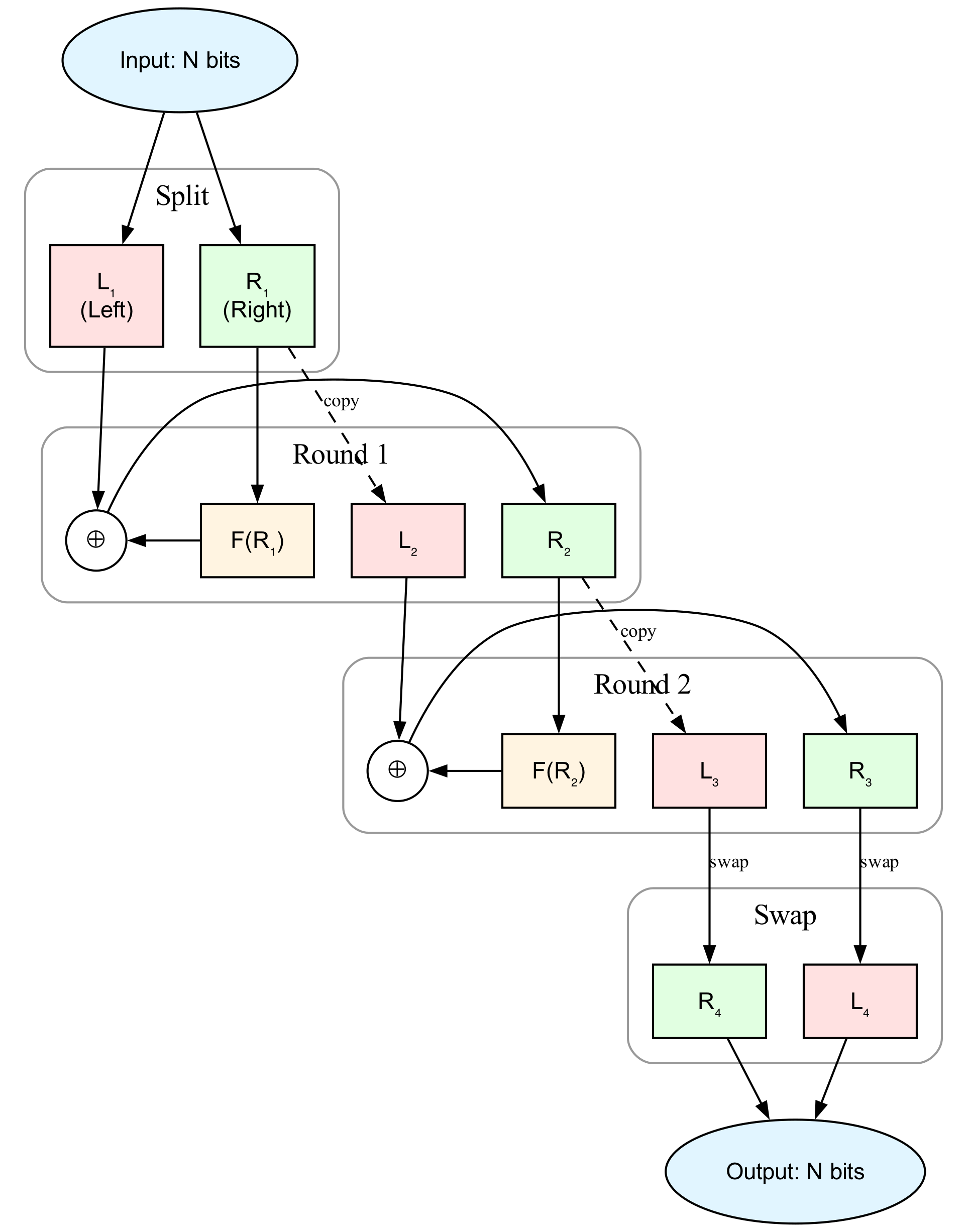
Note: The diagram above illustrates a 2-round Feistel cipher for simplicity. By default, this library uses 16 rounds for better security. The number of rounds is configurable (see Trigger Options).
Self-Inverse Property
The Feistel cipher is self-inverse: applying the same function twice returns the original value. This means encryption and decryption use the exact same algorithm.
Mathematical Proof:
Let's denote the input as $(L_1, R_1)$ and the round function as $F(x)$.
First application (Encryption):
$$ \begin{aligned} L_2 &= R_1, & R_2 &= L_1 \oplus F(R_1) \\ L_3 &= R_2, & R_3 &= L_2 \oplus F(R_2) \\ \text{Output} &= (R_3, L_3) \end{aligned} $$
Second application (Decryption) - Starting with $(R_3, L_3)$:
$$ \begin{aligned} L_2' &= L_3, & R_2' &= R_3 \oplus F(L_3) \\ &= L_3, & &= R_3 \oplus F(R_2) \\ &= L_3, & &= (L_2 \oplus F(R_2)) \oplus F(R_2) \\ &= L_3, & &= L_2 = R_1 \quad \text{(XOR cancellation)} \\ \\ L_3' &= R_2' = R_1, & R_3' &= L_2' \oplus F(R_2') \\ &= R_1, & &= L_3 \oplus F(R_1) \\ &= R_1, & &= R_2 \oplus F(R_1) \\ &= R_1, & &= (L_1 \oplus F(R_1)) \oplus F(R_1) \\ &= R_1, & &= L_1 \quad \text{(XOR cancellation)} \\ \\ \text{Output} &= (R_3', L_3') = (L_1, R_1) \quad \checkmark \end{aligned} $$
Key Insight: The XOR operation's property $a \oplus b \oplus b = a$ ensures that each transformation is reversed when applied twice.
Database Implementation:
In the database trigger implementation, this means:
-- Encryption: seq → id
id = feistel_encrypt(seq, bits, key)

-- Decryption: id → seq (using the same function!)
seq = feistel_encrypt(id, bits, key)
Key Properties
- Deterministic: Same input always produces same output
- Non-sequential: Sequential inputs produce seemingly random outputs
- Collision-free: One-to-one mapping within the bit range
Installation
Using Ash Framework?
If you're using Ash Framework, use
ash_feistel_cipherinstead! It provides a declarative DSL to configure Feistel cipher encryption directly in your Ash resources.For plain Ecto users, continue below.
Using igniter (Recommended)
mix igniter.install feistel_cipher
Manual Installation
# mix.exs
def deps do
  [{:feistel_cipher, "~> 0.13.2"}]
end
Then run:
mix deps.get
mix feistel_cipher.install
Installation Options
Both methods support the following options:
--repoor-r: Specify an Ecto repo (required for manual installation)--functions-prefixor-p: PostgreSQL schema prefix (default:public)--functions-saltor-s: Cipher salt constant, max 2^31-1 (default: randomly generated)
⚠️ Security Note: A cryptographically random salt is generated by default for each project. This ensures that encryption patterns cannot be analyzed across different projects. Never use the same salt across multiple production projects.
Fun Fact: Notice the timestamp
19730501000000in the migration file generated during installation? That's May 1, 1973 - the day Horst Feistel published his groundbreaking paper at IBM, introducing the cipher structure that powers this library. We thought it deserved a permanent timestamp in your database history! 🎂
Usage Example
1. Create Migration
defmodule MyApp.Repo.Migrations.CreatePosts do
  use Ecto.Migration

  def up do
    create table(:posts) do
      add :seq, :bigserial
      add :title, :string
    end

    execute FeistelCipher.up_for_trigger("public", "posts", "seq", "id")
  end

  def down do
    execute FeistelCipher.down_for_trigger("public", "posts", "seq", "id")
    drop table(:posts)
  end
end
2. Define Schema
defmodule MyApp.Post do
  use Ecto.Schema

  # Hide seq in API responses
  @derive {Jason.Encoder, except: [:seq]}

  schema "posts" do
    field :seq, :id, read_after_writes: true
    field :title, :string
  end
end
The read_after_writes: true option tells Ecto to fetch the seq value after INSERT (since it's generated by the database).
Now when you insert a record, seq auto-increments and the trigger automatically sets id = feistel_encrypt(seq):
%Post{title: "Hello"} |> Repo.insert!()
# => %Post{id: 8234567, seq: 1, title: "Hello"}

# In API responses, only id is exposed (seq is hidden)
Security Note: Keep seq internal. Only expose id in APIs to prevent enumeration attacks.
Trigger Options
The up_for_trigger/5 function accepts these options:
⚠️ Important: Once a trigger is created,
bits,rounds,key, andfunctions_prefixcannot be changed. Changing them would break encryption consistency for existing data.
prefix,table,from,to: Table and column names (required)bits: Cipher bit size (default: 52, max: 62, must be even)- Choose different sizes per column: Unlike UUIDs (fixed 36 chars), tailor each column's ID length
- Example: User ID = 40 bits (~1T values), Post ID = 52 bits (~4.5Q values)
- Default 52 ensures JavaScript compatibility (
Number.MAX_SAFE_INTEGER = 2^53 - 1) - Use 62 for maximum range if no browser/JS interaction needed
rounds: Number of Feistel rounds (default: 16, min: 1, max: 32)- Default 16 provides good security/performance balance
- Note: Diagrams and proofs in this README use 2 rounds for simplicity
- More rounds = more secure but slower
- Odd rounds (1, 3, 5...) and even rounds (2, 4, 6...) are both supported
key: Encryption key (auto-generated if not specified)functions_prefix: Schema where cipher functions reside (default:public)
Example with custom options:
execute FeistelCipher.up_for_trigger(
  "public", "posts", "seq", "id",
  bits: 40,
  key: 123456789,
  rounds: 8,
  functions_prefix: "crypto"
)
Performance Considerations
Primary Key Trade-offs
Using the encrypted id as the primary key means non-sequential values, similar to UUIDv4. This has performance implications:
- B-tree insert performance: Random keys cause more page splits compared to sequential keys
- Sequential scan cache locality: Non-sequential ordering reduces cache efficiency
When does this matter?
- High-volume insert workloads
- Frequent sequential range scans over large datasets
When is it fine?
- Typical web applications with moderate insert rates
- Encryption overhead (microseconds) is negligible compared to typical INSERT/UPDATE operations (milliseconds)
- Most applications prioritize security/privacy over marginal insert performance
Alternative: Keep Sequential Primary Key
If you need sequential primary key performance, use the encrypted value as a separate display column:
# Migration
create table(:posts) do
  add :disp_id, :bigint    # Encrypted, for public APIs
  add :title, :string
end

execute FeistelCipher.up_for_trigger("public", "posts", "id", "disp_id")

# Schema
defmodule MyApp.Post do
  use Ecto.Schema

  # Hide internal id in API responses
  @derive {Jason.Encoder, except: [:id]}

  schema "posts" do
    field :disp_id, :id, read_after_writes: true
    field :title, :string
  end
end
Then only expose disp_id in your APIs while keeping id internal.
UUID Comparison
- UUIDv4: Random, 36 characters, same non-sequential issues
- UUIDv7: Sequential but exposes timestamp ordering
- FeistelCipher: Random-like, adjustable size (up to 62 bits), no timestamp leakage
Choose FeistelCipher when you need UUIDv4-like randomness but 36 characters is excessive for your use case.
Advanced Usage
Column Rename
When renaming columns that have triggers, use force_down_for_trigger/4 to safely drop and recreate the trigger:
defmodule MyApp.Repo.Migrations.RenamePostsColumns do
  use Ecto.Migration

  def change do
    # 1. Drop the old trigger
    execute FeistelCipher.force_down_for_trigger("public", "posts", "seq", "id")

    # 2. Rename columns
    rename table(:posts), :seq, to: :sequence
    rename table(:posts), :id, to: :external_id

    # 3. Recreate trigger with SAME encryption parameters
    # IMPORTANT: Generate key using OLD column names (seq, id)
    old_key = FeistelCipher.generate_key("public", "posts", "seq", "id")

    execute FeistelCipher.up_for_trigger("public", "posts", "sequence", "external_id",
      bits: 52,                  # Must match original
      key: old_key,              # Key from OLD column names
      rounds: 16,                # Must match original
      functions_prefix: "public" # Must match original
    )
  end
end
⚠️ Critical: When recreating triggers, ALL encryption parameters (bits, key, rounds, functions_prefix) MUST match the original values. Otherwise:
- Updates will fail with exceptions
- 1:1 mapping breaks (new inserts may produce duplicate encrypted values)
Note:
down_for_trigger/4includes a safety guard (RAISE EXCEPTION) to prevent accidental deletion. For legitimate use cases like column rename, useforce_down_for_trigger/4which bypasses the guard.
Performance
Benchmark results encrypting 100,000 sequential values:
| Rounds | Total Time | Per Encryption | Use Case |
|---|---|---|---|
| 1 | 103 ms | ~1.0μs | Minimal obfuscation |
| 2 | 131 ms | ~1.3μs | Illustration (diagrams/proofs) |
| 4 | 178 ms | ~1.8μs | Light security |
| 8 | 278 ms | ~2.8μs | Moderate security |
| 16 | 444 ms | ~4.4μs | Default (recommended) |
| 32 | 867 ms | ~8.7μs | Maximum security |
The overhead per INSERT/UPDATE is negligible (microseconds) even with 16 rounds.
Benchmark Environment
- CPU: Apple M3 Pro (12 cores)
- Database: PostgreSQL 17 (Postgres.app)
- OS: macOS 15.6
- Elixir: 1.18.3 / OTP 27
Running Benchmarks
MIX_ENV=test mix run benchmark/rounds_benchmark.exs
The benchmark encrypts 100,000 sequential values (1 to 100,000) using a SQL batch function to minimize overhead and measure pure encryption performance.
License
MIT