Macula HTTP/3 Mesh - RPC Guide
View SourceComplete guide to decentralized RPC with DHT-based service discovery
Status: ✅ COMPLETE Last Updated: 2025-01-10
Table of Contents
- Overview
- Architecture
- Service Advertisement
- Service Discovery
- Making RPC Calls
- Error Handling
- Performance Optimization
- Best Practices
- Examples
- Migration from WAMP
Overview
Macula provides fully decentralized RPC without requiring any central registry or broker. Services advertise themselves to a Kademlia DHT (Distributed Hash Table), and consumers discover providers by querying the DHT.
Key Features
✅ Fully Decentralized - No central authority, DHT-based discovery ✅ Local-First Optimization - Zero-latency for local services ✅ Smart Caching - DHT results cached (60s TTL) to reduce queries ✅ Graceful Degradation - Continues operation when DHT unavailable ✅ Multiple Providers - Automatic load balancing across providers ✅ Fault Tolerant - Provider failover if one becomes unavailable ✅ NAT-Friendly - HTTP/3 QUIC works through firewalls
How It Works
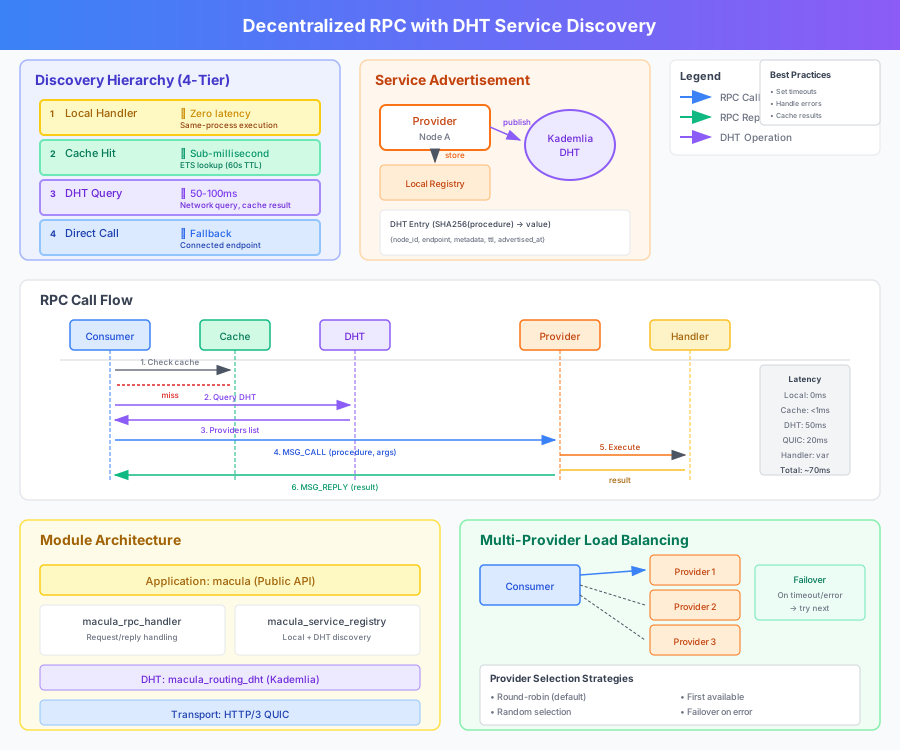
The diagram above illustrates the complete RPC flow:
- Discovery Hierarchy - 4-tier fallback: Local → Cache → DHT → Direct
- Service Advertisement - Providers register to local registry and DHT
- RPC Call Flow - Consumer discovers provider, sends MSG_CALL, receives MSG_REPLY
- Multi-Provider Load Balancing - Round-robin selection with automatic failover
Discovery Hierarchy
Macula uses a 4-tier fallback hierarchy for optimal performance:
- Local Handler ⚡ - Zero latency if service advertised locally
- Cache Hit 🚀 - Fast retrieval from local cache (60s TTL)
- DHT Query 🌐 - Query DHT for providers, cache result
- Direct Call 🔗 - Fallback to connected endpoint
This design ensures:
- Local calls have zero network overhead
- Cached discoveries are sub-millisecond
- DHT queries happen only on cache miss (every 60 seconds per service)
- System continues working even if DHT is unavailable
Architecture
Components
macula_service_registry
Core registry module that manages:
- Local services - Handler functions for services this node provides
- Discovery cache - Cached provider lists from DHT queries (60s TTL)
- DHT integration - Publish/query/remove operations
Key Functions:
advertise_local/4- Store handler locallyget_local_handler/2- Retrieve local handlerdiscover_service/2,3- Check cache for providerscache_service/4- Store DHT results in cachepublish_to_dht/5- Publish service to DHTquery_dht_for_service/3- Query DHT for providersremove_from_dht/3- Remove service from DHT
macula_connection
Connection gen_server that:
- Holds
service_registryin state - Handles
advertise,unadvertise,callrequests - Executes handlers in spawned processes (non-blocking)
- Sends
MSG_CALL,MSG_REPLY,MSG_ERRORmessages
macula (Public API)
The only module applications should import. Delegates to internal modules:
connect/2,connect_local/1- Connect to meshadvertise/3,4- Advertise a servicecall/3,4- Call a serviceunadvertise/2- Stop advertisingdisconnect/1- Close connection
macula_peer (Internal)
Internal mesh participant module (called by macula).
macula_routing_dht
DHT implementation (Kademlia):
- Pure functional DHT operations
- K-bucket routing table
- Store/find value operations
- K-value replication (typically 20)
Data Flow
Service Advertisement:
Application
↓
macula:advertise(Client, Procedure, Handler, Opts)
↓
macula_connection (gen_server:call)
↓
macula_service_registry:advertise_local(Registry, Procedure, Handler, Metadata)
↓
macula_service_registry:publish_to_dht(DhtPid, Procedure, ProviderInfo, TTL, K)
↓
macula_routing_dht (DHT storage at key=SHA256(Procedure))Service Discovery and Call:
Application
↓
macula:call(Client, Procedure, Args)
↓
macula_connection (gen_server:call)
↓
macula_service_registry:get_local_handler(Registry, Procedure)
→ Found? Execute locally (zero-latency path)
↓
macula_service_registry:discover_service(Registry, Procedure)
→ Cache hit? Use cached providers (fast path)
↓
macula_service_registry:query_dht_for_service(DhtPid, Procedure, K)
→ Query DHT, cache result
↓
Pick provider from list
↓
Send MSG_CALL over HTTP/3 QUIC to provider
↓
Provider executes handler → MSG_REPLY
↓
Application receives resultStorage
DHT Key: SHA256(Procedure) (32-byte key)
DHT Value:
#{
node_id => binary(), % 32-byte node identifier
endpoint => binary(), % Connection endpoint (e.g., <<"https://localhost:9443">>)
metadata => map(), % Custom metadata (version, description, etc.)
advertised_at => integer(), % Unix timestamp
ttl => pos_integer() % Seconds
}Local Cache Entry:
#{
service_id => binary(),
providers => [ProviderInfo],
cached_at => integer(), % Unix timestamp
ttl => 60 % Seconds (hard-coded)
}Service Advertisement
Basic Advertisement
%% Erlang
Handler = fun(Args) ->
case Args of
#{user_id := UserId} ->
{ok, #{user_id => UserId, name => <<"Alice">>}};
_ ->
{error, invalid_args}
end
end,
{ok, Ref} = macula:advertise(
Client,
<<"myapp.user.get">>,
Handler
).# Elixir
handler = fn
%{user_id: user_id} ->
{:ok, %{user_id: user_id, name: "Alice"}}
_ ->
{:error, :invalid_args}
end
{:ok, ref} = :macula.advertise(
client,
"myapp.user.get",
handler
)With Options
{ok, Ref} = macula:advertise(
Client,
<<"myapp.user.get">>,
Handler,
#{
metadata => #{
version => <<"1.0.0">>,
description => <<"Fetch user by ID">>,
capabilities => [<<"read">>]
},
ttl => 300 % 5 minutes
}
).Handler Function Contract
Handlers must follow this contract:
-type handler_fn() :: fun((Args :: map()) -> {ok, Result :: term()} | {error, Reason :: term()}).Rules:
- Input: Always a map (even if empty:
#{}) - Output: Tuple
{ok, Result}or{error, Reason} - Execution: Handlers run in spawned processes (non-blocking)
- Errors: Handler crashes are caught and returned as
{error, {handler_crash, Reason}}
TTL and Re-advertisement
Default TTL: 300 seconds (5 minutes)
Services must be re-advertised before TTL expiration to remain discoverable. Currently this is manual - future enhancement will add automatic periodic re-advertisement.
%% Manual re-advertisement pattern
re_advertise_loop(Client, Procedure, Handler, Opts) ->
TTL = maps:get(ttl, Opts, 300),
{ok, _Ref} = macula:advertise(Client, Procedure, Handler, Opts),
%% Re-advertise every 4 minutes (before 5-minute TTL expires)
timer:sleep((TTL - 60) * 1000),
re_advertise_loop(Client, Procedure, Handler, Opts).Unadvertising
ok = macula:unadvertise(Client, <<"myapp.user.get">>).Behavior:
- Removes local handler from service registry
- Attempts to remove from DHT (best-effort)
- DHT entries expire naturally via TTL anyway
Service Discovery
Service discovery happens automatically when calling a service via macula:call/2,3.
Discovery Flow
%% 1. Check local handler (zero-latency)
case macula_service_registry:get_local_handler(Registry, Procedure) of
{ok, Handler} ->
%% Execute locally - no network overhead
Handler(Args);
not_found ->
%% 2. Check cache (fast path)
case macula_service_registry:discover_service(Registry, Procedure) of
{ok, Providers, Registry2} ->
%% Cache hit - use cached providers
pick_provider_and_call(Providers);
{cache_miss, Registry2} ->
%% 3. Query DHT (cache miss)
case macula_service_registry:query_dht_for_service(DhtPid, Procedure, 20) of
{ok, Providers} when Providers =/= [] ->
%% Cache the result (60s TTL)
Registry3 = macula_service_registry:cache_service(
Registry2, Procedure, Providers, 60
),
pick_provider_and_call(Providers);
{ok, []} ->
%% No providers found
{error, service_not_found};
{error, Reason} ->
%% DHT unavailable - fallback to direct call
direct_call_fallback()
end
end
end.Force Refresh
Skip cache and force DHT query:
{ok, Result} = macula:call(
Client,
<<"myapp.user.get">>,
#{user_id => <<"user-123">>},
#{force_refresh => true}
).Cache Management
Cache TTL: 60 seconds (hard-coded in macula_service_registry)
Pruning: Expired entries can be pruned manually:
{Registry2, RemovedCount} = macula_service_registry:prune_expired(Registry).Clearing: Clear all cache entries:
Registry2 = macula_service_registry:clear_cache(Registry).Making RPC Calls
Basic Call
%% Erlang
{ok, User} = macula:call(
Client,
<<"myapp.user.get">>,
#{user_id => <<"user-123">>}
).# Elixir
{:ok, user} = :macula.call(
client,
"myapp.user.get",
%{user_id: "user-123"}
)With Timeout
{ok, Result} = macula:call(
Client,
<<"slow.operation">>,
#{data => SomeData},
#{timeout => 30000} % 30 seconds
).Local-First Pattern
If a service is advertised locally, the call has zero network overhead:
%% Node A advertises service
{ok, _} = macula:advertise(Client, <<"calc.add">>, HandlerFn),
%% Node A calls the same service - executed locally (no network)
{ok, Result} = macula:call(Client, <<"calc.add">>, #{a => 10, b => 5}).
%% Result = #{result => 15}This is extremely efficient for:
- Self-service calls
- Co-located services on the same node
- Testing and development
Error Handling
Error Types
-type call_error() ::
timeout | % Call timed out
service_not_found | % No providers found in DHT
{handler_error, Reason :: term()} | % Handler returned {error, Reason}
{handler_crash, Reason :: term()} | % Handler process crashed
{connection_error, Reason :: term()} | % Network error
term(). % Other errorsComprehensive Error Handling
case macula:call(Client, Procedure, Args, #{timeout => 10000}) of
{ok, Result} ->
%% Success
process_result(Result);
{error, timeout} ->
%% Call timed out after 10 seconds
?LOG_WARNING("RPC call timed out: ~s", [Procedure]),
{error, timeout};
{error, service_not_found} ->
%% No providers found in DHT
?LOG_ERROR("Service not available: ~s", [Procedure]),
{error, unavailable};
{error, {handler_error, Reason}} ->
%% Handler explicitly returned {error, Reason}
?LOG_WARNING("Handler error for ~s: ~p", [Procedure, Reason]),
{error, {business_logic_error, Reason}};
{error, {handler_crash, Reason}} ->
%% Handler process crashed
?LOG_ERROR("Handler crashed for ~s: ~p", [Procedure, Reason]),
{error, internal_error};
{error, {connection_error, Reason}} ->
%% Network/transport error
?LOG_ERROR("Connection error calling ~s: ~p", [Procedure, Reason]),
{error, network_error};
{error, Reason} ->
%% Catch-all for other errors
?LOG_ERROR("Unexpected error calling ~s: ~p", [Procedure, Reason]),
{error, unknown_error}
end.Retry Pattern
call_with_retry(Client, Procedure, Args, MaxRetries) ->
call_with_retry(Client, Procedure, Args, MaxRetries, 0).
call_with_retry(_Client, _Procedure, _Args, MaxRetries, Attempt)
when Attempt >= MaxRetries ->
{error, max_retries_exceeded};
call_with_retry(Client, Procedure, Args, MaxRetries, Attempt) ->
case macula:call(Client, Procedure, Args, #{timeout => 5000}) of
{ok, Result} ->
{ok, Result};
{error, timeout} ->
%% Retry on timeout
timer:sleep(1000 * (Attempt + 1)), % Exponential backoff
call_with_retry(Client, Procedure, Args, MaxRetries, Attempt + 1);
{error, {connection_error, _}} ->
%% Retry on connection errors
timer:sleep(1000 * (Attempt + 1)),
call_with_retry(Client, Procedure, Args, MaxRetries, Attempt + 1);
{error, Reason} ->
%% Don't retry on business logic errors
{error, Reason}
end.Performance Optimization
Local-First Optimization
Zero-latency local calls:
- Local handlers checked first
- No network overhead if service advertised locally
- Ideal for co-located services
Caching Strategy
60-second cache TTL:
- DHT queries cached for 60 seconds
- Reduces DHT load
- Balances freshness vs performance
Cache hit ratio:
Cache Hit Ratio = (Cache Hits) / (Total Calls)
Example:
- Service called 100 times/minute
- Cache TTL = 60 seconds
- DHT queries = ~2/minute (every 60s)
- Cache hit ratio = 98%DHT Query Optimization
Kademlia K-value: 20 (standard)
- Stores service advertisement on 20 nodes
- High availability even if nodes fail
- Fast lookups (log N hops)
SHA-256 Key Distribution:
- Deterministic key generation
- Even distribution across DHT keyspace
- Prevents hotspots
Provider Selection
Current: Simple first-provider selection
Future enhancements:
- Round-robin load balancing
- Random selection
- Least-loaded provider
- Geographic proximity
- Custom selection strategies
Graceful Degradation
DHT unavailable:
- Logs warning but continues
- Falls back to direct call to connected endpoint
- Local services still work
Network partitions:
- Each partition has local DHT
- Services discoverable within partition
- Automatic recovery when partition heals
Best Practices
Service Naming
Use hierarchical naming with dot-separated segments:
%% Good
<<"myapp.user.get">>
<<"energy.home.measure">>
<<"payment.invoice.create">>
%% Avoid
<<"get_user">> % Not namespaced
<<"user">> % Too generic
<<"user-get">> % Use dots, not dashesHandler Design
Keep handlers simple:
%% Good - simple, focused
Handler = fun(#{user_id := UserId}) ->
case user_db:get(UserId) of
{ok, User} -> {ok, User};
not_found -> {error, not_found}
end
end.
%% Avoid - complex logic in handler
Handler = fun(Args) ->
%% Don't do heavy processing in handler
%% Spawn workers if needed
case Args of
#{action := <<"create">>, data := Data} ->
%% Heavy processing...
#{action := <<"update">>, data := Data} ->
%% More heavy processing...
#{action := <<"delete">>, id := Id} ->
%% Even more processing...
end
end.Pattern matching on function heads:
%% Good - separate functions for different actions
handle_get(#{user_id := UserId}) ->
user_db:get(UserId).
handle_create(#{name := Name, email := Email}) ->
user_db:create(Name, Email).
Handler = fun(Args) ->
case Args of
#{action := <<"get">>} -> handle_get(Args);
#{action := <<"create">>} -> handle_create(Args);
_ -> {error, invalid_action}
end
end.Metadata Usage
Include useful metadata:
#{
metadata => #{
version => <<"1.2.3">>, % Semantic version
description => <<"User management">>, % Human-readable description
capabilities => [<<"read">>, <<"write">>], % What it can do
schema => #{ % Input/output schema
input => [user_id],
output => [user_id, name, email]
}
}
}TTL Configuration
Choose TTL based on service characteristics:
%% Long-lived services (rarely change)
#{ttl => 3600} % 1 hour
%% Normal services
#{ttl => 300} % 5 minutes (default)
%% Dynamic services (frequently changing)
#{ttl => 60} % 1 minuteError Handling in Handlers
Always return proper error tuples:
Handler = fun(Args) ->
try
Result = do_work(Args),
{ok, Result}
catch
error:{badmatch, _} ->
{error, invalid_args};
error:database_error ->
{error, service_unavailable};
Class:Reason ->
?LOG_ERROR("Handler crashed: ~p:~p", [Class, Reason]),
{error, internal_error}
end
end.Monitoring
Log important events:
%% On advertisement
?LOG_INFO("Advertised service ~s with metadata ~p", [Procedure, Metadata]),
%% On DHT publish success/failure
?LOG_INFO("Published service ~s to DHT", [Procedure]),
?LOG_WARNING("Failed to publish service ~s to DHT: ~p", [Procedure, Reason]),
%% On service calls
?LOG_DEBUG("Calling service ~s with args ~p", [Procedure, Args]),
?LOG_INFO("Service ~s completed in ~p ms", [Procedure, Duration]).Examples
Example 1: Calculator Service
%% calculator_service.erl
-module(calculator_service).
-export([start/1, advertise/1]).
start(Client) ->
Handler = fun(Args) ->
case Args of
#{operation := <<"add">>, a := A, b := B} ->
{ok, #{result => A + B}};
#{operation := <<"subtract">>, a := A, b := B} ->
{ok, #{result => A - B}};
#{operation := <<"multiply">>, a := A, b := B} ->
{ok, #{result => A * B}};
#{operation := <<"divide">>, a := A, b := 0} ->
{error, division_by_zero};
#{operation := <<"divide">>, a := A, b := B} ->
{ok, #{result => A / B}};
_ ->
{error, invalid_operation}
end
end,
macula:advertise(
Client,
<<"calculator.compute">>,
Handler,
#{metadata => #{version => <<"1.0.0">>}}
).
%% Client code
{ok, Client} = macula:connect(<<"https://localhost:9443">>, #{}),
{ok, _Ref} = calculator_service:advertise(Client),
%% Make calls
{ok, #{result := 15}} = macula:call(
Client, <<"calculator.compute">>,
#{operation => <<"add">>, a => 10, b => 5}
).Example 2: User Service with Database
%% user_service.erl
-module(user_service).
-export([start/1]).
start(Client) ->
Handler = fun(Args) ->
handle_request(Args)
end,
macula:advertise(
Client,
<<"users.manage">>,
Handler,
#{
metadata => #{
version => <<"2.0.0">>,
capabilities => [<<"read">>, <<"write">>, <<"delete">>]
},
ttl => 300
}
).
handle_request(#{action := <<"get">>, user_id := UserId}) ->
case user_db:fetch(UserId) of
{ok, User} -> {ok, User};
not_found -> {error, user_not_found}
end;
handle_request(#{action := <<"create">>, name := Name, email := Email}) ->
case user_db:create(#{name => Name, email => Email}) of
{ok, UserId} ->
{ok, #{user_id => UserId, name => Name, email => Email}};
{error, Reason} ->
{error, Reason}
end;
handle_request(#{action := <<"delete">>, user_id := UserId}) ->
case user_db:delete(UserId) of
ok -> {ok, #{status => <<"deleted">>}};
{error, Reason} -> {error, Reason}
end;
handle_request(_) ->
{error, invalid_action}.Example 3: Multi-Provider Discovery
%% Provider Node 1
{ok, Client1} = macula:connect(<<"https://node1:9443">>, #{}),
{ok, _} = macula:advertise(Client1, <<"weather.get">>, Handler1),
%% Provider Node 2
{ok, Client2} = macula:connect(<<"https://node2:9443">>, #{}),
{ok, _} = macula:advertise(Client2, <<"weather.get">>, Handler2),
%% Consumer Node
{ok, Client3} = macula:connect(<<"https://node3:9443">>, #{}),
%% Call service - DHT returns both providers
%% One is selected automatically
{ok, Weather} = macula:call(
Client3,
<<"weather.get">>,
#{city => <<"Brussels">>}
).Example 4: Elixir Phoenix Application
# lib/my_app/macula_rpc.ex
defmodule MyApp.MaculaRPC do
use GenServer
def start_link(opts) do
GenServer.start_link(__MODULE__, opts, name: __MODULE__)
end
def init(_opts) do
{:ok, client} = :macula.connect("https://localhost:9443", %{
realm: "com.myapp"
})
# Advertise multiple services
advertise_services(client)
{:ok, %{client: client}}
end
defp advertise_services(client) do
# User service
user_handler = fn
%{action: "get", user_id: user_id} ->
case MyApp.Users.get(user_id) do
{:ok, user} -> {:ok, user}
_ -> {:error, :not_found}
end
%{action: "create", params: params} ->
case MyApp.Users.create(params) do
{:ok, user} -> {:ok, user}
{:error, changeset} -> {:error, {:validation, changeset}}
end
end
:macula.advertise(client, "myapp.users", user_handler, %{
metadata: %{version: "1.0.0", description: "User management"}
})
# Post service
post_handler = fn args -> MyApp.Posts.handle_rpc(args) end
:macula.advertise(client, "myapp.posts", post_handler, %{
metadata: %{version: "1.0.0"}
})
end
# Client wrapper
def call(procedure, args, opts \\ %{}) do
client = GenServer.call(__MODULE__, :get_client)
:macula.call(client, procedure, args, opts)
end
def handle_call(:get_client, _from, %{client: client} = state) do
{:reply, client, state}
end
end
# Usage in Phoenix controller
defmodule MyAppWeb.UserController do
use MyAppWeb, :controller
def show(conn, %{"id" => id}) do
case MyApp.MaculaRPC.call("myapp.users", %{action: "get", user_id: id}) do
{:ok, user} ->
json(conn, user)
{:error, :not_found} ->
conn
|> put_status(:not_found)
|> json(%{error: "User not found"})
{:error, reason} ->
conn
|> put_status(:internal_server_error)
|> json(%{error: inspect(reason)})
end
end
endMigration from WAMP
Key Differences
| Aspect | WAMP (Bondy) | Macula HTTP/3 |
|---|---|---|
| Discovery | Centralized registry | DHT-based (decentralized) |
| Transport | WebSocket | HTTP/3 QUIC |
| Registration | session.register(Procedure, Handler) | macula:advertise(Client, Procedure, Handler) |
| RPC Call | session.call(Procedure, Args) | macula:call(Client, Procedure, Args) |
| Unregister | session.unregister(Registration) | macula:unadvertise(Client, Procedure) |
| Handler Args | [Args, Kwargs] (positional + keyword) | Args :: map() (map only) |
| NAT Traversal | Requires special config | Built-in (QUIC) |
Migration Steps
1. Update Dependencies
%% Before (WAMP)
{deps, [
{bondy, {git, "https://github.com/bondy-io/bondy.git", {tag, "1.0.0"}}}
]}.
%% After (Macula)
{deps, [
{macula, "0.6.6"}
]}.2. Convert Registration
%% Before (WAMP)
Handler = fun([Args, Kwargs]) ->
UserId = proplists:get_value(<<"user_id">>, Kwargs),
{ok, #{user_id => UserId, name => <<"Alice">>}}
end,
{ok, Registration} = bondy:register(Session, <<"myapp.user.get">>, Handler).
%% After (Macula)
Handler = fun(Args) ->
#{user_id := UserId} = Args,
{ok, #{user_id => UserId, name => <<"Alice">>}}
end,
{ok, Ref} = macula:advertise(Client, <<"myapp.user.get">>, Handler).3. Convert RPC Calls
%% Before (WAMP)
{ok, Result} = bondy:call(Session, <<"myapp.user.get">>, [#{user_id => <<"123">>}]).
%% After (Macula)
{ok, Result} = macula:call(Client, <<"myapp.user.get">>, #{user_id => <<"123">>}).4. Update Handler Signatures
%% Before (WAMP) - separate positional and keyword args
Handler = fun([PositionalArgs, KeywordArgs]) ->
UserId = proplists:get_value(<<"user_id">>, KeywordArgs),
%% ...
end.
%% After (Macula) - single map argument
Handler = fun(Args) ->
#{user_id := UserId} = Args,
%% ...
end.5. Update Error Handling
%% Before (WAMP)
case bondy:call(Session, Procedure, Args) of
{ok, Result} -> handle_result(Result);
{error, {wamp_error, Uri, Details, _Args}} -> handle_wamp_error(Uri)
end.
%% After (Macula)
case macula:call(Client, Procedure, Args) of
{ok, Result} -> handle_result(Result);
{error, timeout} -> handle_timeout();
{error, service_not_found} -> handle_not_found();
{error, {handler_error, Reason}} -> handle_business_error(Reason)
end.Migration Checklist
- [ ] Update dependencies (WAMP → Macula)
- [ ] Convert handler signatures (
[Args, Kwargs]→Args :: map()) - [ ] Replace
bondy:register/3withmacula:advertise/3,4 - [ ] Replace
bondy:call/3withmacula:call/2,3 - [ ] Replace
bondy:unregister/2withmacula:unadvertise/2 - [ ] Update error handling patterns
- [ ] Add periodic re-advertisement logic (if needed)
- [ ] Test with DHT unavailable (graceful degradation)
- [ ] Update monitoring and logging
See Also
- Quick Start Guide - Getting started tutorial
- PubSub Guide - Pub/Sub patterns and usage
- Glossary - Terminology reference
Last Updated: 2025-11-30 Status: ✅ Complete