# Bin
A Membrane's bin is a container for [elements](../glossary/glossary.md#element), which allows for creating reusable groups of elements.
Bin is similar to a [pipeline](../glossary/glossary.md#pipeline) in that it consists of linked elements. Such bin can then be placed inside a pipeline and linked with other entities - elements or bins. Bins can also be nested within one another.
Bin also has another advantage - it manages its children, for instance by dynamically spawning or replacing them as the stream changes.
## Enclosing pipeline elements inside a bin
As you can see, we have [`Source`](../glossary/glossary.md#source) -> [`Ordering Buffer`](../glossary/glossary.md#jitter-buffer--ordering-buffer) -> [`Depayloader`](../glossary/glossary.md#payloader-and-depayloader) chain, which is duplicated.
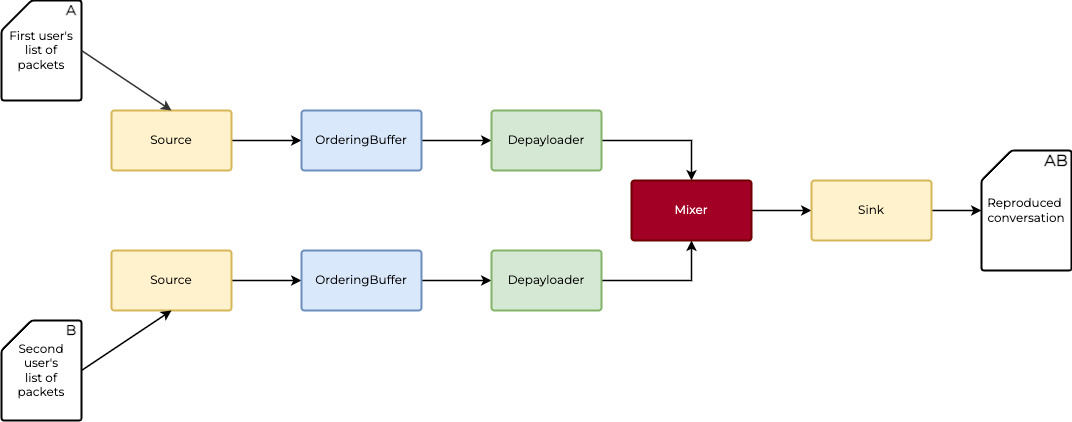
We can encapsulate these elements inside `Bin`.
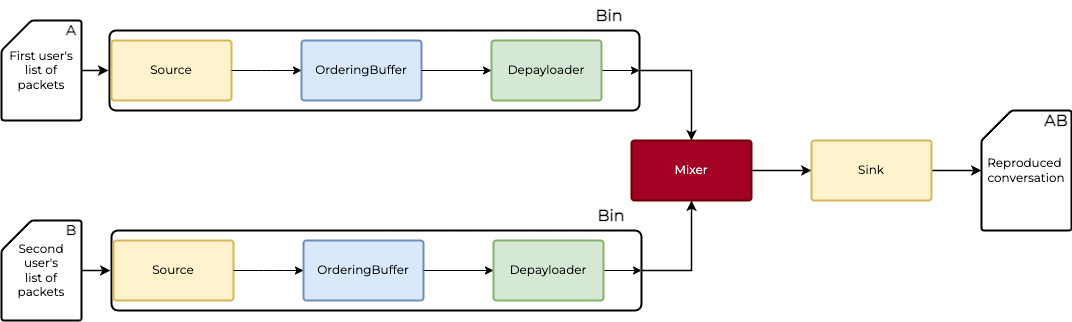
Notice that there is no direct connection between `Depayloader` and [`Mixer`](../glossary/glossary.md#mixer). We have to explicitly link the `Depayloader` with `Bin`'s output [pads](../glossary/glossary.md#pad) and then we will connect the output pads to `Mixer`'s input pads.
Let's define the bin's output pads and its elements.
**_`lib/Bin.ex`_**
```elixir
defmodule Basic.Bin do
use Membrane.Bin
def_output_pad :output, accepted_format: %Basic.Formats.Frame{encoding: :utf8}
def_options input_filename: [
type: :string,
description: "Input file for conversation."
]
@impl true
def handle_init(_ctx, options) do
spec = [
child(:input, %Basic.Elements.Source{location: options.input_filename})
|> child(:ordering_buffer, Basic.Elements.OrderingBuffer)
|> child(:depayloader, %Basic.Elements.Depayloader{packets_per_frame: 4})
|> bin_output(:output)
]
{[spec: spec] %{} }
end
end
```
The output pads of the bin are matching the ones we [defined for depayloader](/basic_pipeline/08_Depayloader.md#libelementsdepayloaderex-2).
Notice that the last link is between `depayloader` and the bin's output pads. In general, if we wanted to receive data in a bin we would need to link the first processing component in the bin with the `bin_input()`.
## Modifying pipeline using bin
Using the bin we created, we can replace the elements in the pipeline.
**_`lib/Pipeline.ex`_**
```elixir
defmodule Basic.Pipeline do
@moduledoc """
A module providing the pipeline, which aggregates and links the elements.
"""
use Membrane.Pipeline
@impl true
def handle_init(_ctx, _opts) do
spec = [
child(:bin1, %Basic.Bin{input_filename: "input.A.txt"})
|> via_in(:first_input)
|> child(:mixer, Basic.Elements.Mixer),
child(:bin2, %Basic.Bin{input_filename: "input.B.txt"})
|> via_in(:second_input)
|> get_child(:mixer),
get_child(:mixer)
|> child(:output, %Basic.Elements.Sink{location: "output.txt"})
]
{[spec: spec], %{}}
end
end
```
Combining the usage of the bin and [dynamic pads](13_DynamicPads.md) will result in an even cleaner and more scalable solution.