README

A bitwise radix tree for prefix based matching on bitstring keys of any length.
Radix provides a radix tree whose radius is 2, has path-compression and no one-way branching. Entries consist of {key, value}-pairs whose insertion/deletion is always based on an exact key-match. Retrieval can be either exact or is based on a prefix match.
Examples
iex> t = new()
...>     |> put(<<1, 1, 1>>, "1.1.1/24")
...>     |> put(<<1, 1, 1, 0::6>>, "1.1.1.0/30")
...>     |> put(<<1, 1, 1, 1::1>>, "1.1.1.128/25")
...>     |> put(<<255>>, "255/8")
iex>
iex>
iex> # longest prefix match
iex>
iex> lookup(t, <<1, 1, 1, 255>>)
{<<1, 1, 1, 1::1>>, "1.1.1.128/25"}
iex>
iex>
iex> # more specific matches (includes search key if present)
iex>
iex> more(t, <<1, 1, 1>>)
[{<<1, 1, 1, 0::size(6)>>, "1.1.1.0/30"}, {<<1, 1, 1>>, "1.1.1/24"}, {<<1, 1, 1, 1::size(1)>>, "1.1.1.128/25"}]
iex>
iex>
iex> # less specific matches (includes search key if present)
iex>
iex> less(t, <<1, 1, 1, 3>>)
[{<<1, 1, 1, 0::size(6)>>, "1.1.1.0/30"}, {<<1, 1, 1>>, "1.1.1/24"}]
iex>
iex> # exact match
iex> get(t, <<1, 1, 1, 0::6>>)
{<<1, 1, 1, 0::6>>, "1.1.1.0/30"}
iex>
iex> get(t, <<1, 1, 1, 0>>)
nil
iex>
iex> dot(t) |> (&File.write("img/readme.dot", &1)).()
The radix tree above looks something like this:
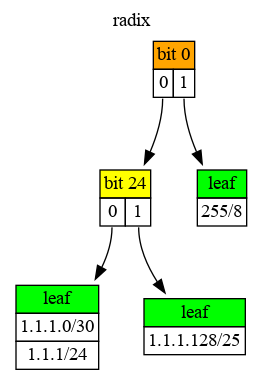
The tree is represented by two types of nodes:
- internal node, as a
{bit, left, right}-tuple, and - leaf node, which is either
nilor a non-empty list of{key,value}-pairs
The bit denotes the bitposition to check in a key during a tree traversal,
where 0 means go left and 1 means go right. A bit beyond a key's
length is considered to be 0. Path-compression means not all bits are
checked during tree traversal, only those that differentiate the keys stored
below the current internal node. Hence, branches are formed as keys with
different patterns are stored in the tree.
The leaf node can have a list of {key, value}-pairs where all longer keys
have all shorter keys as their prefix. In other words, they all agree on the
bits that were checked to arrive at that node. The key is stored alongside
the value since, due to path-compression, a final match is needed to ensure
a correct match. Hence, retrieval functions return the {key, value}-pair,
rather than just the value, since the stored key is not always equal to the
given search key (e.g. when doing a longest prefix match).
Since binaries are bitstrings too, they work as well:
iex> t = new([{"A.new", "new"}, {"A.newer", "newer"}, {"B.newest", "newest"}])
iex> more(t, "A.") |> Enum.reverse()
[{"A.new", "new"}, {"A.newer", "newer"}]
#
iex> lookup(t, "A.newest")
{"A.new", "new"}
#
iex> more(t, "C.")
[]
Note: if Radix is used only for put/get operations, using a regular map
is way faster.
Installation
If available in Hex, the package can be installed
by adding radix to your list of dependencies in mix.exs:
def deps do
  [
    {:radix, "~> 0.1.0"}
  ]
end
Documentation can be generated with ExDoc and published on HexDocs. Once published, the docs can be found at https://hexdocs.pm/radix.