A framework for services over RDF repositories that implements the DCAT-R specification.
What is DCAT-R?
DCAT-R (DCAT for RDF Repositories) is an OWL vocabulary extending DCAT 3 for representing RDF datasets as hierarchical catalog structures. It is designed primarily for building specialized RDF repository services - systems that provide operations (versioning, validation, inference, API access) over datasets. While DCAT-R can also be useful for simpler use cases like cataloging or organizing read-only data, its full power emerges when extended to create custom service types with domain-specific operations and supporting infrastructure.
How does DCAT-R extend DCAT?
Domain specialization: While DCAT is designed for cataloging data generally, DCAT-R applies DCAT's catalog model specifically to RDF 1.1 datasets - cataloging the individual graphs within RDF datasets rather than arbitrary data files.
Service as configuration: While DCAT treats
dcat:DataServiceprimarily as a catalogable metadata object, DCAT-R uses it as configuration for implementing services. A DCAT-R service is not just described by metadata; it IS the runtime configuration that service implementations use to provide operations.
Core Concepts
DCAT-R organizes RDF repositories through a multi-layer catalog hierarchy:
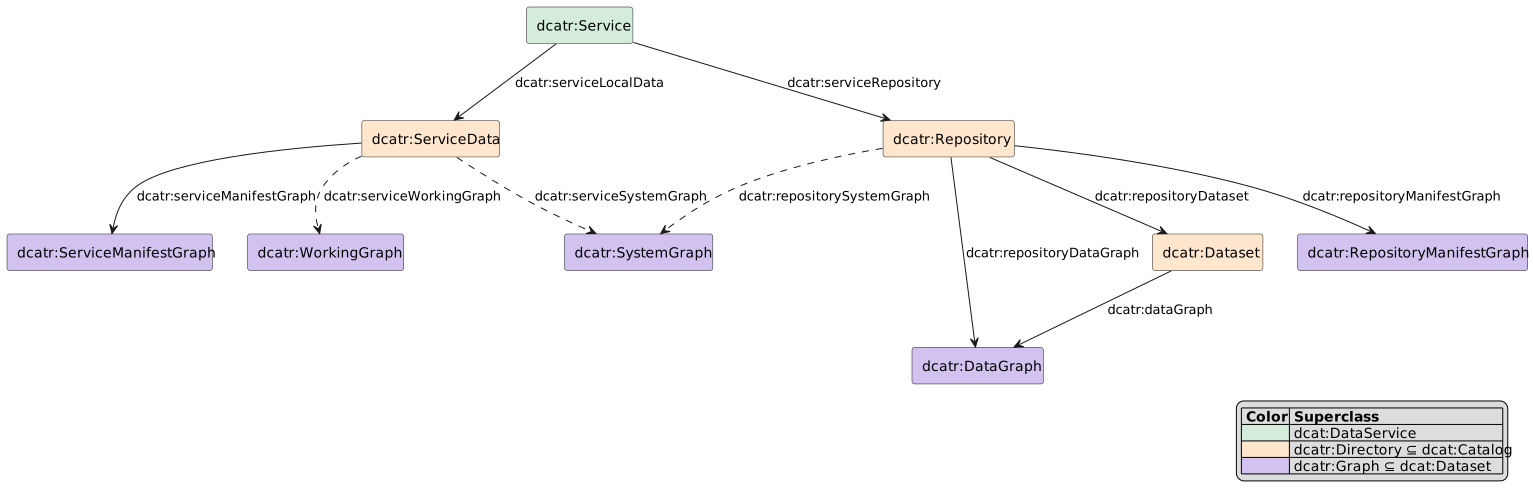
Service Layer
The operations layer - what you can DO with the data. Services define and implement operations like querying, committing changes, validating, or transforming data. A service aggregates both distributable repository data and local instance-specific configuration.
See DCATR.Service for details.
Repository Layer
The distributable data catalog - global/static content that can be replicated across service instances. Contains the dataset (user data) plus metadata and optional distributed system graphs (e.g., history, provenance, shared indexes).
See DCATR.Repository for details.
ServiceData Layer
The local data catalog - instance-specific data that is never distributed. Contains service manifests (configuration), working graphs (temporary/draft data), and optional local system graphs (e.g., caches, logs, local indexes).
See DCATR.ServiceData for details.
Dataset Layer
The pure user data catalog - free from operational concerns. A dataset is simply a catalog of data graphs, always contained within a repository and always distributed.
See DCATR.Dataset for details.
Graph Taxonomy
DCAT-R defines a complete taxonomy of graph types. Every graph belongs to exactly one of four disjoint classes:
DataGraph
Primary user data - the actual content of the dataset. Always contained in the dataset catalog, always distributed with the repository.
See DCATR.DataGraph for details.
ManifestGraph
Configuration that DCAT-R understands and processes. Contains DCAT-R-specific metadata like graph name mappings and service settings. Two concrete types:
- RepositoryManifestGraph: Repository metadata (distributed)
- ServiceManifestGraph: Service configuration (local)
See DCATR.ManifestGraph for details.
SystemGraph
Infrastructure data supporting service operations. Can be deployed in two modes:
- Distributed (in Repository): History, provenance, shared indexes
- Local (in ServiceData): Caches, logs, local indexes
See DCATR.SystemGraph for details.
WorkingGraph
Temporary/draft data for service-local operations. Always in ServiceData, never distributed. Analogous to a working directory in version control systems.
See DCATR.WorkingGraph for details.
Primary Graph
DCAT-R supports designating a primary graph in two ways:
dcatr:repositoryDataGraph- for single-graph repositories (provides both containment and designation)dcatr:repositoryPrimaryGraph- for multi-graph repositories (pure designator, no containment)
See DCATR.Repository for details.
Manifest System
Services are typically loaded from RDF manifest files via DCATR.Manifest, which provides
hierarchical, environment-aware configuration loading. See DCATR.Manifest for details.
Extending DCAT-R
DCAT-R provides extension points for building specialized service types, from simple cataloging to complex operational services. The framework is designed primarily for the latter - building specialized services - but remains useful for simpler cases without extension.
Extension Pattern
When building specialized services, the extension pattern is:
- Define operations - What can users DO with the data? (commit, validate, transform, query, etc.)
- Define SystemGraphs - What infrastructure do operations need? (history, caches, indexes, etc.)
- Implement via Type behaviours - Custom types for Service, Repository, and/or ServiceData
Example: A versioning service (like Ontogen) defines commit operations, which require history graphs (distributed SystemGraphs). A validation service defines validation operations, which may need validation report graphs (could be distributed or local).
The complete technical pattern is documented in DCATR.Service.Type.
Key Extension Points
DCATR.Service.Type- Define service operations and override repository/service-data typesDCATR.Repository.Type- Add distributed SystemGraphs for repository-level infrastructureDCATR.ServiceData.Type- Add local SystemGraphs for instance-specific infrastructureDCATR.GraphResolver- Custom graph selectors viaresolve_graph_selector/2
Further Reading
- DCAT-R specification - Formal specification
- DCAT-R term reference - Vocabulary term definitions
Summary
Functions
Returns the configured manifest type for the application.
Functions
Returns the configured manifest type for the application.
Applications with custom manifest types (implementing DCATR.Manifest.Type) can set
this in their config to use their manifest type as the default in tasks like mix dcatr.init.
Example
# config/config.exs
config :dcatr, :manifest_type, MyApp.Manifest