Subscriptions in erl-esdb
View SourceSubscriptions enable real-time event delivery to consumers. When events are written to streams, subscribers receive notifications automatically, enabling reactive architectures and event-driven systems.

How Subscriptions Work
erl-esdb uses Khepri triggers for guaranteed event delivery:
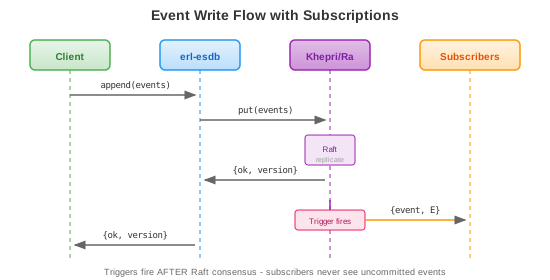
Key guarantee: Triggers only fire AFTER events are committed via Raft consensus. Subscribers never receive events that don't exist.
Subscription Types
erl-esdb supports four subscription types for flexible event filtering:
1. Stream Subscription
Subscribe to all events in a specific stream:
%% Subscribe to a single order's events
{ok, SubKey} = erl_esdb_subscriptions:subscribe(
    my_store,
    stream,                          %% subscription type
    <<"order-123">>,                 %% stream ID
    <<"order_123_handler">>          %% subscription name
).
Use cases:
- Aggregate projections (one read model per aggregate)
- Saga/process managers following a specific entity
- Real-time UI updates for a specific resource
2. Event Type Subscription
Subscribe to events of a specific type across all streams:
%% Subscribe to all PaymentReceived events
{ok, SubKey} = erl_esdb_subscriptions:subscribe(
    my_store,
    event_type,
    <<"PaymentReceived">>,
    <<"payment_processor">>
).
Use cases:
- Cross-cutting concerns (logging, auditing)
- Metrics collection
- Notification services
3. Event Pattern Subscription
Subscribe to events matching a stream ID pattern with wildcards:
%% Subscribe to all order streams
{ok, SubKey} = erl_esdb_subscriptions:subscribe(
    my_store,
    event_pattern,
    <<"order-*">>,                   %% wildcard pattern
    <<"order_projection">>
).

%% Subscribe to all streams in a region
{ok, SubKey2} = erl_esdb_subscriptions:subscribe(
    my_store,
    event_pattern,
    <<"*-region-eu">>,
    <<"eu_analytics">>
).
Use cases:
- Category projections (all orders, all users)
- Regional processing
- Multi-tenant partitioning
4. Payload Subscription
Subscribe to events matching specific payload criteria:
%% Subscribe to high-value orders
{ok, SubKey} = erl_esdb_subscriptions:subscribe(
    my_store,
    event_payload,
    #{total => {gt, 10000}},         %% total > 10000
    <<"high_value_order_handler">>
).

%% Subscribe to orders from VIP customers
{ok, SubKey2} = erl_esdb_subscriptions:subscribe(
    my_store,
    event_payload,
    #{customer_type => <<"VIP">>},
    <<"vip_handler">>
).
Use cases:
- Conditional processing
- Fraud detection (high amounts)
- Priority handling
Creating Subscriptions
Basic Subscription
%% Create a subscription
{ok, SubscriptionKey} = erl_esdb_subscriptions:subscribe(
    StoreId,
    Type,
    Selector,
    SubscriptionName
).

%% The subscription key uniquely identifies this subscription
%% Use it for management operations
Subscription Options
%% Advanced options
{ok, SubKey} = erl_esdb_subscriptions:subscribe(
    my_store,
    event_pattern,
    <<"order-*">>,
    <<"order_projection">>,
    #{
        pool_size => 4,              %% Emitter pool size for parallelism
        start_from => 0,             %% Start position (0 = beginning)
        subscriber => self()         %% Direct subscriber PID
    }
).
Options:
pool_size: Number of emitter workers for parallel delivery (default: 1)start_from: Starting event position for catch-up (default: 0)subscriber: PID to receive events directly
Receiving Events
Using Process Groups
The recommended approach is joining the emitter group:
-module(my_event_handler).
-behaviour(gen_server).

init(StoreId) ->
    %% Create subscription
    {ok, SubKey} = erl_esdb_subscriptions:subscribe(
        StoreId,
        event_pattern,
        <<"order-*">>,
        <<"my_handler">>
    ),

    %% Join the emitter group to receive events
    erl_esdb_emitter_group:join(StoreId, SubKey, self()),

    {ok, #{store_id => StoreId, sub_key => SubKey}}.

handle_info({event, Event}, State) ->
    %% Process the event
    handle_event(Event),
    {noreply, State}.

handle_event(#event{event_type = <<"OrderPlaced">>} = Event) ->
    logger:info("Order placed: ~p", [Event#event.data]),
    update_projection(Event);
handle_event(#event{event_type = <<"OrderShipped">>} = Event) ->
    logger:info("Order shipped: ~p", [Event#event.data]),
    update_projection(Event);
handle_event(_Event) ->
    %% Ignore other events
    ok.
Multiple Handlers
For high throughput, use multiple handler processes:
-module(order_handler_pool).

start_pool(StoreId, PoolSize) ->
    %% Create subscription with pool size
    {ok, SubKey} = erl_esdb_subscriptions:subscribe(
        StoreId,
        event_pattern,
        <<"order-*">>,
        <<"order_handler_pool">>,
        #{pool_size => PoolSize}
    ),

    %% Start worker processes
    [begin
        {ok, Pid} = order_handler_worker:start_link(StoreId, SubKey, N),
        Pid
    end || N <- lists:seq(1, PoolSize)].

-module(order_handler_worker).

init({StoreId, SubKey, WorkerId}) ->
    %% Join the same emitter group
    %% Events are distributed round-robin among workers
    erl_esdb_emitter_group:join(StoreId, SubKey, self()),
    {ok, #{worker_id => WorkerId}}.
Managing Subscriptions
List Subscriptions
%% List all subscriptions
{ok, Subscriptions} = erl_esdb_subscriptions:list(my_store).

%% Each subscription record contains:
%% - type: stream | event_type | event_pattern | event_payload
%% - selector: The filter criteria
%% - subscription_name: Human-readable name
%% - created_at: Timestamp
%% - pool_size: Number of emitters
Check Subscription Exists
%% Check if subscription exists
case erl_esdb_subscriptions:exists(my_store, SubscriptionKey) of
    true -> io:format("Subscription is active~n");
    false -> io:format("Subscription not found~n")
end.
Get Subscription Details
%% Get subscription by key
case erl_esdb_subscriptions:get(my_store, SubscriptionKey) of
    {ok, Subscription} ->
        io:format("Type: ~p~n", [Subscription#subscription.type]),
        io:format("Selector: ~p~n", [Subscription#subscription.selector]);
    {error, not_found} ->
        io:format("Subscription not found~n")
end.
Unsubscribe
%% Unsubscribe by key
ok = erl_esdb_subscriptions:unsubscribe(my_store, SubscriptionKey).

%% Unsubscribe by type and name
ok = erl_esdb_subscriptions:unsubscribe(my_store, event_pattern, <<"order_projection">>).
Catch-Up Subscriptions
Catch-up subscriptions process historical events before receiving live events:
%% Start from the beginning (catch up on all history)
{ok, SubKey} = erl_esdb_subscriptions:subscribe(
    my_store,
    event_pattern,
    <<"order-*">>,
    <<"new_projection">>,
    #{start_from => 0}                %% Start from first event
).

%% Start from a specific position (e.g., after rebuilding)
{ok, SubKey2} = erl_esdb_subscriptions:subscribe(
    my_store,
    event_pattern,
    <<"order-*">>,
    <<"resumed_projection">>,
    #{start_from => 12345}            %% Resume from position 12345
).
Checkpointing
Track your position to resume after restarts:
-module(checkpointed_handler).

init(StoreId) ->
    %% Load last processed position
    LastPosition = load_checkpoint(StoreId),

    {ok, SubKey} = erl_esdb_subscriptions:subscribe(
        StoreId,
        event_pattern,
        <<"order-*">>,
        <<"checkpointed_handler">>,
        #{start_from => LastPosition}
    ),

    erl_esdb_emitter_group:join(StoreId, SubKey, self()),
    {ok, #{store_id => StoreId, sub_key => SubKey}}.

handle_info({event, Event}, #{store_id := StoreId} = State) ->
    %% Process the event
    handle_event(Event),

    %% Save checkpoint
    save_checkpoint(StoreId, Event#event.version),

    {noreply, State}.

%% Checkpoints can be stored in:
%% - The event store itself (as a special stream)
%% - ETS/DETS
%% - External database
Best Practices
1. Idempotent Event Handling
Events may be delivered more than once. Make handlers idempotent:
handle_event(Event) ->
    EventId = Event#event.event_id,

    %% Check if already processed
    case ets:lookup(processed_events, EventId) of
        [{EventId, _}] ->
            %% Already processed, skip
            ok;
        [] ->
            %% Process and mark as done
            do_process_event(Event),
            ets:insert(processed_events, {EventId, erlang:system_time()})
    end.
2. Handle Ordering Carefully
Within a single stream, events are ordered. Across streams, ordering is not guaranteed:
%% Events from stream "order-123" arrive in order:
%% OrderPlaced -> ItemAdded -> OrderShipped

%% But events from different streams may interleave:
%% order-123:OrderPlaced
%% order-456:OrderPlaced     %% Different stream, no ordering guarantee
%% order-123:ItemAdded
%% order-456:PaymentReceived
3. Graceful Shutdown
Leave emitter groups on shutdown:
terminate(_Reason, #{store_id := StoreId, sub_key := SubKey}) ->
    %% Leave the emitter group
    erl_esdb_emitter_group:leave(StoreId, SubKey, self()),
    ok.
4. Monitor Subscription Lag
Track how far behind your subscription is:
%% Check current stream version vs processed version
StreamVersion = erl_esdb_streams:get_version(StoreId, StreamId),
ProcessedVersion = get_last_processed_version(),
Lag = StreamVersion - ProcessedVersion,

case Lag > 1000 of
    true ->
        logger:warning("Subscription lag is high: ~p events behind", [Lag]);
    false ->
        ok
end.
Further Reading
- Event Sourcing Guide - Foundation concepts
- CQRS Guide - Using subscriptions for projections
- Snapshots Guide - Optimizing catch-up subscriptions
References
- Event Store: Persistent Subscriptions
- Axon Framework: Event Processors