Architecture
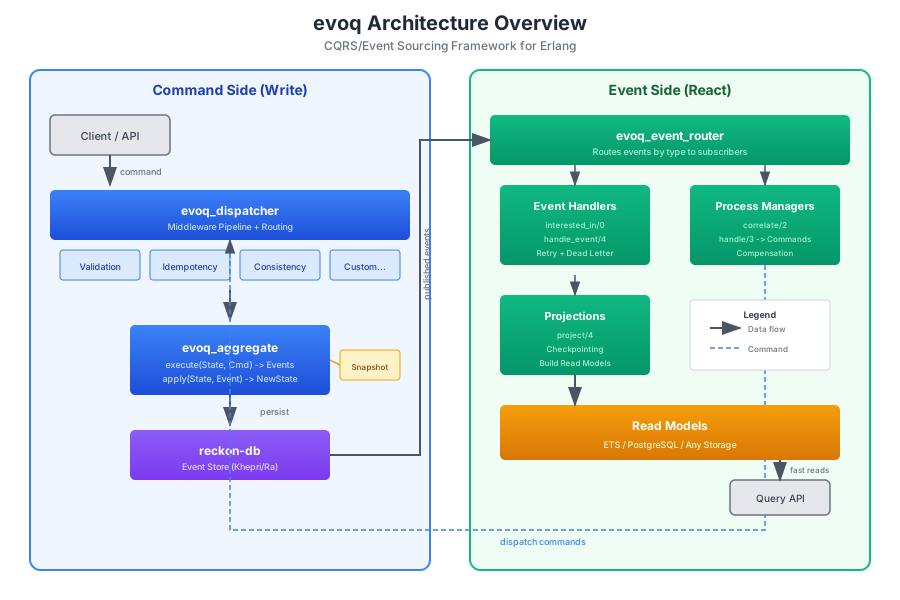
View Sourceevoq implements CQRS (Command Query Responsibility Segregation) and Event Sourcing patterns for Erlang applications. This guide explains the core architecture and how the components work together.
Core Principles
1. Commands Produce Events, Events Update State
The fundamental flow in evoq:
- Command arrives (user intent)
- Aggregate validates and produces Events (facts)
- Events are persisted to the event store
- Events are applied to update aggregate state
- Events are routed to subscribers (handlers, projections, process managers)
This separation ensures:
- Commands can be rejected (validation failed)
- Events are immutable facts (already happened)
- State can be rebuilt by replaying events
2. Read Models Are Separate From Write Models
CQRS separates:
| Write Side | Read Side |
|---|---|
| Commands | Queries |
| Aggregates | Projections |
| Event Store | Read Models |
| Business logic | Optimized views |
Benefits:
- Read models can be denormalized for fast queries
- Each read model optimized for specific use case
- Read models can be rebuilt from events
3. Event Type Subscriptions (Not Stream-Based)
Unlike stream-based subscriptions, evoq routes events by type:
%% Handler declares interest by event type
interested_in() ->
    [<<"OrderPlaced">>, <<"PaymentReceived">>].
Why this matters:
- 1 million orders = 1 million streams
- Stream subscriptions = 1 million subscriptions (memory explosion)
- Type subscriptions = ~10 event types (constant memory)
Component Overview
evoq_dispatcher
Entry point for command processing. Routes commands through the middleware pipeline to the target aggregate.
%% Dispatch a command
{ok, Version, Events} = evoq_dispatcher:dispatch(Command).
evoq_middleware
Pluggable pipeline for command processing:
-behaviour(evoq_middleware).

before_dispatch(Pipeline) ->
    %% Validate, check idempotency, etc.
    {ok, Pipeline}.

after_dispatch(Pipeline) ->
    %% Post-processing
    {ok, Pipeline}.
Built-in middleware:
- Validation - Schema and business rule validation
- Idempotency - Prevent duplicate command processing
- Consistency - Strong or eventual consistency guarantees
evoq_aggregate
Business logic container. Validates commands and produces events.
-behaviour(evoq_aggregate).

%% Initialize state
init(AggregateId) -> {ok, InitialState}.

%% Validate and produce events
execute(State, Command) -> {ok, [Event]} | {error, Reason}.

%% Update state from event
apply(State, Event) -> NewState.
evoq_event_router
Routes persisted events to interested subscribers by event type.
Subscribers:
- Event Handlers (side effects)
- Process Managers (orchestration)
- Projections (read models)
evoq_event_handler
React to events with side effects:
-behaviour(evoq_event_handler).

interested_in() -> [<<"UserRegistered">>].

handle_event(EventType, Event, Metadata, State) ->
    send_welcome_email(Event),
    {ok, State}.
Features:
- Retry strategies (exponential backoff)
- Dead letter queue for failed events
- Checkpoint-based recovery
evoq_process_manager
Coordinate long-running business processes (sagas):
-behaviour(evoq_process_manager).

interested_in() -> [<<"OrderPlaced">>, <<"PaymentReceived">>].

correlate(Event, _Meta) ->
    {continue, maps:get(order_id, Event)}.

handle(State, Event, _Meta) ->
    Cmd = create_next_command(Event),
    {ok, State, [Cmd]}.

compensate(State, FailedCommand) ->
    {ok, [create_rollback_command(FailedCommand)]}.
evoq_projection
Build read models from events:
-behaviour(evoq_projection).

interested_in() -> [<<"OrderPlaced">>, <<"OrderShipped">>].

project(Event, Metadata, State, ReadModel) ->
    Updated = update_order_summary(Event, ReadModel),
    {ok, State, Updated}.
Data Flow
Command Processing
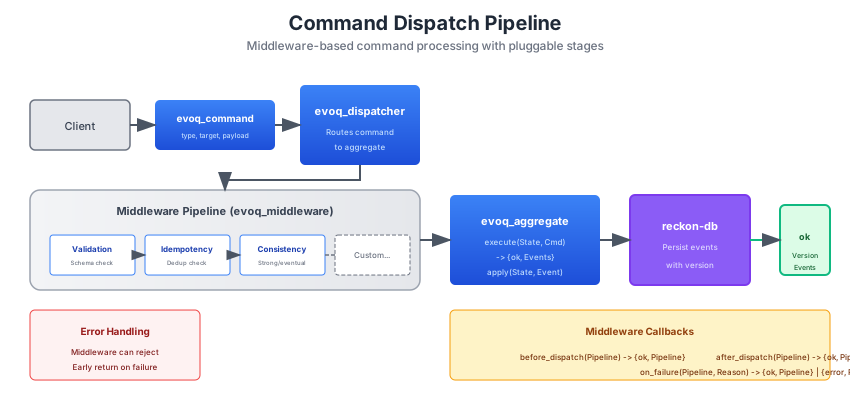
- Client creates command via
evoq_command:new/4 - Dispatcher routes through middleware pipeline
- Aggregate executes command, produces events
- Events persisted to reckon-db
- Result returned to client
Event Distribution
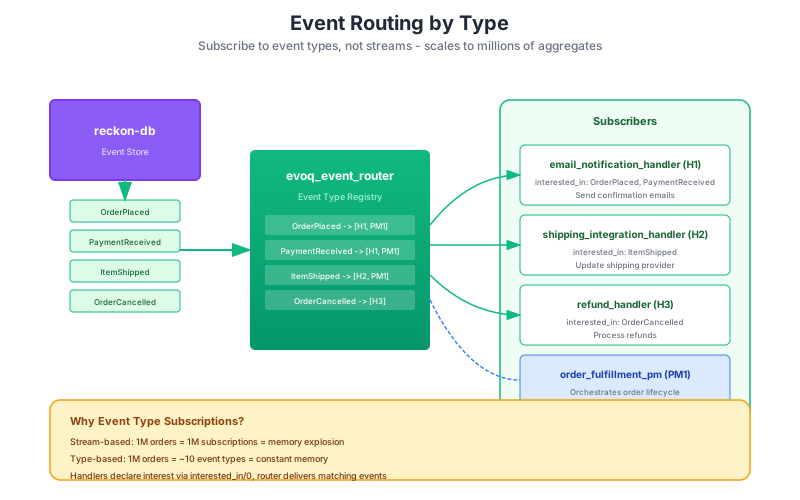
- Events persisted to event store
- Event router receives notification
- Router looks up subscribers by event type
- Events delivered to matching handlers
Supervision Tree
evoq_sup
├── evoq_aggregates_sup           # Dynamic aggregate supervisors
│   ├── evoq_aggregate_partition_sup_0
│   │   └── evoq_aggregate (bank_account, "acc-1")
│   │   └── evoq_aggregate (bank_account, "acc-2")
│   ├── evoq_aggregate_partition_sup_1
│   │   └── ...
│   └── ... (4 partitions by default)
├── evoq_event_handler_sup        # Event handlers
│   └── evoq_event_handler (email_handler)
│   └── evoq_event_handler (audit_handler)
├── evoq_process_manager_sup      # Process managers
│   └── evoq_process_manager (order_pm, "order-123")
├── evoq_projection_sup           # Projections
│   └── evoq_projection (order_summary)
├── evoq_memory_monitor           # Memory pressure monitoring
└── evoq_event_router             # Event type registry
Partitioned Supervision
Aggregates are distributed across 4 partition supervisors using consistent hashing. This prevents:
- Single supervisor bottleneck
- Cascade failures affecting all aggregates
- Uneven load distribution
Integration with reckon-db
evoq uses reckon-db for event persistence:
%% Event store operations delegated to reckon-db
evoq_event_store:append(StoreId, StreamId, ExpectedVersion, Events)
evoq_event_store:read(StoreId, StreamId, StartVersion, Count)
evoq_event_store:subscribe(StoreId, EventTypes, Handler)
The adapter pattern allows different backends:
%% Configure adapter in sys.config
{evoq, [
    {event_store_adapter, evoq_esdb_adapter}
]}
Next Steps
- Aggregates Guide - Deep dive into aggregate patterns
- Event Handlers Guide - Building reactive systems
- Process Managers Guide - Orchestrating workflows
- Projections Guide - Building read models