Aggregates
View SourceAggregates are the core building blocks of your domain. They encapsulate business logic, maintain invariants, and produce events that represent state changes.
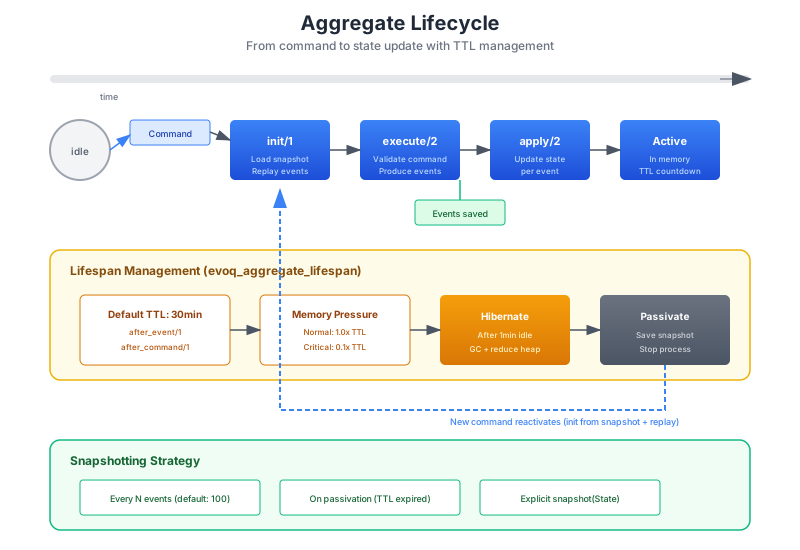
The Aggregate Pattern
An aggregate in evoq:
- Receives commands - User intents to change state
- Validates business rules - Ensures invariants are maintained
- Produces events - Facts representing what happened
- Applies events - Updates internal state
-module(bank_account).
-behaviour(evoq_aggregate).

-export([init/1, execute/2, apply/2]).

%% Initialize a new aggregate
init(_AccountId) ->
    {ok, #{balance => 0, status => active}}.

%% Validate command and produce events
execute(#{status := closed}, _Command) ->
    {error, account_closed};
execute(#{balance := Balance}, #{command_type := withdraw, amount := Amount})
  when Amount > Balance ->
    {error, insufficient_funds};
execute(_State, #{command_type := deposit, amount := Amount}) ->
    {ok, [#{event_type => <<"MoneyDeposited">>, data => #{amount => Amount}}]}.

%% Apply event to update state
apply(#{balance := Balance} = State, #{event_type := <<"MoneyDeposited">>, data := #{amount := Amount}}) ->
    State#{balance => Balance + Amount}.
Required Callbacks
init/1
Called when an aggregate is first created or reactivated.
-spec init(AggregateId :: binary()) -> {ok, State :: term()}.

init(AccountId) ->
    %% Return initial state for new aggregate
    {ok, #{
        account_id => AccountId,
        balance => 0,
        opened_at => undefined,
        status => new
    }}.
execute/2
Validates the command against current state and produces events.
-spec execute(State :: term(), Command :: map()) ->
    {ok, [Event :: map()]} | {error, Reason :: term()}.

execute(#{status := new}, #{command_type := open_account, initial_deposit := Amount}) ->
    {ok, [
        #{event_type => <<"AccountOpened">>, data => #{initial_deposit => Amount}},
        #{event_type => <<"MoneyDeposited">>, data => #{amount => Amount}}
    ]};
execute(#{status := active, balance := Balance}, #{command_type := withdraw, amount := Amount})
  when Amount =< Balance ->
    {ok, [#{event_type => <<"MoneyWithdrawn">>, data => #{amount => Amount}}]};
execute(#{status := active, balance := Balance}, #{command_type := withdraw, amount := Amount})
  when Amount > Balance ->
    {error, {insufficient_funds, Balance, Amount}}.
Key patterns:
- Use pattern matching on state for preconditions
- Use guards for numeric validations
- Return
{ok, [Events]}on success - Return
{error, Reason}on validation failure - Never produce events if validation fails
apply/2
Updates state from a single event. Called for each event produced by execute/2 and during replay.
-spec apply(State :: term(), Event :: map()) -> NewState :: term().

apply(State, #{event_type := <<"AccountOpened">>, data := Data}) ->
    State#{
        status => active,
        opened_at => erlang:system_time(millisecond),
        initial_deposit => maps:get(initial_deposit, Data)
    };
apply(#{balance := Balance} = State, #{event_type := <<"MoneyDeposited">>, data := #{amount := Amount}}) ->
    State#{balance => Balance + Amount};
apply(#{balance := Balance} = State, #{event_type := <<"MoneyWithdrawn">>, data := #{amount := Amount}}) ->
    State#{balance => Balance - Amount}.
Key patterns:
- Must be pure (no side effects)
- Must be deterministic (same input = same output)
- Handle all event types the aggregate produces
- Called during replay - don't assume order
Optional Callbacks
snapshot/1 and from_snapshot/1
Enable snapshotting for faster aggregate loading:
-spec snapshot(State :: term()) -> SnapshotData :: term().
snapshot(State) ->
    %% Serialize state for storage
    State.

-spec from_snapshot(SnapshotData :: term()) -> State :: term().
from_snapshot(SnapshotData) ->
    %% Deserialize state from storage
    SnapshotData.
When loading an aggregate:
- Load latest snapshot (if exists)
- Replay events after snapshot version
- Much faster than replaying all events
Lifecycle Management
Aggregates are not kept in memory forever. The evoq_aggregate_lifespan behavior controls:
- How long to keep aggregate active
- When to hibernate (reduce memory)
- When to passivate (stop process)
- When to save snapshots
Default Lifespan
%% Default behavior
-module(evoq_aggregate_lifespan_default).

after_event(_Event) ->
    30 * 60 * 1000.  %% 30 minute timeout

after_command(_Command) ->
    30 * 60 * 1000.  %% 30 minute timeout

after_error(_Error) ->
    infinity.  %% Keep active on error for debugging

on_timeout(State) ->
    {snapshot, stop}.  %% Save snapshot, then stop
Custom Lifespan
-module(my_aggregate_lifespan).
-behaviour(evoq_aggregate_lifespan).

after_event(#{event_type := <<"HighValueTransaction">>}) ->
    infinity;  %% Keep high-value accounts active
after_event(_) ->
    5 * 60 * 1000.  %% 5 minute timeout for others

after_command(_) ->
    10 * 60 * 1000.

after_error({insufficient_funds, _, _}) ->
    60 * 1000;  %% 1 minute for expected errors
after_error(_) ->
    infinity.  %% Keep active for unexpected errors

on_timeout(State) ->
    case maps:get(balance, State, 0) > 10000 of
        true -> {snapshot, hibernate};  %% Snapshot high-value, hibernate
        false -> {ok, stop}  %% Just stop low-value
    end.
Memory Pressure
The evoq_memory_monitor adjusts aggregate TTLs based on system memory:
| Pressure | Memory Usage | TTL Factor | Effect |
|---|---|---|---|
| normal | < 70% | 1.0x | Normal TTL |
| elevated | 70-85% | 0.5x | Faster passivation |
| critical | > 85% | 0.1x | Aggressive cleanup |
This prevents OOM conditions under load while keeping aggregates active when memory is available.
Dispatching Commands
Create and dispatch commands:
%% Create a command
Command = evoq_command:new(
    deposit,           %% command type atom
    bank_account,      %% aggregate module
    <<"acc-123">>,     %% aggregate id
    #{amount => 100}   %% payload
),

%% With metadata
CommandWithMeta = evoq_command:with_metadata(Command, #{
    user_id => <<"user-456">>,
    correlation_id => <<"corr-789">>
}),

%% Dispatch
case evoq_dispatcher:dispatch(CommandWithMeta) of
    {ok, NewVersion, ProducedEvents} ->
        %% Success - version and events returned
        ok;
    {error, Reason} ->
        %% Command rejected by aggregate or middleware
        handle_error(Reason)
end.
Concurrency Control
reckon-db uses optimistic concurrency with expected versions:
%% First write to new stream
append(StoreId, StreamId, -1, Events)  %% -1 = stream must not exist

%% Append to existing stream
append(StoreId, StreamId, 5, Events)   %% Must be at version 5

%% Append without version check
append(StoreId, StreamId, -2, Events)  %% -2 = any version
If another process appended events, you get:
{error, {wrong_expected_version, Expected, Actual}}evoq handles this automatically with retries when appropriate.
Testing Aggregates
Test aggregates in isolation:
-module(bank_account_tests).
-include_lib("eunit/include/eunit.hrl").

deposit_test() ->
    {ok, State0} = bank_account:init(<<"test-acc">>),

    %% Execute command
    Command = #{command_type => deposit, amount => 100},
    {ok, Events} = bank_account:execute(State0, Command),

    %% Apply events
    State1 = lists:foldl(fun bank_account:apply/2, State0, Events),

    ?assertEqual(100, maps:get(balance, State1)).

insufficient_funds_test() ->
    {ok, State0} = bank_account:init(<<"test-acc">>),

    Command = #{command_type => withdraw, amount => 100},
    ?assertEqual({error, insufficient_funds}, bank_account:execute(State0, Command)).
Best Practices
1. Keep Aggregates Small
Aggregates should be cohesive:
- One aggregate = one consistency boundary
- If two things can change independently, they're separate aggregates
- Large aggregates = more conflicts, slower loading
2. Use Domain Language
Events should reflect business meaning:
%% Good - business language
#{event_type => <<"AccountOverdrawn">>}
#{event_type => <<"LoyaltyPointsEarned">>}

%% Bad - CRUD language
#{event_type => <<"AccountUpdated">>}
#{event_type => <<"BalanceChanged">>}
3. Events Are Facts
Events represent what happened, not what will happen:
%% Good - past tense, immutable fact
<<"MoneyDeposited">>
<<"AccountClosed">>

%% Bad - future/present tense
<<"DepositMoney">>
<<"CloseAccount">>
4. Validate Early
Reject invalid commands before producing events:
execute(_, #{command_type := deposit, amount := Amount}) when Amount =< 0 ->
    {error, {invalid_amount, Amount}};
execute(State, #{command_type := deposit, amount := Amount}) ->
    %% Only valid deposits reach here
    {ok, [#{event_type => <<"MoneyDeposited">>, data => #{amount => Amount}}]}.
Next Steps
- Event Handlers - React to events
- Process Managers - Coordinate workflows
- Projections - Build read models