evoq
View Source
Erlang CQRS/Event Sourcing framework built on reckon-db.
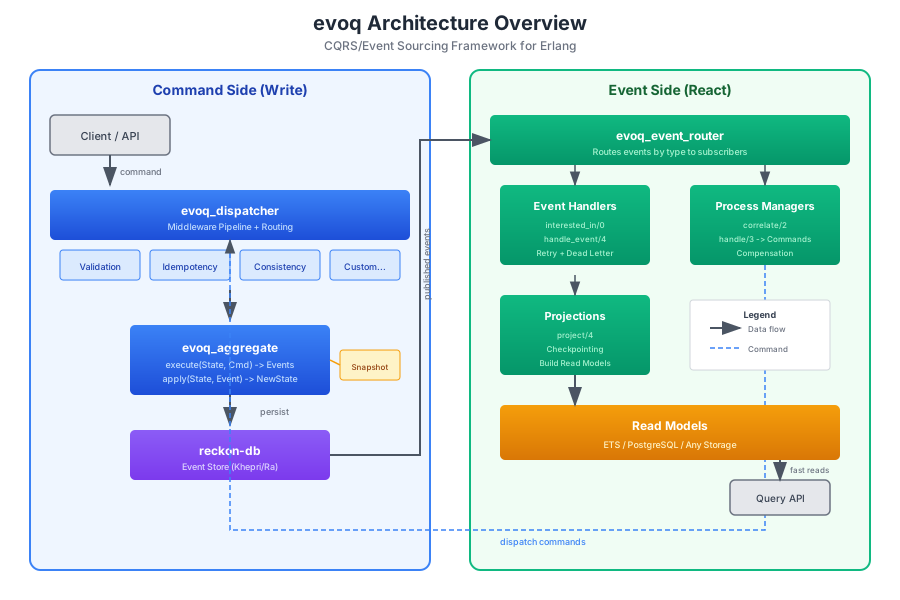
Features
- Aggregate lifecycle with configurable TTL and passivation
- Per-event-type subscriptions (not per-stream)
- Command idempotency
- Middleware pipeline for command dispatch
- Event handlers with retry strategies and dead letter support
- Process managers (sagas) with compensation
- Projections with checkpointing
- Schema evolution via event upcasters
- Memory pressure monitoring with adaptive TTL
- Comprehensive telemetry integration
Installation
Add to your rebar.config:
{deps, [
    {evoq, "1.0.0"}
]}.
Quick Start
Defining an Aggregate
-module(bank_account).
-behaviour(evoq_aggregate).

-export([init/1, execute/2, apply/2]).

init(_AccountId) ->
    {ok, #{balance => 0, status => active}}.

execute(#{status := closed}, _Command) ->
    {error, account_closed};
execute(_State, #{command_type := open_account, initial_balance := B}) ->
    {ok, [#{event_type => <<"AccountOpened">>, data => #{balance => B}}]};
execute(#{balance := Bal}, #{command_type := deposit, amount := A}) ->
    {ok, [#{event_type => <<"MoneyDeposited">>, data => #{amount => A}}]}.

apply(State, #{event_type := <<"AccountOpened">>, data := #{balance := B}}) ->
    State#{balance => B};
apply(#{balance := B} = State, #{event_type := <<"MoneyDeposited">>, data := #{amount := A}}) ->
    State#{balance => B + A}.
Dispatching Commands
%% Create a command
Command = evoq_command:new(
    deposit,           %% command type
    bank_account,      %% aggregate module
    <<"acc-123">>,     %% aggregate id
    #{amount => 100}   %% payload
),

%% Dispatch it
{ok, Version, Events} = evoq_router:dispatch(Command).
Event Handlers
-module(notification_handler).
-behaviour(evoq_event_handler).

-export([interested_in/0, init/1, handle_event/4]).

interested_in() ->
    [<<"AccountOpened">>, <<"LargeDeposit">>].

init(_Config) ->
    {ok, #{}}.

handle_event(<<"AccountOpened">>, Event, _Metadata, State) ->
    send_welcome_email(Event),
    {ok, State};
handle_event(<<"LargeDeposit">>, Event, _Metadata, State) ->
    send_deposit_alert(Event),
    {ok, State}.
Process Managers (Sagas)
-module(order_fulfillment_pm).
-behaviour(evoq_process_manager).

-export([interested_in/0, correlate/2, handle/3, apply/2]).

interested_in() ->
    [<<"OrderPlaced">>, <<"PaymentReceived">>, <<"ItemShipped">>].

correlate(#{data := #{order_id := OrderId}}, _Meta) ->
    {continue, OrderId}.

handle(State, #{event_type := <<"OrderPlaced">>} = Event, _Meta) ->
    Cmd = evoq_command:new(process_payment, payment, OrderId, #{}),
    {ok, State, [Cmd]};
handle(State, #{event_type := <<"PaymentReceived">>}, _Meta) ->
    Cmd = evoq_command:new(ship_item, shipping, OrderId, #{}),
    {ok, State, [Cmd]};
handle(State, #{event_type := <<"ItemShipped">>}, _Meta) ->
    {ok, State#{status => completed}}.

apply(State, _Event) ->
    State.
Projections
-module(account_summary_projection).
-behaviour(evoq_projection).

-export([interested_in/0, init/1, project/4]).

interested_in() ->
    [<<"AccountOpened">>, <<"MoneyDeposited">>, <<"MoneyWithdrawn">>].

init(_Config) ->
    {ok, ReadModel} = evoq_read_model:new(evoq_read_model_ets, #{}),
    {ok, #{}, ReadModel}.

project(#{event_type := <<"AccountOpened">>, data := #{balance := B}},
        #{aggregate_id := Id}, State, ReadModel) ->
    {ok, NewRM} = evoq_read_model:put(Id, #{balance => B, tx_count => 0}, ReadModel),
    {ok, State, NewRM};
project(#{event_type := <<"MoneyDeposited">>, data := #{amount := A}},
        #{aggregate_id := Id}, State, ReadModel) ->
    {ok, Current} = evoq_read_model:get(Id, ReadModel),
    Updated = Current#{
        balance => maps:get(balance, Current) + A,
        tx_count => maps:get(tx_count, Current) + 1
    },
    {ok, NewRM} = evoq_read_model:put(Id, Updated, ReadModel),
    {ok, State, NewRM}.
Core Behaviors
Domain Artifacts
Domain artifacts stay inside the bounded context. They use atom keys and Erlang terms.
evoq_command
Commands represent intentions to change state. Formal contract for command modules.
-behaviour(evoq_command).

%% Required
-callback command_type() -> atom().
-callback new(Params :: map()) -> {ok, Command} | {error, Reason}.
-callback to_map(Command) -> map().

%% Optional
-callback validate(Command) -> ok | {ok, Command} | {error, Reason}.
-callback from_map(Map :: map()) -> {ok, Command} | {error, Reason}.
evoq_event
Events represent facts that have happened. Immutable once stored.
-behaviour(evoq_event).

%% Required
-callback event_type() -> atom().
-callback new(Params :: map()) -> Event.
-callback to_map(Event) -> map().

%% Optional
-callback from_map(Map :: map()) -> {ok, Event} | {error, Reason}.
Integration Artifacts
Integration artifacts cross bounded context boundaries. They use binary keys and are JSON-serializable.
evoq_fact
Facts translate domain events into payloads for external consumption via pg or mesh.
-behaviour(evoq_fact).

%% Required
-callback fact_type() -> binary().          %% e.g., <<"hecate.venture.initiated">>
-callback from_event(EventType :: atom(), EventData :: map(), Metadata :: map()) ->
    {ok, Payload :: map()} | skip.

%% Optional (defaults use OTP 27 json module)
-callback serialize(Payload :: map()) -> {ok, binary()} | {error, Reason}.
-callback deserialize(Binary :: binary()) -> {ok, map()} | {error, Reason}.
-callback schema() -> map().
evoq_hope
Hopes are outbound RPC requests between agents. Unlike facts (fire-and-forget), hopes expect a response.
-behaviour(evoq_hope).

%% Required
-callback hope_type() -> binary().
-callback new(Params :: map()) -> {ok, Hope} | {error, Reason}.
-callback to_payload(Hope) -> map().
-callback from_payload(Payload :: map()) -> {ok, Hope} | {error, Reason}.

%% Optional
-callback validate(Hope) -> ok | {error, Reason}.
See Artifacts Guide for detailed documentation and examples.
evoq_aggregate
Aggregates maintain business invariants and produce events.
-callback init(AggregateId :: binary()) -> {ok, State :: term()}.
-callback execute(State :: term(), Command :: map()) ->
    {ok, [Event :: map()]} | {error, Reason :: term()}.
-callback apply(State :: term(), Event :: map()) -> NewState :: term().

%% Optional: snapshotting
-callback snapshot(State :: term()) -> SnapshotData :: term().
-callback from_snapshot(SnapshotData :: term()) -> State :: term().
evoq_aggregate_lifespan
Controls aggregate lifecycle (TTL, passivation).
-callback after_event(Event :: map()) -> timeout() | infinity | hibernate | stop.
-callback after_command(Command :: map()) -> timeout() | infinity | hibernate | stop.
-callback after_error(Error :: term()) -> timeout() | infinity | hibernate | stop.
-callback on_timeout(State :: term()) -> {ok, action()} | {snapshot, action()}.
Default: 30-minute idle timeout, snapshot on passivation.
evoq_event_handler
Subscribe to events by type (not by stream).
-callback interested_in() -> [EventType :: binary()].
-callback init(Config :: map()) -> {ok, State :: term()}.
-callback handle_event(EventType, Event, Metadata, State) ->
    {ok, NewState} | {error, Reason}.
evoq_process_manager
Coordinate long-running business processes (sagas).
-callback interested_in() -> [EventType :: binary()].
-callback correlate(Event, Metadata) -> {start | continue | stop, ProcessId} | false.
-callback handle(State, Event, Metadata) -> {ok, State} | {ok, State, [Command]}.
-callback apply(State, Event) -> NewState.

%% Optional: saga compensation
-callback compensate(State, FailedCommand) -> {ok, [CompensatingCommand]} | skip.
evoq_projection
Build read models from events.
-callback interested_in() -> [EventType :: binary()].
-callback init(Config) -> {ok, State, ReadModel}.
-callback project(Event, Metadata, State, ReadModel) ->
    {ok, NewState, NewReadModel} | {skip, State, ReadModel}.
evoq_middleware
Intercept command dispatch.
-callback before_dispatch(Pipeline) -> {ok, Pipeline} | {error, Reason}.
-callback after_dispatch(Pipeline) -> {ok, Pipeline}.
-callback on_failure(Pipeline, Reason) -> {ok, Pipeline} | {error, Reason}.
Configuration
%% sys.config
[{evoq, [
    {store_id, my_store},

    {aggregate_defaults, #{
        idle_timeout => 1800000,    %% 30 minutes
        hibernate_after => 60000,   %% 1 minute
        snapshot_every => 100       %% events
    }},

    {aggregate_partitions, 4},

    {memory_monitor, #{
        check_interval => 10000,    %% 10 seconds
        elevated_threshold => 0.70,
        critical_threshold => 0.85
    }},

    {handler_defaults, #{
        consistency => eventual,
        start_from => origin
    }}
]}].
Memory Pressure Handling
The memory monitor adjusts aggregate TTLs based on system memory usage:
| Pressure Level | Memory Usage | TTL Factor |
|---|---|---|
| normal | < 70% | 1.0x |
| elevated | 70-85% | 0.5x |
| critical | > 85% | 0.1x |
Telemetry Events
All events follow the pattern: [evoq, component, action, stage]
Aggregate Events
[evoq, aggregate, execute, start | stop | exception][evoq, aggregate, init | hibernate | passivate | activate][evoq, aggregate, snapshot, save | load]
Handler Events
[evoq, handler, start | stop | exception][evoq, handler, event, start | stop | exception][evoq, handler, retry | dead_letter]
Process Manager Events
[evoq, process_manager, start | stop][evoq, process_manager, command | compensate]
Projection Events
[evoq, projection, start | stop | exception][evoq, projection, event | checkpoint]
Testing
# Unit tests
rebar3 eunit --dir=test/unit

# Integration tests
rebar3 ct

# Dialyzer
rebar3 dialyzer

# All tests with coverage
rebar3 do eunit, ct, cover
Key Design Decisions
Per-Event-Type Subscriptions
Unlike stream-based subscriptions, evoq subscribes by event type. This prevents subscription explosion when you have millions of aggregates.
Default TTL (Not Infinity!)
Aggregates have a 30-minute default idle timeout. This prevents unbounded memory growth that occurs with infinite lifespan defaults.
Partitioned Supervision
Aggregates are distributed across 4 partition supervisors using consistent hashing, preventing single-supervisor bottlenecks.
Documentation
Comprehensive guides are available:
- Architecture Overview - How the components work together
- Aggregates - Building domain models with event sourcing
- Event Handlers - Reacting to events with side effects
- Process Managers - Coordinating long-running workflows
- Projections - Building optimized read models
- Adapters - Integrating with different event stores
License
Apache-2.0