Macula Authorization Guide
View SourceThis guide provides a comprehensive overview of Macula's authorization system, including decentralized identity, capability-based permissions, self-sovereign certificates, and UCAN-based licensing.
Overview
Macula implements decentralized authorization using industry-standard cryptographic primitives. Unlike traditional client-server authorization where a central authority validates requests, Macula's authorization is:
- Self-sovereign: Identity controlled by the owner's keypair
- Cryptographically verifiable: No network calls needed for validation
- Capability-based: Fine-grained permissions via UCAN tokens
- Offline-capable: All validation happens locally
Core Concepts
Decentralized Identifiers (DIDs)
A DID (Decentralized Identifier) is a globally unique identifier that enables verifiable, decentralized digital identity. DIDs are defined by the W3C DID Core Specification.
Macula DID Format
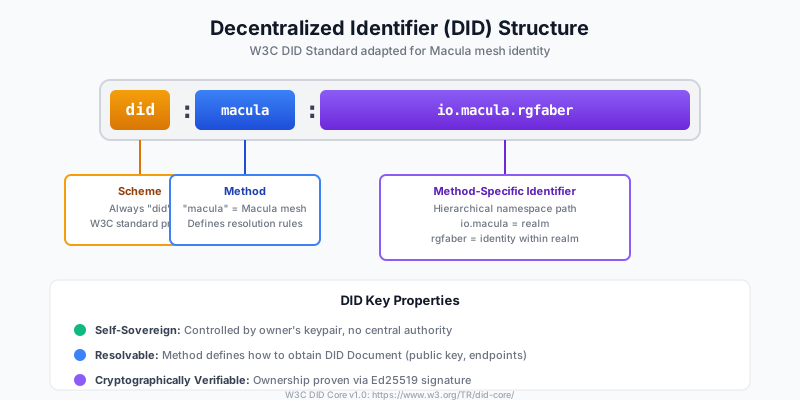
did:macula:io.macula.rgfaber
|   |      +------------------ Method-specific identifier (namespace)
|   +-------------------------- Method (macula)
+------------------------------- Scheme (always "did")
Key Properties:
| Property | Description |
|---|---|
| Self-sovereign | Controlled by owner's Ed25519 keypair |
| Human-readable | Hierarchical namespace format |
| Resolvable | Method defines how to obtain public key |
| Cryptographically verifiable | Ownership proven via signature |
DID Resolution
When a DID is encountered, Macula resolves it to extract:
- Method:
macula(defines resolution rules) - Identity:
io.macula.rgfaber(namespace path) - Parts:
["io", "macula", "rgfaber"](hierarchy) - Depth:
3(hierarchy level)
The macula_did_cache module provides high-performance caching using Erlang's persistent_term:
%% Parse and cache a DID (or retrieve from cache)
{ok, Parsed} = macula_did_cache:get_or_parse(<<"did:macula:io.macula.rgfaber">>).
%% => {ok, #{<<"method">> => <<"macula">>,
%%           <<"identity">> => <<"io.macula.rgfaber">>,
%%           <<"parts">> => [<<"io">>, <<"macula">>, <<"rgfaber">>],
%% <<"depth">> => 3}}Performance: persistent_term provides O(1) lookups with zero garbage collection impact, making it ideal for frequently-accessed identity data.
DID to Common Name Conversion
%% DID to CN (reverse the parts)
CN = macula_cert:did_to_cn(<<"did:macula:io.example.org.app.node01">>).
%% Result: <<"app.node01.io.example.org">>

%% CN to DID
DID = macula_cert:cn_to_did(<<"app.node01.io.example.org">>).
%% Result: <<"did:macula:io.example.org.app.node01">>
Further Reading:
User Controlled Authorization Networks (UCANs)
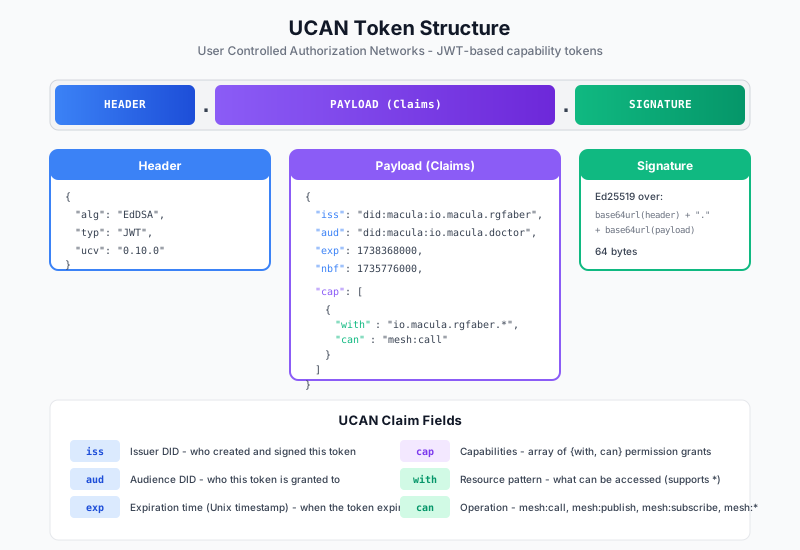
UCAN (User Controlled Authorization Networks) is a capability-based authorization system built on JWT (JSON Web Tokens). UCANs enable delegation chains where permissions can be granted and re-delegated without involving a central authority.
UCAN Token Structure
A UCAN is a JWT with specific claims:
| Claim | Description |
|---|---|
iss | Issuer DID - Who created and signed this token |
aud | Audience DID - Who this token is granted to |
exp | Expiration - Unix timestamp when token expires |
nbf | Not Before - Token valid only after this time |
cap | Capabilities - Array of permission grants |
prf | Proofs - Chain of parent UCANs (for delegation) |
Capability Format
Capabilities define what actions are permitted on which resources:
#{
    <<"with">> => <<"io.macula.rgfaber.*">>,   % Resource pattern
    <<"can">> => <<"mesh:call">>               % Operation
}
Supported Operations:
| Operation | Description |
|---|---|
mesh:call | RPC procedure invocation |
mesh:publish | Publish to topic |
mesh:subscribe | Subscribe to topic |
mesh:* | All mesh operations |
Wildcards:
io.macula.rgfaber.*matches any resource in namespacemesh:*matches any mesh operation
Delegation Chains
UCANs support attenuated delegation: permissions can be re-delegated but only with equal or narrower scope.
Alice (owns io.macula.alice.*)
  |
  +---> grants Bob: mesh:call on io.macula.alice.api.*
        |
        +---> Bob grants Carol: mesh:call on io.macula.alice.api.read_only
              (valid - narrower scope)

        +---> Bob grants Dave: mesh:call on io.macula.alice.*
              (INVALID - broader than Bob received)
Further Reading:
Namespace Ownership Model
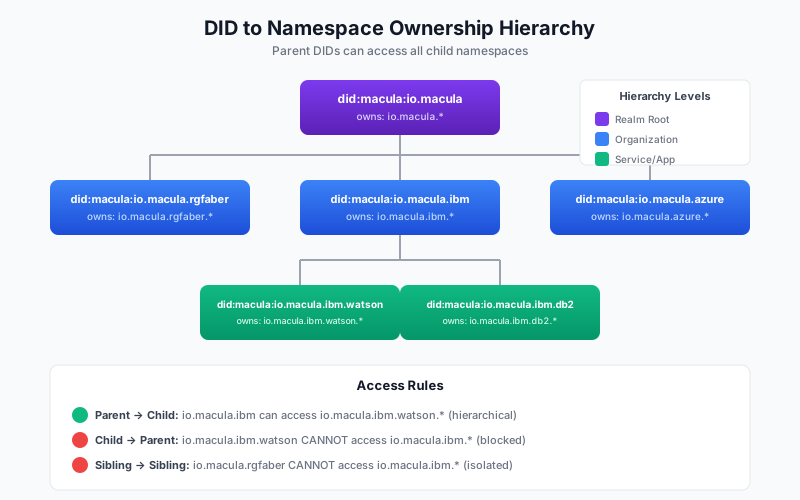
Macula uses a hierarchical namespace ownership model where DIDs map directly to namespaces they control:
DID to Namespace Mapping
DID                              Owns Namespace
-------------------------------  -----------------------------
did:macula:io.macula             io.macula.* (realm root)
did:macula:io.macula.rgfaber     io.macula.rgfaber.*
did:macula:io.macula.ibm         io.macula.ibm.*
did:macula:io.macula.ibm.watson  io.macula.ibm.watson.*
Hierarchical Access Rules
- Owner access: A DID can always access its own namespace
- Parent access: Parent DIDs can access child namespaces
- Sibling isolation: Siblings cannot access each other's namespaces
%% Examples
did:macula:io.macula.ibm         -> CAN access io.macula.ibm.watson.*
did:macula:io.macula.ibm.watson  -> CANNOT access io.macula.ibm.*
did:macula:io.macula.rgfaber     -> CANNOT access io.macula.ibm.*
Self-Sovereign Certificates
Macula uses Ed25519-based certificates anchored to DIDs, enabling identity without external certificate authorities.
Certificate Hierarchy
Realm Certificate (self-signed)
did:macula:io.customer.org
     |
     +-- Instance Certificate (signed by realm)
     |   did:macula:io.customer.org.app1.node01
     |
     +-- Instance Certificate (signed by realm)
     |   did:macula:io.customer.org.app1.node02
     |
     +-- Instance Certificate (signed by realm)
         did:macula:io.customer.org.app2.node01
Certificate Structure
#{
    subject => #{
        did => <<"did:macula:io.customer.org.app.node01">>,
        common_name => <<"app.node01.io.customer.org">>
    },
    issuer => #{
        did => <<"did:macula:io.customer.org">>,
        common_name => <<"io.customer.org">>
    },
    not_before => 1704067200,
    not_after => 1735689600,
    public_key => <<...>>,   %% Ed25519 (32 bytes)
    signature => <<...>>     %% Ed25519 (64 bytes)
}
Certificate API
Generate Keypair
{PubKey, PrivKey} = macula_cert:generate_keypair().
%% PubKey: 32 bytes, PrivKey: 64 bytes (seed + public key)
Create Realm Certificate (Self-Signed)
RealmDID = <<"did:macula:io.example.org">>,
{PubKey, PrivKey} = macula_cert:generate_keypair(),

{ok, RealmCert} = macula_cert:generate_realm_cert(RealmDID, PubKey, PrivKey).

%% Or with custom validity
{ok, RealmCert} = macula_cert:generate_realm_cert(RealmDID, PubKey, PrivKey, 365).
Create Instance Certificate (Signed by Realm)
InstanceDID = <<"did:macula:io.example.org.app.node01">>,
{InstancePubKey, _} = macula_cert:generate_keypair(),

{ok, InstanceCert} = macula_cert:generate_instance_cert(
    InstanceDID, InstancePubKey, RealmCert, RealmPrivKey
).

%% Or with custom validity (90 days)
{ok, InstanceCert} = macula_cert:generate_instance_cert(
    InstanceDID, InstancePubKey, RealmCert, RealmPrivKey, 90
).
Verify Certificates
ok = macula_cert:verify_self_signed(RealmCert).
ok = macula_cert:verify_cert(InstanceCert, RealmCert).
true = macula_cert:is_valid_now(InstanceCert).
Encode/Decode
{ok, Binary} = macula_cert:encode(Cert).
{ok, Cert} = macula_cert:decode(Binary).
Map = macula_cert:to_map(Cert).
{ok, Cert} = macula_cert:from_map(Map).
Trust Store
The trust store manages trusted realm certificates.
{ok, _Pid} = macula_trust_store:start_link().

%% Add a trusted realm
ok = macula_trust_store:add_trusted_realm(RealmDID, RealmCert).

%% Verify instance cert chains back to a trusted realm
ok = macula_trust_store:verify_instance_cert(InstanceCert).

%% Query trust store
true = macula_trust_store:is_trusted(RealmDID).
{ok, RealmCert} = macula_trust_store:get_realm_cert(RealmDID).
TrustedRealms = macula_trust_store:list_trusted().
Certificate Security Considerations
- Private keys should never leave the generating node
- Instance certificates should have shorter validity (30-90 days)
- Realm certificates can have longer validity (1-5 years)
- Implement automatic renewal before expiration
| Aspect | Self-Sovereign | Traditional PKI |
|---|---|---|
| Trust root | Realm certificate | External CA |
| Issuance | Instant, local | Requires CA interaction |
| Cost | Free | Often paid |
| Privacy | No third party | CA sees all certs |
| Revocation | Limited | CRL/OCSP |
| Interop | Macula ecosystem | Web browsers, etc. |
UCAN-Based Licensing
Macula uses UCAN tokens for software licensing in the marketplace, providing decentralized, capability-based license management.
License Models
| Model | Description | UCAN Configuration |
|---|---|---|
| Free | No restrictions | Auto-granted, no expiration |
| Trial | Time-limited evaluation | Short exp (14-30 days) |
| Perpetual | One-time purchase | No expiration |
| Subscription | Recurring payment | exp set to subscription end |
| Per-seat | Limited installations | nb.max_nodes claim |
License Token Structure
{
  "iss": "did:macula:io.publisher.org",
  "aud": "did:macula:io.customer.org",
  "exp": 1735689600,
  "nbf": 1704067200,
  "att": [
    {
      "with": "did:macula:io.publisher.org/app/my_app",
      "can": "artifact/run"
    },
    {
      "with": "did:macula:io.publisher.org/app/my_app",
      "can": "artifact/update"
    }
  ],
  "fct": {
    "license_model": "subscription",
    "max_nodes": 5
  }
}
License Capability Types
| Capability | Description |
|---|---|
artifact/run | Permission to run the application |
artifact/update | Permission to update to new versions |
artifact/install | Permission to install the application |
License Validation
case bc_gitops_license:validate(LicenseSpec, #{app_name => Name}) of
    ok -> deploy(AppSpec);
    {warning, expiring_soon} -> log_warning("License expiring soon"), deploy(AppSpec);
    {error, expired} -> {error, {license_validation_failed, expired}};
    {error, invalid_signature} -> {error, {license_validation_failed, invalid_signature}};
    {error, node_limit_exceeded} -> {error, {license_validation_failed, node_limit_exceeded}}
end.
License Procurement Flows
Free Applications: User installs, UCAN auto-granted with no expiration.
Trial Applications: User starts trial, UCAN generated with 14-day expiration.
Paid Applications: User installs, payment required, publisher issues UCAN after payment, user retries install.
License Renewal
- User/system requests renewal from publisher
- Payment processed (if subscription)
- Publisher issues new UCAN with extended expiration
- Update app.config with new UCAN
- bc-gitops reconciles with new license
Authorization Flow
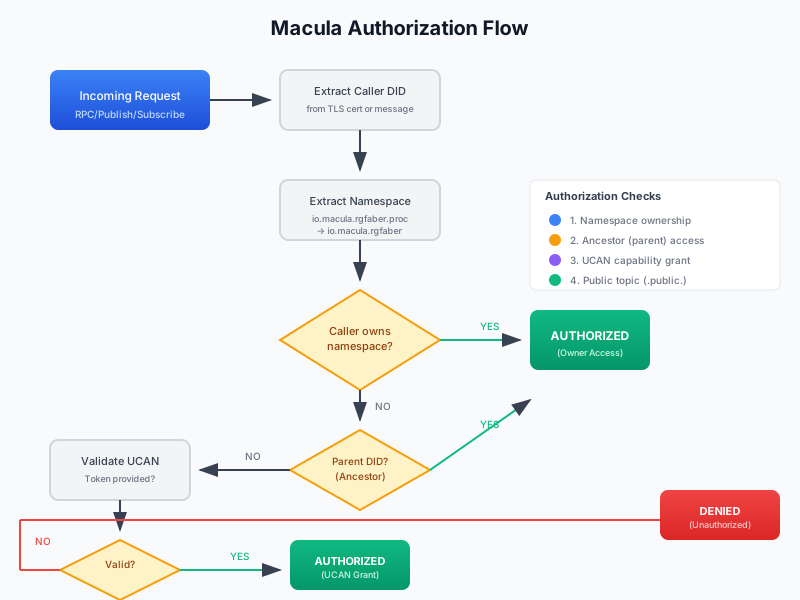
When a mesh operation (RPC call, publish, subscribe) is requested, Macula follows this authorization flow:
Step 1: Extract Caller DID
The caller's DID is extracted from:
- TLS Certificate SAN (Subject Alternative Name URI field)
- Message Header (for explicit caller identification)
Step 2: Extract Namespace
The namespace is derived from the topic/procedure:
io.macula.rgfaber.place_order -> io.macula.rgfaberStep 3: Check Ownership
case macula_authorization:check_namespace_ownership(CallerDID, Namespace) of
    {ok, owner} -> authorized;
    {ok, ancestor} -> authorized;
    {error, not_owner} -> check_ucan()
end.
Step 4: Validate UCAN (if needed)
If the caller doesn't own the namespace, a valid UCAN token is required:
case macula_authorization:validate_ucan_for_operation(UcanToken, CallerDID, Resource, Operation) of
    {ok, authorized} -> proceed;
    {error, Reason} -> deny
end.
Public Topics
Topics containing .public. are world-readable without ownership or UCAN:
io.macula.rgfaber.public.announcements  -> Anyone can subscribe
io.macula.public.news -> Anyone can subscribeNote: Publishing to public topics still requires ownership or a valid UCAN grant.
Revocation
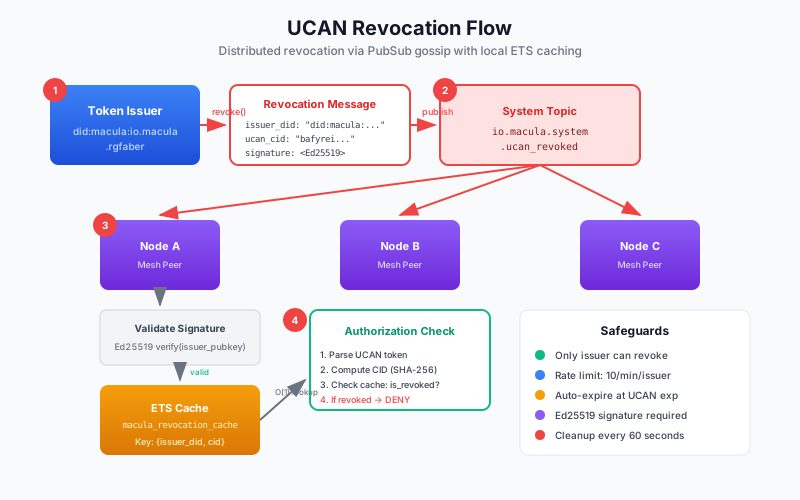
UCANs can be revoked before expiration using the revocation system:
Revocation Process
- Issuer initiates: Only the token issuer can revoke
- Compute CID: SHA-256 hash of the UCAN, base64url encoded
- Sign revocation: Ed25519 signature proves issuer authority
- Broadcast: Published to
io.macula.system.ucan_revokedtopic - Cache locally: Each node stores in ETS with TTL
Safeguards
| Safeguard | Implementation |
|---|---|
| Issuer-only | Signature validated against issuer's public key |
| Rate limiting | Max 10 revocations per issuer per minute |
| Auto-expiry | Revocation cached until original UCAN exp time |
| Ed25519 required | 64-byte signature format enforced |
Revocation API
{ok, CID} = macula_ucan_revocation:revoke(IssuerDID, UcanToken, ExpiresAt).
true = macula_ucan_revocation:is_revoked(IssuerDID, CID).
Audit Logging
All authorization decisions are logged via the audit system:
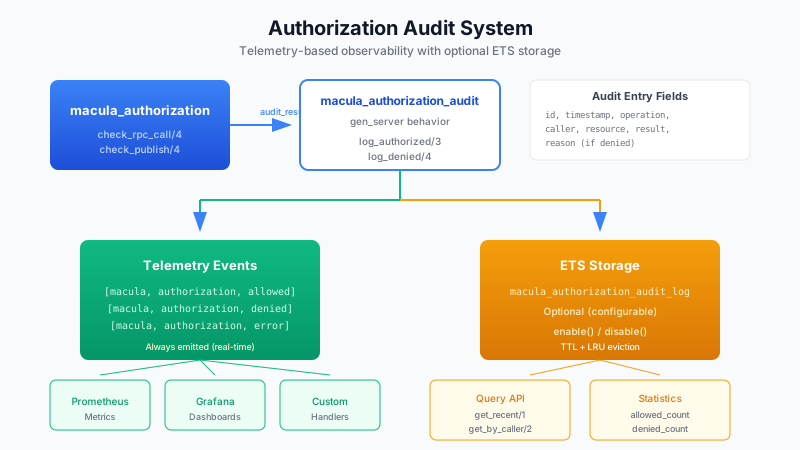
Telemetry Events
| Event | Description |
|---|---|
[macula, authorization, allowed] | Authorization succeeded |
[macula, authorization, denied] | Authorization denied |
[macula, authorization, error] | Authorization check failed |
Event Metadata
#{
    operation => call | publish | subscribe | announce,
    caller => <<"did:macula:io.macula.rgfaber">>,
    resource => <<"io.macula.other.service">>,
    timestamp => 1704672000,
    reason => unauthorized | invalid_ucan | expired_ucan | ...
}
ETS Storage (Optional)
macula_authorization_audit:enable().
macula_authorization_audit:disable().
Entries = macula_authorization_audit:get_recent(100).
CallerEntries = macula_authorization_audit:get_by_caller(CallerDID, 50).
Stats = macula_authorization_audit:get_stats().
LRU Eviction
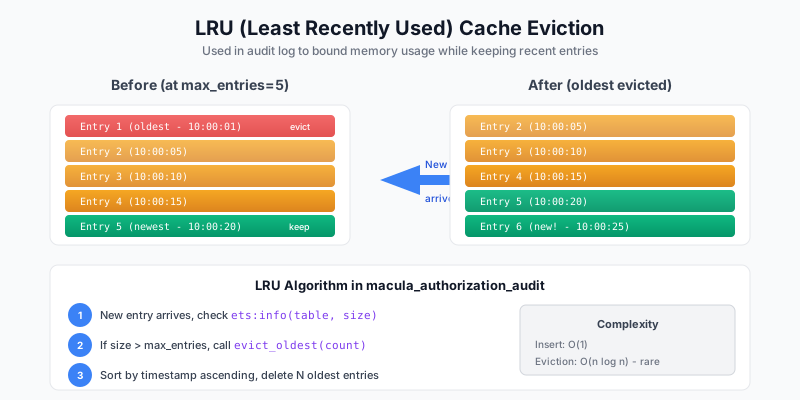
When the log exceeds max_entries, the oldest entries (by timestamp) are evicted, ensuring bounded memory usage while retaining the most recent authorization decisions.
macula_authorization_audit:set_max_entries(5000).
macula_authorization_audit:set_retention(7200).
API Reference
Core Authorization
macula_authorization:check_rpc_call(CallerDID, Procedure, UcanToken, Opts).
macula_authorization:check_publish(CallerDID, Topic, UcanToken, Opts).
macula_authorization:check_subscribe(CallerDID, Topic, Opts).
macula_authorization:check_subscribe(CallerDID, Topic, UcanToken, Opts).
macula_authorization:check_announce(CallerDID, Procedure, Opts).
Namespace Operations
macula_authorization:extract_namespace(<<"io.macula.rgfaber.service">>).
macula_authorization:check_namespace_ownership(CallerDID, Namespace).
macula_authorization:is_public_topic(<<"io.macula.rgfaber.public.news">>).
DID Cache
macula_did_cache:get_or_parse(DID).
macula_did_cache:invalidate(DID).
macula_did_cache:clear().
macula_did_cache:cache_size().
UCAN Revocation
{ok, Pid} = macula_ucan_revocation:start_link().
{ok, CID} = macula_ucan_revocation:revoke(IssuerDID, UcanToken, ExpiresAt).
macula_ucan_revocation:is_revoked(IssuerDID, CID).
macula_ucan_revocation:get_stats().
Audit Logging
{ok, Pid} = macula_authorization_audit:start_link().
macula_authorization_audit:log_authorized(Operation, CallerDID, Resource).
macula_authorization_audit:log_denied(Operation, CallerDID, Resource, Reason).
macula_authorization_audit:get_recent(Limit).
macula_authorization_audit:get_by_caller(CallerDID, Limit).
macula_authorization_audit:get_by_resource(Resource, Limit).
macula_authorization_audit:enable().
macula_authorization_audit:disable().
macula_authorization_audit:set_max_entries(N).
macula_authorization_audit:set_retention(Seconds).
Best Practices
Token Lifetime Guidelines
| Use Case | Recommended Lifetime |
|---|---|
| API calls | 1-24 hours |
| Treatment periods | Days to weeks |
| Long-term partnerships | Months (narrow scope) |
| Sensitive operations | Always short |
| Trial licenses | 14-30 days |
| Subscription licenses | Match billing period |
Security Recommendations
- Use short-lived tokens for sensitive operations
- Narrow capability scope - grant only what's needed
- Monitor audit logs for unusual patterns
- Enable telemetry for real-time observability
- Revoke promptly when relationships end
- Store UCAN tokens securely (encrypted at rest, treat as credentials)
- Always verify Ed25519 signatures on license tokens
- Protect private keys - never leave the generating node
Performance Tips
- DID cache handles repeated lookups efficiently
- Ownership check first - faster than UCAN validation
- ETS audit storage can be disabled in production
- Telemetry handlers should be non-blocking
Glossary
| Term | Definition |
|---|---|
| DID | Decentralized Identifier - globally unique, self-sovereign identity |
| UCAN | User Controlled Authorization Network - capability-based auth token |
| Capability | Permission grant with resource and operation |
| Namespace | Hierarchical identifier path (e.g., io.macula.rgfaber) |
| CID | Content Identifier - cryptographic hash of content |
| LRU | Least Recently Used - cache eviction strategy |
| Ed25519 | Elliptic curve signature algorithm |
| Realm Certificate | Self-signed root certificate for a Macula realm |
| Instance Certificate | Certificate signed by a realm certificate for a specific node |
| Trust Store | Local store of trusted realm certificates |
References
Standards
- W3C DID Core 1.0 - Decentralized Identifiers specification
- UCAN Specification - User Controlled Authorization Networks
- RFC 7519 - JWT - JSON Web Token specification
- RFC 8032 - Ed25519 - Edwards-Curve Digital Signature Algorithm
Academic Papers
- Sporny, M., et al. (2022). Decentralized Identifiers (DIDs) v1.0. W3C Recommendation.
- Zelenka, B. (2021). UCAN: Trustless, Server-Free Authorization. Fission.
- Bernstein, D.J., et al. (2012). High-speed high-security signatures. Journal of Cryptographic Engineering.
Implementation Resources
- persistent_term Documentation - Erlang cache module
- ETS Documentation - Erlang Term Storage
- Telemetry Documentation - Observability library
Related Guides
- Clustering Guide - Using certificates in clusters
- MRI Guide - Resource identifiers for authorization scoping