Kademlia DHT Architecture in Macula
View SourceOverview
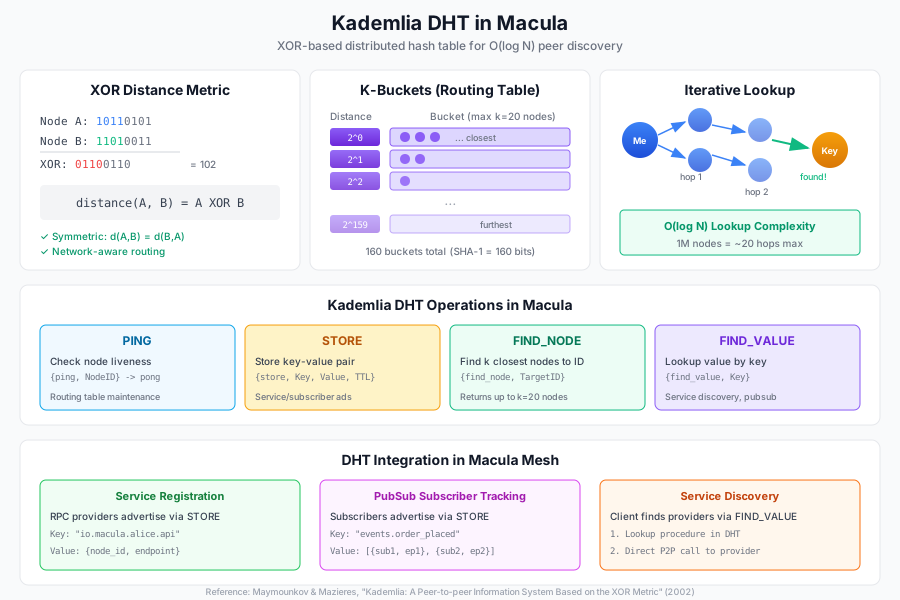
Macula uses a Kademlia Distributed Hash Table (DHT) for decentralized service discovery and peer-to-peer routing. This document describes how Kademlia principles are implemented in the HTTP/3 mesh network.
Key Reference: Kademlia: A Peer-to-peer Information System Based on the XOR Metric (Maymounkov & Mazières, 2002)
Why Kademlia?
Traditional DHTs (like Chord) use numeric distance metrics that don't align well with network topology. Kademlia's XOR-based metric provides:
- Symmetric distance -
distance(A, B) = distance(B, A) - Network-aware routing - Nodes sharing common prefixes tend to be routed through similar paths
- O(log N) lookup complexity - Efficient even with millions of nodes
- Self-organizing - No central coordination required
- NAT-friendly - Works well with HTTP/3's connection-oriented transport
Core Concepts
1. Node IDs and XOR Metric
Every node in the Macula mesh has a 160-bit Node ID derived from:
- Hash of (realm + peer_id) for deterministic addressing
- Or randomly generated via
crypto:strong_rand_bytes(32)on startup
Note: Since v0.8.5, all nodes have identical capabilities. The terms "Gateway mode" and "Edge peer mode" are deprecated.
XOR Distance Formula:
distance(A, B) = A ⊕ B (bitwise XOR)Example:
Node A: 0b10110101
Node B: 0b11010011
-------
XOR:    0b01100110  (distance = 102 decimal)
Nodes are considered "closer" when their XOR distance is smaller. This creates a geometric address space where routing naturally follows network topology.
2. K-Buckets (Routing Table)
Each node maintains a routing table of 160 k-buckets, where k = 20 (typical value).
Structure:
- Bucket 0: Nodes at distance
2^0to2^1 - 1(immediate neighbors) - Bucket 1: Nodes at distance
2^1to2^2 - 1 - Bucket i: Nodes at distance
2^ito2^(i+1) - 1 - Bucket 159: Nodes at distance
2^159to2^160 - 1(furthest)
K-Bucket Properties:
- Maximum of
kentries per bucket - Least-recently-seen nodes are evicted first (LRU)
- Bucket 0 (closest nodes) is most important for routing
Macula Implementation:
%% In macula_routing.erl (conceptual)
-define(KADEMLIA_K, 20).          %% Bucket size
-define(KADEMLIA_ALPHA, 3).       %% Parallel lookup factor
-define(ID_BITS, 160).            %% SHA-1 hash size

-record(k_bucket, {
    distance_range :: {integer(), integer()},
    nodes :: [node_entry()],       %% Max 20 entries
    last_updated :: erlang:timestamp()
}).
3. DHT Operations
Kademlia defines four core RPC operations:
PING
Purpose: Check if a node is alive
Request:
{ping, FromNodeID, Timestamp}Response:
{pong, ToNodeID, Timestamp}Use Case: Health checking, routing table maintenance
STORE
Purpose: Store a key-value pair on a node
Request:
{store, Key, Value, TTL}Response:
{stored, Key, ExpiresAt}Macula Mapping:
- Key: Service name hash (e.g.,
sha1("game.matchmaking")) - Value: Service endpoint info (realm, node_id, capabilities)
- TTL: Advertisement lifetime (default: 5 minutes)
FIND_NODE
Purpose: Locate k closest nodes to a target ID
Request:
{find_node, TargetID, K}Response:
{nodes, [
    {NodeID1, IP1, Port1, Realm1},
    {NodeID2, IP2, Port2, Realm2},
    ...
]} %% Sorted by XOR distance to TargetID
Use Case: Populating routing table, iterative lookups
FIND_VALUE
Purpose: Retrieve value for a key (service discovery)
Request:
{find_value, Key}Response (if found):
{value, Key, ServiceInfo}Response (if not found):
{nodes, [...]} %% Fallback to FIND_NODEMacula Mapping:
- Key: Service name (e.g.,
"game.matchmaking") - ServiceInfo: List of providers advertising that service
4. Iterative Lookup Algorithm
To find a service or node, Macula performs an iterative FIND_VALUE lookup:
Algorithm:
- Start with the
α = 3closest nodes from local routing table - Send parallel
FIND_VALUErequests to these nodes - If value found → return immediately
- Otherwise, add returned nodes to candidate set
- Select next
αclosest unqueried nodes - Repeat until:
- Value is found, OR
- No closer nodes remain, OR
- Maximum hops reached (log₂N)
Convergence: Guaranteed to find value in O(log N) hops
Macula Implementation (conceptual):
find_service(ServiceName, Realm) ->
    Key = crypto:hash(sha, ServiceName),
    ClosestNodes = get_closest_nodes(Key, ?KADEMLIA_ALPHA),
    iterative_lookup(Key, ClosestNodes, #{}, 0).

iterative_lookup(Key, [], _Queried, _Hops) ->
    {error, not_found};
iterative_lookup(Key, Candidates, Queried, Hops) when Hops > 20 ->
    {error, max_hops_exceeded};
iterative_lookup(Key, Candidates, Queried, Hops) ->
    %% Query α closest unqueried nodes in parallel
    Results = query_nodes(Candidates, {find_value, Key}),

    case find_value_in_results(Results) of
        {ok, Value} ->
            {ok, Value};
        not_found ->
            NewNodes = extract_nodes(Results),
            NextCandidates = select_closest_unqueried(Key, NewNodes, Queried),
            iterative_lookup(Key, NextCandidates,
                           maps:merge(Queried, mark_queried(Candidates)),
                           Hops + 1)
    end.
Macula-Specific Adaptations
1. Realm-Scoped DHT
Unlike traditional Kademlia, Macula implements multi-tenancy via realms:
- Each realm has its own isolated DHT keyspace
- Node IDs include realm hash:
sha1(Realm || IP || Port) - Service keys are realm-scoped:
sha1(Realm || ServiceName) - Cross-realm queries are blocked at protocol level
Example:
%% Realm "macula.arcade"
NodeID_A = sha1("macula.arcade" ++ "192.168.1.10" ++ "4433")

%% Realm "macula.energy"
NodeID_B = sha1("macula.energy" ++ "192.168.1.10" ++ "4433")

%% Same IP/port, different realms → different DHT partitions
2. Seed Nodes (Bootstrap)
Traditional Kademlia requires bootstrap nodes to join the network. Macula uses seed nodes:
All Nodes Are Equal (v0.8.5+):
- Any node can serve as a seed node for new peers
- Seed nodes are configured via
MACULA_BOOTSTRAP_REGISTRYenv var - Published at predictable URLs (e.g.,
https://seed.example.com:4433)
Joining Process:
- New peer connects to seed node
- Seed returns
αclosest nodes to peer's ID - Peer populates routing table via
FIND_NODErequests
No Hardcoded Bootstrap IPs: Unlike BitTorrent DHT, Macula uses DNS/HTTPS URLs for seed discovery, making it firewall-friendly.
Note: The terms "Gateway mode" and "Edge peer mode" are deprecated since v0.8.5. All nodes have identical capabilities.
3. Service Advertisement TTL
Services are stored in the DHT with a Time-To-Live (TTL):
- Default TTL: 5 minutes
- Providers re-advertise every 60 seconds (heartbeat)
- Expired entries are removed by
macula_advertisement_manager
Rationale: Short TTL ensures stale services don't linger after node crashes, while frequent heartbeats maintain availability.
4. HTTP/3 Transport Integration
Traditional Kademlia uses UDP for RPCs. Macula uses QUIC (HTTP/3):
Advantages:
- Reliable transport (no packet loss issues)
- Connection multiplexing (multiple RPCs over one connection)
- TLS 1.3 encryption (secure by default)
- NAT traversal (QUIC connection migration)
Message Encoding:
%% DHT query wrapped in Macula protocol
#{
  type => dht_query,
  operation => find_value,
  key => <<ServiceNameHash:160>>,
  realm => <<"macula.arcade">>,
  from_node_id => <<SenderNodeID:160>>,
  timestamp => erlang:system_time(millisecond)
}
Routing Table Maintenance
Macula keeps routing tables fresh through active probing:
1. Passive Updates
- When receiving any message from node N, refresh N's entry in k-bucket
- Update last-seen timestamp
- Move N to tail of LRU list (most recently seen)
2. Active Probing
- Every 60 seconds, ping least-recently-seen node in each non-empty bucket
- If ping fails 3 times consecutively, evict node
- Backfill bucket via
FIND_NODErequest
3. Bucket Splitting
- When bucket 0 (closest nodes) exceeds
kentries, split into two buckets - Move nodes to new buckets based on refined distance ranges
- Only split buckets containing own node ID (hot zone)
Implementation:
%% In macula_routing.erl
-define(REFRESH_INTERVAL, 60000).  %% 60 seconds
-define(PING_TIMEOUT, 5000).       %% 5 seconds
-define(MAX_FAILURES, 3).

refresh_buckets(State) ->
    lists:foldl(fun refresh_bucket/2, State, State#state.k_buckets).

refresh_bucket(Bucket, State) ->
    case get_least_recent_node(Bucket) of
        undefined -> State;  %% Empty bucket
        Node ->
            case ping_node(Node) of
                pong -> update_node_timestamp(Node, State);
                timeout -> handle_ping_failure(Node, State)
            end
    end.
Performance Characteristics
| Metric | Value | Notes |
|---|---|---|
| Lookup Time | O(log N) hops | N = total nodes in mesh |
| Routing Table Size | O(log N) entries | ~160 buckets × 20 nodes = 3,200 max |
| Network Traffic | O(log N) messages/lookup | α parallel requests per hop |
| Storage | O(k × log N) | Per node, for advertised services |
| Convergence | < 1 second | Typical for 10,000-node network |
Example (10,000-node network):
- Expected hops:
log₂(10,000) ≈ 13.3→ 14 hops max - Parallel factor α = 3 → ~5 rounds of queries
- Average lookup time:
5 rounds × 100ms RTT = 500ms
Comparison to Other DHTs
| Feature | Kademlia (Macula) | Chord | Pastry |
|---|---|---|---|
| Distance Metric | XOR (symmetric) | Modular arithmetic | Numeric proximity |
| Routing Complexity | O(log N) | O(log N) | O(log N) |
| Lookup Parallelism | Yes (α = 3) | No (sequential) | Limited |
| NAT-Friendly | ✅ (with HTTP/3) | ❌ | ❌ |
| Bootstrap Required | Optional (gateway) | Yes | Yes |
| Self-Organizing | ✅ | ✅ | ✅ |
Future Enhancements
1. S/Kademlia (Secure Kademlia)
- Cryptographic node ID generation (prevent Sybil attacks)
- Require nodes to solve proof-of-work for ID assignment
- Disjoint routing paths for redundancy
2. DHT Persistence
- Store service advertisements in distributed database (e.g., CRDT)
- Survive network partitions with eventual consistency
- Reduce re-advertisement overhead
3. Adaptive K-Bucket Sizing
- Dynamically adjust
kbased on network churn rate - Larger
kfor stable networks (less probing overhead) - Smaller
kfor high-churn networks (faster convergence)
References
- Kademlia Paper: Maymounkov & Mazières (2002)
- S/Kademlia: Baumgart & Mies (2007)
- BitTorrent DHT (BEP-0005): bittorrent.org/beps/bep_0005.html
- QUIC Protocol: RFC 9000
- Macula Architecture:
docs/QUIC_TLS_GATEWAY_SETUP.md
Last Updated: 2026-01-25 Macula Version: 0.20.2+ Status: ✅ Production-ready DHT implementation