NAT Types Explained
View SourceUnderstanding NAT (Network Address Translation) types is essential for building P2P applications that work across different network environments. This guide explains the NAT classification model used in Macula based on the NATCracker methodology.
Why NAT Matters for P2P
The challenge with P2P: Neither peer can initiate a connection to the other because NATs block unsolicited incoming traffic. Macula solves this by detecting NAT characteristics and choosing optimal traversal strategies.
NAT Policy Classification
Macula uses the NATCracker 3-policy classification model to characterize NAT behavior. Each NAT is described by three policies:
1. Mapping Policy (How NAT assigns external addresses)
| Policy | Code | Behavior | Prevalence |
|---|---|---|---|
| Endpoint-Independent | EI | Same external addr for all destinations | ~52% |
| Host-Dependent | HD | Different external addr per destination host | ~12% |
| Port-Dependent | PD | Different external addr per destination host:port | ~36% |
Example - Endpoint-Independent (EI):
Local: 192.168.1.10:5000
  -> Destination A: 8.8.8.8:53     => NAT maps to 203.0.113.5:40000
  -> Destination B: 1.1.1.1:53     => NAT maps to 203.0.113.5:40000  (same!)
Example - Port-Dependent (PD):
Local: 192.168.1.10:5000
  -> Destination A: 8.8.8.8:53     => NAT maps to 203.0.113.5:40000
  -> Destination B: 1.1.1.1:53     => NAT maps to 203.0.113.5:40001  (different!)
2. Filtering Policy (What incoming traffic NAT accepts)
| Policy | Code | Behavior | Security |
|---|---|---|---|
| Endpoint-Independent | EI | Accepts from any source | Low |
| Host-Dependent | HD | Accepts from hosts we've contacted | Medium |
| Port-Dependent | PD | Accepts from host:port we've contacted | High |
Example - Port-Dependent filtering:
Local 192.168.1.10:5000 sends to 8.8.8.8:53
NAT now accepts incoming on 203.0.113.5:40000 ONLY from 8.8.8.8:53
  -> 8.8.8.8:53     => ALLOWED
  -> 8.8.8.8:80     => BLOCKED (wrong port)
  -> 1.1.1.1:53     => BLOCKED (wrong host)
3. Allocation Policy (How NAT chooses external ports)
| Policy | Code | Behavior | Predictability |
|---|---|---|---|
| Port-Preservation | PP | external_port = local_port | High |
| Port-Contiguity | PC | external_port = last_port + delta | Medium |
| Random | RD | No predictable pattern | None |
Example - Port-Preservation (PP):
Local: 192.168.1.10:5000 => NAT: 203.0.113.5:5000 (same port!)Example - Port-Contiguity (PC):
Local: 192.168.1.10:5000  => NAT: 203.0.113.5:40000
Local: 192.168.1.10:5001  => NAT: 203.0.113.5:40001  (delta = 1)
Common NAT Type Combinations
Based on NATCracker research across millions of NATs:
| Type | Mapping | Filtering | Allocation | Prevalence | Direct P2P |
|---|---|---|---|---|---|
| Full Cone | EI | EI | PP | 15% | Yes |
| Restricted Cone | EI | HD | PP | 37% | With punch |
| Port Restricted | EI | PD | PP | 20% | With punch |
| Symmetric | PD | PD | RD | 12% | No (relay) |
| CGNAT | varies | PD | varies | 16% | Usually relay |
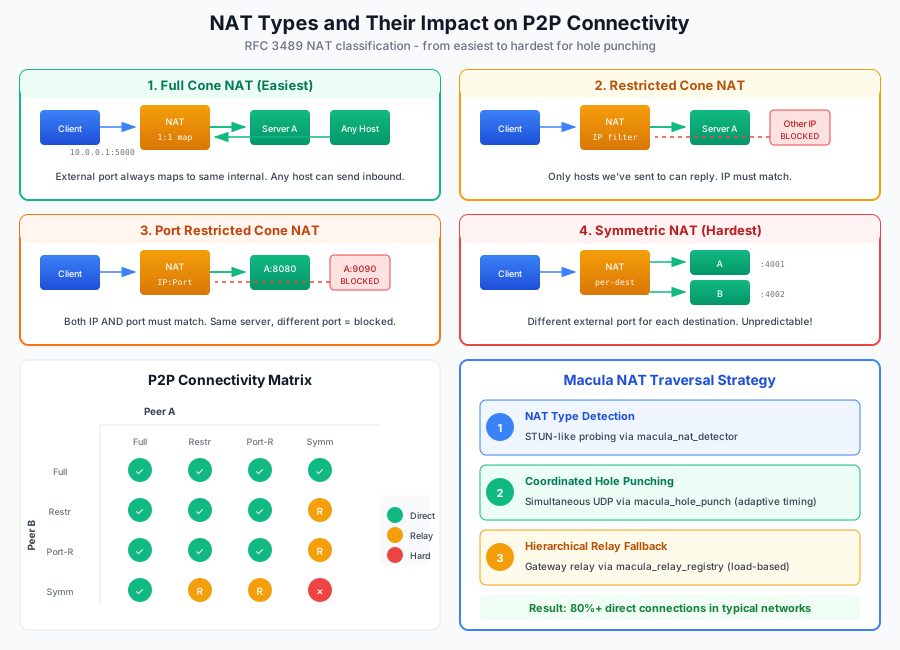
Full Cone NAT (EI, EI, PP) - Best Case
Any external host can send to this address after ANY outbound packet from local peer. Direct P2P: YES - Any peer can connect directly.
Restricted Cone NAT (EI, HD, PP) - Good
Only hosts we've contacted can send back (but from any port). Direct P2P: YES with hole punching.
Symmetric NAT (PD, PD, RD) - Worst Case
Each destination gets different external address. External port is random and unpredictable. Direct P2P: NO - must use relay.
NAT Detection in Macula
Macula detects NAT type automatically using macula_nat_detector:
%% Get local NAT profile
{ok, Profile} = macula_nat_detector:get_local_profile().

%% Profile contains:
#{
    mapping => ei,           % Endpoint-Independent
    filtering => pd,         % Port-Dependent
    allocation => pp,        % Port-Preservation
    public_ip => {203,0,113,5},
    public_port => 5000,
    detected_at => 1700000000
}
Detection Algorithm
Send NAT_PROBE to primary observer (gateway/public peer)
- Receive reflexive address (your public IP:port as seen from outside)
Send NAT_PROBE to secondary observer (different public peer)
- Compare reflexive addresses
Classification:
- Same address for both observers -> EI mapping
- Same IP, different port -> HD mapping
- Different IP -> PD mapping (or multiple NATs)
Connection Strategy Decision Tree
The diagram at the top of this document shows the connection strategy matrix. Macula's macula_nat_coordinator follows this logic:
- Either has public IP? → Direct connection to public peer
- Both have EI mapping? → Hole punching possible
- EI filtering → Simple hole punch
- PD filtering → Coordinated hole punch
- Either has PD+PD+RD (symmetric)? → Must use relay
- Otherwise → Try hole punch with port prediction
Hole Punching Explained
Hole punching creates NAT mappings that allow peers to communicate:
| Time | Event | Result |
|---|---|---|
| T0 | Initial state | Peer A and B have no mappings to each other |
| T1 | Coordinator signal | Both peers simultaneously send packets to each other's predicted external address |
| T2 | NAT processing | Both NATs create outbound mappings for the other peer's address |
| T3 | Connection established | Subsequent packets pass through created mappings |
Requirements for successful hole punch:
- Both NATs have EI or HD mapping (predictable external address)
- At least one has PP or PC allocation (predictable port)
- Timing coordination within ~100ms
CGNAT (Carrier-Grade NAT)
ISPs increasingly use CGNAT, adding another NAT layer:
| Layer | Address | Role |
|---|---|---|
| Your Device | 192.168.1.10 | Local network address |
| Home Router NAT | → 10.0.0.50 | ISP private address (RFC 1918) |
| CGNAT | → 203.0.113.5 | Public address (shared with other customers) |
| Internet | Global routing |
CGNAT complications:
- Multiple customers share same public IP
- Often uses PD filtering (restrictive)
- Hole punching success rate drops to ~40%
- Relay fallback frequently needed
Best Practices
For Application Developers
- Always have relay fallback - Some NATs cannot be traversed
- Detect NAT type early - Cache profile at peer startup
- Prefer EI-mapping peers as coordinators - Better success rate
For Network Operators
- Use Full Cone or Restricted Cone NAT - Best P2P compatibility
- Enable UPnP/NAT-PMP - Allows applications to request mappings
- Avoid Symmetric NAT - Breaks most P2P protocols
Further Reading
- RFC 5780 - NAT Behavior Discovery
- NATCracker Paper - 27 NAT type classification
See Also:
- NAT Traversal Developer Guide - API usage and code examples