Evolution Strategies Guide
View SourceThis guide explains the pluggable evolution strategy system in macula_neuroevolution. The system supports multiple evolution algorithms through a common behaviour interface, allowing you to choose the best approach for your problem.
Overview
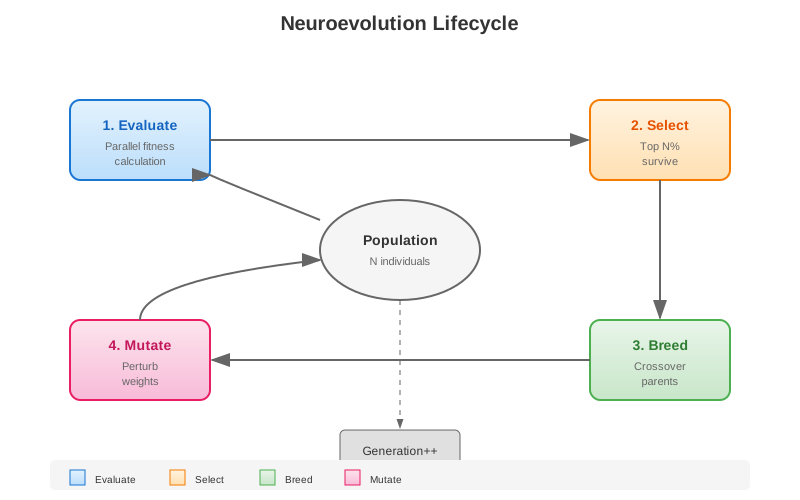
Evolution strategies determine how the population evolves over time. Different strategies have different characteristics:
| Strategy | Description | Best For |
|---|---|---|
generational_strategy | Classic generational GA | Simple problems, benchmarking |
steady_state_strategy | Continuous replacement | Real-time adaptation, online learning |
island_strategy | Parallel subpopulations | Complex fitness landscapes, diversity preservation |
novelty_strategy | Novelty search | Deceptive problems, exploration |
map_elites_strategy | MAP-Elites quality-diversity | Diverse solution discovery, coverage |
Quick Start
Using Generational Strategy (Default)
Config = #neuro_config{
    population_size = 50,
    evaluations_per_individual = 10,
    selection_ratio = 0.20,
    mutation_rate = 0.10,
    mutation_strength = 0.3,
    network_topology = {42, [16, 8], 6},
    evaluator_module = my_evaluator
    %% No strategy_config = uses generational_strategy by default
}.

{ok, Server} = neuroevolution_server:start_link(Config).
Using Steady-State Strategy
Config = #neuro_config{
    population_size = 50,
    network_topology = {42, [16, 8], 6},
    evaluator_module = my_evaluator,
    strategy_config = #strategy_config{
        strategy_module = steady_state_strategy,
        strategy_params = #{
            replacement_count => 2,      %% Replace 2 individuals per cycle
            victim_selection => worst,   %% Remove lowest fitness
            max_age => 100               %% Force replacement after 100 evals
        }
    }
}.
Using Island Strategy
Config = #neuro_config{
    population_size = 100,  %% Overridden by island settings
    network_topology = {42, [16, 8], 6},
    evaluator_module = my_evaluator,
    strategy_config = #strategy_config{
        strategy_module = island_strategy,
        strategy_params = #{
            island_count => 4,
            population_per_island => 25,
            migration_interval => 50,
            migration_count => 2,
            migration_selection => best,
            topology => ring,
            island_strategy => generational_strategy,
            island_strategy_params => #{
                selection_ratio => 0.3
            }
        }
    }
}.
Using Novelty Strategy
Config = #neuro_config{
    population_size = 50,
    network_topology = {42, [16, 8], 6},
    evaluator_module = my_evaluator,  %% Must return behavior descriptors
    strategy_config = #strategy_config{
        strategy_module = novelty_strategy,
        strategy_params = #{
            archive_size => 1000,        %% Max archive size
            archive_probability => 0.10, %% Chance to add to archive
            k_nearest => 15,             %% Neighbors for novelty calc
            include_fitness => false,    %% Pure novelty (no fitness)
            fitness_weight => 0.0        %% Ignored if include_fitness=false
        }
    }
}.
Using MAP-Elites Strategy
Config = #neuro_config{
    population_size = 100,  %% Not used - batch_size controls evaluation
    network_topology = {42, [16, 8], 6},
    evaluator_module = my_evaluator,  %% Must return behavior descriptors
    strategy_config = #strategy_config{
        strategy_module = map_elites_strategy,
        strategy_params = #{
            behavior_dimensions => 2,           %% 2D behavior space
            bins_per_dimension => 20,           %% 20x20 = 400 cells
            behavior_bounds => [{0.0, 1.0}, {0.0, 1.0}],
            batch_size => 10,                   %% Evaluations per iteration
            random_probability => 0.10,         %% 10% random, 90% from elites
            mutation_strength => 0.3
        }
    }
}.
Strategy Details
Generational Strategy
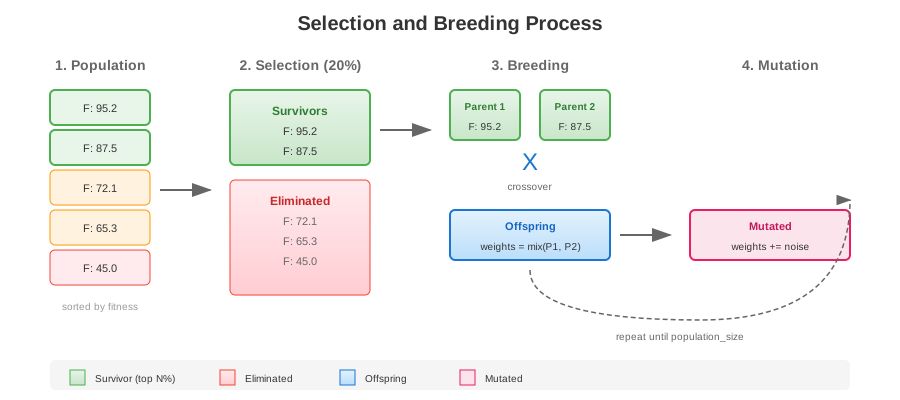
The classic genetic algorithm approach where the entire population is evaluated, then selection and breeding produce a new generation.
Parameters (via #generational_params{} or map):
| Parameter | Default | Description |
|---|---|---|
selection_method | top_n | top_n, tournament, or roulette |
selection_ratio | 0.20 | Fraction that survives (for top_n) |
tournament_size | 3 | Size for tournament selection |
mutation_rate | 0.10 | Probability of mutating each weight |
mutation_strength | 0.3 | Magnitude of weight perturbation |
crossover_rate | 0.75 | Probability of crossover vs mutation-only |
elitism | true | Preserve best individual unchanged |
elite_count | 1 | Number of elites to preserve |
Lifecycle Events:
individual_born- When offspring are createdindividual_died- When individuals are eliminatedindividual_evaluated- After each fitness evaluationcohort_evaluated- When all individuals in generation are evaluatedbreeding_complete- After selection and breeding
Best Practices:
- Use for problems where you can evaluate all individuals in parallel
- Good baseline for comparing other strategies
- Elitism prevents losing the best solution
Steady-State Strategy
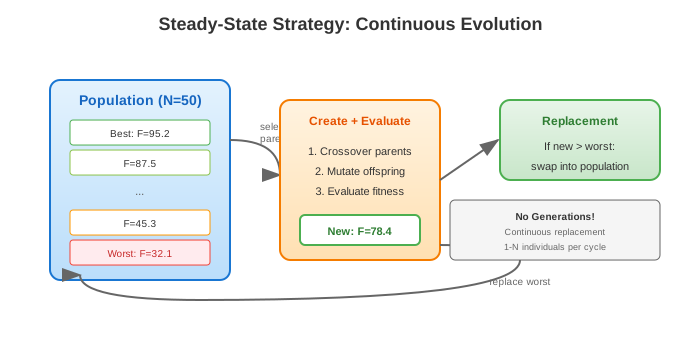
Continuous evolution where only 1-N individuals are replaced per cycle. No distinct generations - evolution is ongoing.
Parameters (via #steady_state_params{} or map):
| Parameter | Default | Description |
|---|---|---|
replacement_count | 1 | Individuals replaced per cycle |
parent_selection | tournament | tournament, fitness_proportional, random |
victim_selection | worst | worst, oldest, random, tournament |
tournament_size | 3 | Size for tournament selection |
mutation_rate | 0.10 | Probability of mutating each weight |
mutation_strength | 0.3 | Magnitude of weight perturbation |
max_age | 0 | Force replacement after N evals (0 = disabled) |
Lifecycle Events:
individual_born- When offspring are createdindividual_died- When victims are replacedindividual_evaluated- After each fitness evaluationsteady_state_replacement- When replacement cycle occurs
Best Practices:
- Use for real-time or online learning scenarios
- Good when evaluations are expensive (don't wait for whole generation)
max_ageprevents stagnation from old individuals
Island Strategy
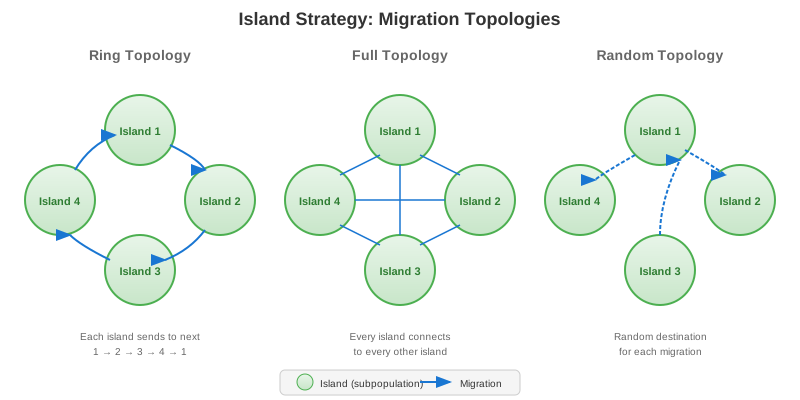
Meta-strategy that runs multiple isolated subpopulations with periodic migration. Maintains diversity and explores multiple fitness peaks.
Parameters (via #island_params{} or map):
| Parameter | Default | Description |
|---|---|---|
island_count | 4 | Number of islands |
population_per_island | 25 | Individuals per island |
migration_interval | 50 | Evaluations between migrations |
migration_count | 2 | Migrants per event |
migration_selection | best | best, random, diverse |
topology | ring | ring, full, random, custom |
custom_connections | [] | For custom topology |
island_strategy | generational_strategy | Sub-strategy module |
island_strategy_params | #{} | Sub-strategy parameters |
Migration Topologies:
ring- Each island sends to next (1→2→3→4→1)full- Every island can send to every otherrandom- Random destination for each migrationcustom- User-specified connections
Lifecycle Events:
- All sub-strategy events (tagged with
island_idin metadata) island_migration- When individuals migrate
Best Practices:
- Use for complex problems with multiple local optima
- Different islands can explore different regions of the fitness landscape
- Migration spreads good solutions while maintaining diversity
Novelty Strategy
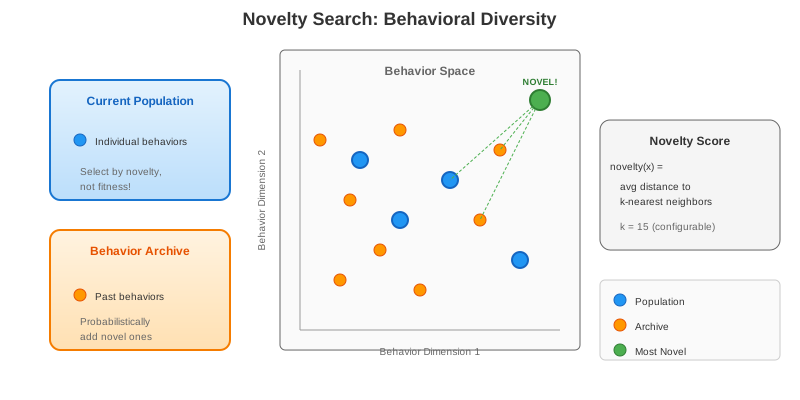
Novelty Search replaces fitness-based selection with novelty-based selection. Instead of selecting the fittest individuals, it selects those with the most novel behaviors - behaviors different from the current population and an archive of past behaviors.
Parameters (via #novelty_params{} or map):
| Parameter | Default | Description |
|---|---|---|
archive_size | 1000 | Maximum archive size |
archive_probability | 0.10 | Probability of adding to archive |
k_nearest | 15 | Neighbors for novelty calculation |
include_fitness | false | Enable hybrid mode |
fitness_weight | 0.0 | Fitness weight in hybrid mode (0-1) |
novelty_threshold | 0.0 | Minimum novelty for archive |
behavior_dimensions | undefined | Expected behavior vector size |
Behavior Descriptors:
The evaluator must return a behavior descriptor in the metrics:
#{fitness => 100.0, metrics => #{behavior => [1.0, 2.5, 3.7]}}The behavior vector characterizes what the individual did, not how well it did:
- For a maze robot: final (x, y) position
- For a game AI: action frequencies, states visited
- For neural networks: activation patterns
Lifecycle Events:
individual_born- When offspring are createdindividual_died- When individuals are eliminatedindividual_evaluated- After each evaluation (includes novelty score)cohort_evaluated- When all individuals evaluated
Best Practices:
- Use for deceptive problems where fitness gradients lead to local optima
- Behavior descriptors should capture meaningful behavioral differences
- Archive preserves behavioral diversity over time
- Hybrid mode (fitness_weight > 0) balances novelty and performance
MAP-Elites Strategy
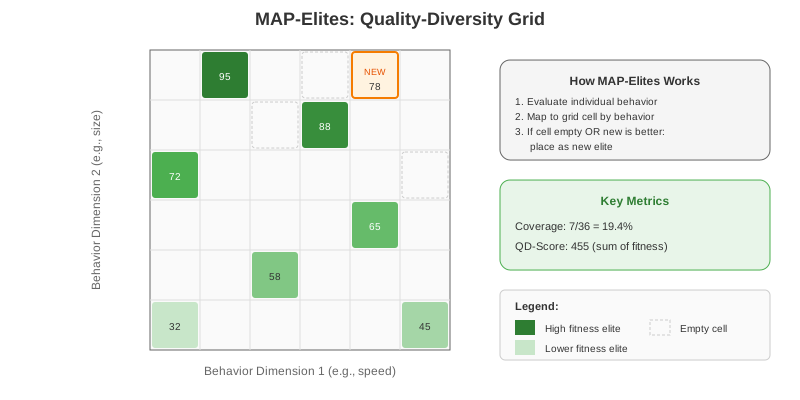
MAP-Elites is a quality-diversity algorithm that maintains a grid of elite solutions. Each cell corresponds to a region of behavior space and contains the highest-fitness individual whose behavior maps to that region.
Parameters (via #map_elites_params{} or map):
| Parameter | Default | Description |
|---|---|---|
behavior_dimensions | 2 | Number of behavior dimensions |
bins_per_dimension | 10 | Discretization resolution |
behavior_bounds | [] | Min/max for each dimension |
batch_size | 10 | Evaluations per iteration |
random_probability | 0.10 | Chance of random vs elite mutation |
mutation_rate | 0.10 | Probability of weight mutation |
mutation_strength | 0.3 | Magnitude of weight perturbation |
Behavior Space:
The grid divides behavior space into discrete cells:
behavior_dimensions = 2withbins_per_dimension = 10creates 100 cells- Each cell can hold one elite (the best individual for that behavior)
- Cells compete within their region, not globally
Key Metrics:
- Coverage: Fraction of cells occupied (diversity measure)
- QD-Score: Sum of all elite fitnesses (quality × diversity)
Lifecycle Events:
individual_born- When new individuals are generated or elites placedindividual_died- When individuals are rejected or replacedindividual_evaluated- After each evaluation
Best Practices:
- Use when you want diverse, high-quality solutions
- Behavior bounds should be set based on expected behavioral range
- Higher bins = finer granularity but slower coverage
- Random probability helps escape local behavioral patterns
Lifecycle Events
All strategies emit lifecycle events that can be subscribed to via neuroevolution_events:
%% Subscribe to events
Realm = <<"my-realm">>,
Topic = neuroevolution_events:events_topic(Realm),
ok = neuroevolution_events:subscribe(Topic),

%% Receive events
receive
    {neuro_event, Topic, Event} ->
        handle_event(Event)
end.
Universal Events (all strategies)
#individual_born{
    id :: individual_id(),
    parent_ids :: [individual_id()],
    origin :: initial | crossover | mutation | migration,
    timestamp :: timestamp(),
    metadata :: map()  %% May include island_id, generation, etc.
}.

#individual_died{
    id :: individual_id(),
    reason :: selection_pressure | age_limit | replacement | ...,
    final_fitness :: float(),
    timestamp :: timestamp(),
    metadata :: map()
}.

#individual_evaluated{
    id :: individual_id(),
    fitness :: float(),
    metrics :: map(),
    timestamp :: timestamp(),
    metadata :: map()
}.
Strategy-Specific Events
%% Generational
#cohort_evaluated{generation, best_fitness, avg_fitness, ...}.
#breeding_complete{generation, survivor_count, offspring_count, ...}.

%% Steady-State
#steady_state_replacement{replaced_ids, offspring_ids, best_fitness, ...}.

%% Island
#island_migration{individual_id, from_island, to_island, fitness, ...}.
Meta-Controller Integration
All strategies support the meta-controller interface for adaptive hyperparameter tuning:
%% Get normalized inputs (0-1 range) for meta-controller
Inputs = evolution_strategy:get_meta_inputs(Module, State).
%% Returns: [diversity, improvement_gap, mutation_rate, ...]

%% Apply parameter adjustments
NewState = evolution_strategy:apply_meta_params(Module, #{
    mutation_rate => 0.15,
    mutation_strength => 0.25
}, State).
Creating Custom Strategies
Implement the evolution_strategy behaviour:
-module(my_strategy).
-behaviour(evolution_strategy).

-export([
    init/1,
    handle_evaluation_result/3,
    tick/1,
    get_population_snapshot/1,
    get_meta_inputs/1,
    apply_meta_params/2,
    terminate/2
]).

init(Config) ->
    %% Initialize population and state
    %% Returns: {ok, State, [lifecycle_event()]}
    ...

handle_evaluation_result(IndividualId, FitnessResult, State) ->
    %% Process evaluation, update state, maybe breed
    %% Returns: {[action()], [event()], NewState}
    ...

tick(State) ->
    %% Periodic maintenance (age culling, etc.)
    %% Returns: {[action()], [event()], NewState}
    ...

get_population_snapshot(State) ->
    %% Return population_snapshot() map
    ...

get_meta_inputs(State) ->
    %% Return [float()] normalized inputs for meta-controller
    ...

apply_meta_params(MetaParams, State) ->
    %% Apply parameter updates, return new state
    ...

terminate(Reason, State) ->
    %% Cleanup
    ok.
Testing with Mock Networks
For unit testing without the full macula_tweann dependency, use mock_network_factory:
TestConfig = #{
    neuro_config => #neuro_config{...},
    strategy_params => #{...},
    network_factory => mock_network_factory  %% Use mock for testing
}.

{ok, State, Events} = generational_strategy:init(TestConfig).
The network_factory interface provides:
create_feedforward/1- Create new networkmutate/2- Mutate network weightscrossover/2- Crossover two networks
Performance Considerations
- Generational Strategy: Best when you can parallelize all evaluations
- Steady-State Strategy: Lower memory, better for expensive evaluations
- Island Strategy: Overhead from managing multiple sub-strategies, but better exploration
- Novelty Strategy: Archive operations add O(k*n) overhead per evaluation; good for exploration
- MAP-Elites Strategy: Memory scales with grid size (bins^dimensions); best for behavior space coverage
Further Reading
guides/meta-controller.md- Adaptive hyperparameter tuningguides/custom-evaluator.md- Creating fitness evaluatorsinclude/evolution_strategy.hrl- Type definitions and parameter recordsinclude/lifecycle_events.hrl- Event record definitions