Overview
View Sourcemacula_neuroevolution is an Erlang library that provides domain-agnostic population-based evolutionary training for neural networks. It works with macula_tweann to evolve network weights through selection, crossover, and mutation.
What is Neuroevolution?
Neuroevolution is a machine learning technique that uses evolutionary algorithms to train neural networks. Instead of gradient-based optimization (like backpropagation), neuroevolution:
- Maintains a population of neural networks
- Evaluates each network's fitness on a task
- Selects the best performers
- Creates new networks through crossover (combining parents) and mutation
- Repeats for many generations
This approach is particularly effective for:
- Reinforcement learning tasks where gradients are hard to compute
- Problems with sparse or delayed rewards
- Multi-objective optimization
- Evolving network topologies
Weight Evolution vs Topology Evolution
macula_neuroevolution currently provides weight evolution with fixed network topologies, while macula_tweann provides the full TWEANN (Topology and Weight Evolving) capabilities.
| Capability | macula_tweann | macula_neuroevolution |
|---|---|---|
| Weight mutation | Yes | Yes |
| Weight crossover | Yes | Yes |
| Add neuron | Yes | Planned |
| Add/remove connections | Yes | Planned |
| Activation function mutation | Yes | Planned |
| LTC parameter evolution | Yes | Planned |
The topology evolution operators in macula_tweann include:
add_neuron/1- Insert neuron into existing connectionadd_outlink/1- Add output connection from neuronadd_inlink/1- Add input connection to neuronoutsplice/1- Split output connection with new neuronadd_sensorlink/1,add_actuatorlink/1- Modify I/O connections
These operators follow the NEAT (NeuroEvolution of Augmenting Topologies) approach where networks start minimal and grow complexity over generations. The Liquid Conglomerate meta-controller could naturally extend to control topology evolution rates alongside weight mutation parameters.
See Topology Evolution Roadmap for future integration plans.
Architecture
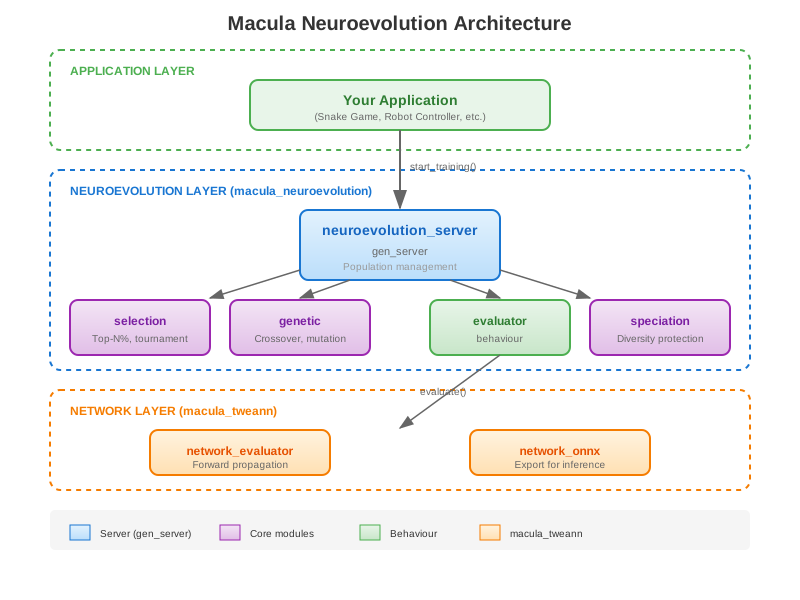
Key Components
Individual Record
Each individual in the population is represented by an #individual{} record:
#individual{
    id :: term(),                    % Unique identifier
    network :: network(),            % Neural network from macula_tweann
    parent1_id :: term() | undefined,% Lineage tracking
    parent2_id :: term() | undefined,
    fitness :: float(),              % Calculated fitness
    metrics :: map(),                % Domain-specific metrics
    generation_born :: pos_integer(),
    is_survivor :: boolean(),        % Survived selection
    is_offspring :: boolean()        % Created through breeding
}
Configuration
The #neuro_config{} record controls training behavior:
#neuro_config{
    population_size = 50,           % Number of individuals
    evaluations_per_individual = 10,% Evaluations per generation
    selection_ratio = 0.20,         % Top 20% survive
    mutation_rate = 0.10,           % 10% of weights mutated
    mutation_strength = 0.3,        % Mutation magnitude
    max_generations = infinity,     % When to stop
    network_topology = {42, [16, 8], 6}, % Network structure
    evaluator_module = my_evaluator,% Your evaluator
    evaluator_options = #{},        % Options for evaluator
    event_handler = undefined       % Optional event callback
}
Separation of Concerns
This library intentionally separates:
- Network operations (
macula_tweann) - Creating, evaluating, and modifying neural networks - Training orchestration (
macula_neuroevolution) - Population management, selection, breeding - Domain evaluation (your code) - Game/task-specific fitness calculation
This separation allows you to use the same training infrastructure for different domains by simply implementing the neuroevolution_evaluator behaviour.
Academic References
Evolutionary Algorithms
Holland, J.H. (1975). Adaptation in Natural and Artificial Systems. MIT Press. Foundational text on genetic algorithms.
Goldberg, D.E. (1989). Genetic Algorithms in Search, Optimization, and Machine Learning. Addison-Wesley. Comprehensive coverage of genetic algorithm theory.
Neuroevolution
Yao, X. (1999). Evolving Artificial Neural Networks. Proceedings of the IEEE, 87(9), 1423-1447. Comprehensive survey of neuroevolution approaches.
Stanley, K.O. & Miikkulainen, R. (2002). Evolving Neural Networks through Augmenting Topologies. Evolutionary Computation, 10(2). NEAT paper with speciation concepts applicable to weight evolution.
Selection Methods
- Miller, B.L. & Goldberg, D.E. (1995). Genetic Algorithms, Tournament Selection, and the Effects of Noise. Complex Systems, 9(3), 193-212. Tournament selection analysis.
Related Projects
Macula Ecosystem
- macula_tweann - Neural network library with topology evolution, LTC neurons, ONNX export
- macula - HTTP/3 mesh networking for distributed neuroevolution
External
- DXNN2 - Gene Sher's original Erlang implementation
- NEAT-Python - Python NEAT implementation
- OpenAI ES - Evolution strategies for reinforcement learning
- EvoTorch - Modern PyTorch-based evolutionary algorithms
The Liquid Conglomerate
This library includes an LTC Meta-Controller - part of a larger architecture called the Liquid Conglomerate. This hierarchical system of Liquid Time-Constant networks creates a self-optimizing training system that learns how to learn.
Key benefits:
- Self-tuning hyperparameters - No manual tuning required
- Automatic stagnation recovery - Escapes local optima automatically
- Phase-appropriate strategies - Adapts behavior throughout training
- Transfer of meta-knowledge - Training strategies can transfer across domains
The meta-controller observes training dynamics (fitness, diversity, improvement rate) and adapts hyperparameters (mutation rate, selection ratio) in real-time.
See The Liquid Conglomerate for a comprehensive explanation of the theory and effects, or LTC Meta-Controller for implementation details.
Next Steps
- See Getting Started for a quick setup guide
- Read Custom Evaluators to implement your own evaluator
- Explore The Liquid Conglomerate for the hierarchical meta-learning theory
- See LTC Meta-Controller for implementation details
- Check the module documentation for API details