Liquid Conglomerate (LC) Overview
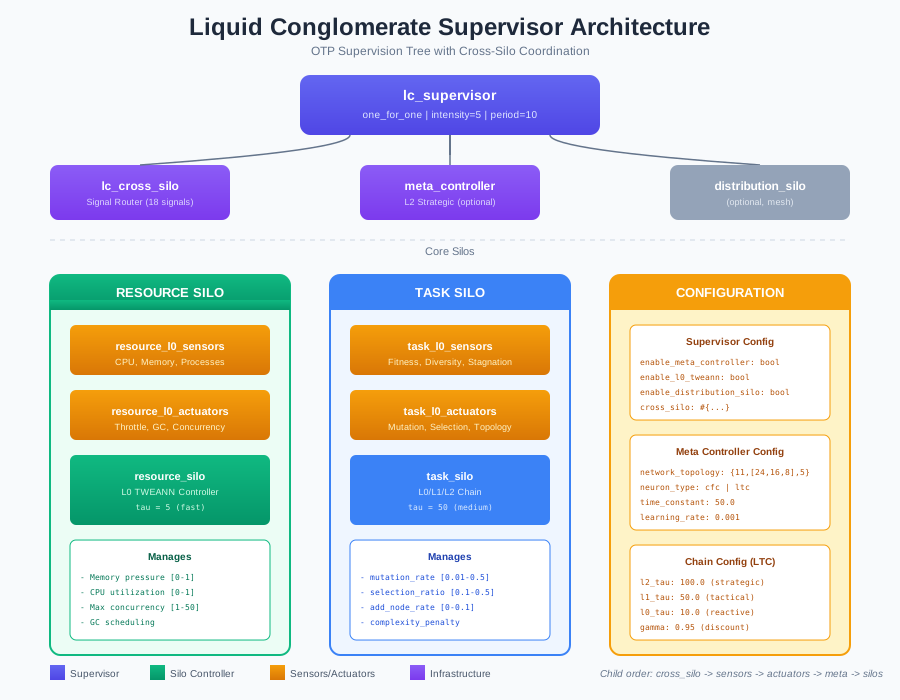
View SourceThe Liquid Conglomerate is the meta-controller architecture that supervises, coordinates, and configures all silos. It provides unified management of 13 specialized silos through OTP supervision, cross-silo signal routing, and hierarchical L0/L1/L2 TWEANN controllers.
Overview
The LC architecture implements "learning to learn" - TWEANNs that adapt hyperparameters based on training dynamics, enabling neuroevolution to self-optimize without manual tuning.
Key Components:
- lc_supervisor - OTP supervisor managing all silo processes
- lc_cross_silo - Signal router coordinating inter-silo communication
- Hierarchical Controllers - L2 (strategic) -> L1 (tactical) -> L0 (reactive)
- lc_reward - Cooperative reward computation encouraging silo alignment
Why a Meta-Controller?
| Traditional Approach | Liquid Conglomerate |
|---|---|
| Fixed hyperparameters | Adaptive hyperparameters |
| Manual tuning required | Self-tuning via TWEANNs |
| Isolated subsystems | Coordinated silos |
| Static resource allocation | Dynamic resource negotiation |
| Single timescale control | Hierarchical timescales (L0/L1/L2) |
Architecture
OTP Supervision Tree
The lc_supervisor manages the LC as an OTP application with one-for-one restart strategy:
%% Supervisor configuration
SupFlags = #{
    strategy => one_for_one,
    intensity => 5,   % Max 5 restarts
    period => 10      % Per 10 seconds
}.
Child Start Order (dependencies require this order):
lc_cross_silo- Signal router (must start first)resource_l0_sensors/task_l0_sensors- Metric collectorsresource_l0_actuators/task_l0_actuators- Hyperparameter appliersmeta_controller(optional) - L2 strategic layerresource_silo/task_silo- Main controllersdistribution_silo(optional) - Mesh optimization
Core Silos
| Silo | Purpose | Time Constant |
|---|---|---|
| Resource Silo | System stability (memory, CPU, GC) | tau = 5 (fast) |
| Task Silo | Evolution optimization (mutation, selection) | tau = 50 (medium) |
| Distribution Silo | Mesh networking (optional) | tau = 1 (very fast) |
Cross-Silo Coordination
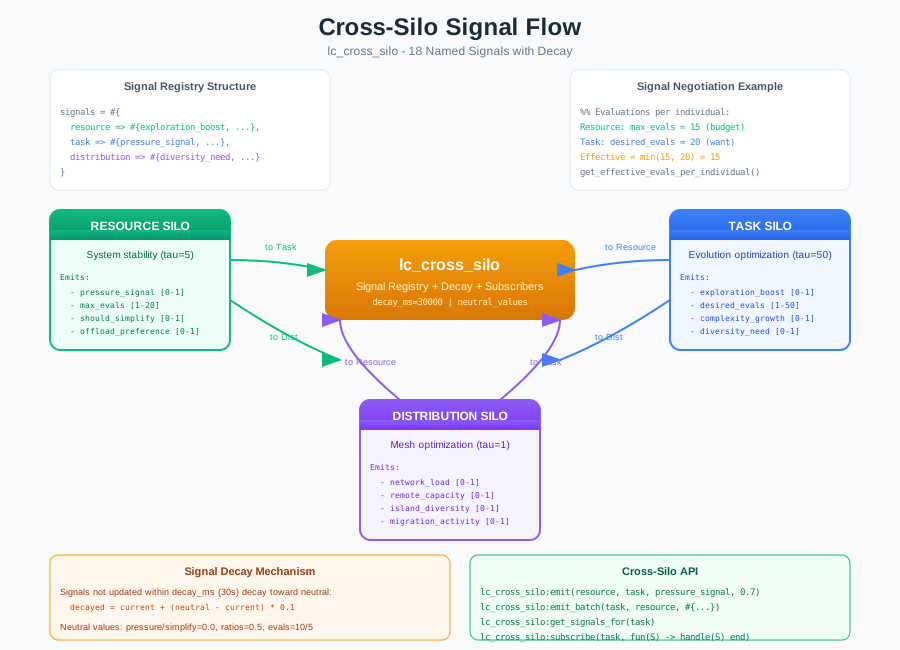
The lc_cross_silo module manages signal exchange between silos, enabling cooperative control.
Signal Routes
18 named signals are valid between silos:
| From | To | Signals |
|---|---|---|
| Resource | Task | pressure_signal, max_evals_per_individual, should_simplify |
| Resource | Distribution | offload_preference, local_capacity |
| Task | Resource | exploration_boost, desired_evals_per_individual, expected_complexity_growth |
| Task | Distribution | diversity_need, speciation_pressure |
| Distribution | Resource | network_load_contribution, remote_capacity_available |
| Distribution | Task | island_diversity_score, migration_activity |
Signal Negotiation
Silos negotiate shared resources via signals:
%% Example: Evaluations per individual
ResourceMax = 15,     % Resource Silo sets budget limit
TaskDesired = 20,     % Task Silo requests based on fitness needs
Effective = min(15, 20) = 15  % Negotiated result
Signal Decay
Signals not updated within decay_ms (default 30s) decay toward neutral values:
%% Decay formula (10% per decay period)
decayed_value = current + (neutral - current) * 0.1

%% Neutral values by signal type
pressure_signal -> 0.0
should_simplify -> 0.0
max_evals_per_individual -> 10
diversity ratios -> 0.5
Signal API
%% Emit a signal from one silo to another
lc_cross_silo:emit(resource, task, pressure_signal, 0.7)

%% Emit multiple signals at once
lc_cross_silo:emit_batch(task, resource, #{
    exploration_boost => 0.5,
    desired_evals_per_individual => 15
})

%% Get all signals destined for a silo
Signals = lc_cross_silo:get_signals_for(task)
%% Returns: #{pressure_signal => 0.7, max_evals_per_individual => 15, ...}

%% Subscribe to signal changes
lc_cross_silo:subscribe(task, fun(Signals) -> handle_signals(Signals) end)

%% Get negotiated effective evals
Effective = lc_cross_silo:get_effective_evals_per_individual()
Hierarchical Control (L0/L1/L2)
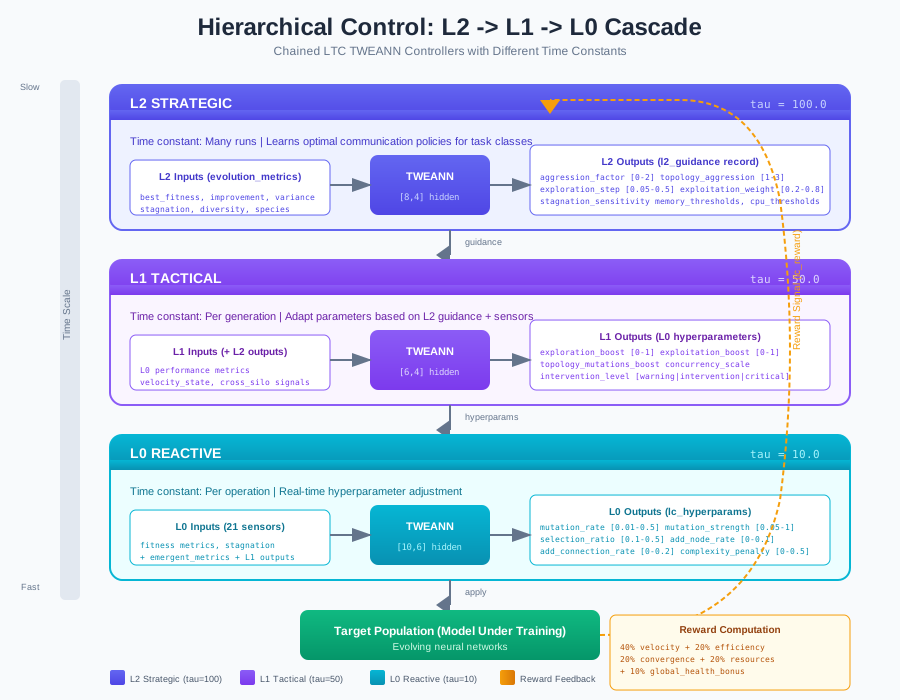
The LC uses cascaded TWEANN controllers operating at different timescales.
Time Constants
| Level | Name | Time Constant | Timescale | Controls |
|---|---|---|---|---|
| L2 | Strategic | tau = 100 | Many runs | How L1 should adjust |
| L1 | Tactical | tau = 50 | Per generation | How L0 should behave |
| L0 | Reactive | tau = 10 | Per operation | Direct hyperparameters |
L2 Strategic Layer
L2 learns optimal policies across entire training runs:
Inputs (evolution_metrics):
best_fitness,avg_fitnessfitness_improvement,fitness_variancestagnation_counter,generation_progresspopulation_diversity,species_count
Outputs (l2_guidance record):
| Parameter | Range | Effect |
|---|---|---|
aggression_factor | [0.0, 2.0] | How strongly L1 responds to stagnation |
exploration_step | [0.05, 0.5] | Speed of exploration boost increase |
stagnation_sensitivity | [0.0001, 0.01] | What counts as "improvement" |
topology_aggression | [1.0, 3.0] | Structural mutation boost |
exploitation_weight | [0.2, 0.8] | Exploration vs exploitation balance |
adaptation_momentum | [0.0, 0.95] | Smoothness of transitions |
L1 Tactical Layer
L1 adapts L0 hyperparameters based on L2 guidance and current metrics:
Inputs:
- L2 guidance parameters
- L0 performance metrics
velocity_state(improvement rate)- Cross-silo signals
Outputs:
exploration_boost[0-1]exploitation_boost[0-1]topology_mutations_boostconcurrency_scaleintervention_level(warning/intervention/critical)
L0 Reactive Layer
L0 directly controls evolution hyperparameters in real-time:
Inputs (21 sensors):
- Fitness metrics
- Stagnation severity
emergent_metrics(convergence, complexity, innovation)- L1 outputs
Outputs (lc_hyperparams record):
| Parameter | Range | Default | Effect |
|---|---|---|---|
mutation_rate | [0.01, 0.5] | 0.1 | Probability of mutation |
mutation_strength | [0.05, 1.0] | 0.3 | Magnitude of mutations |
selection_ratio | [0.1, 0.5] | 0.2 | Fraction selected |
add_node_rate | [0.0, 0.1] | 0.03 | Structural mutation rate |
add_connection_rate | [0.0, 0.2] | 0.05 | Connection mutation rate |
Reward Computation
The lc_reward module computes cooperative reward signals encouraging silo alignment.
Task Silo Reward
%% Weighted components
reward = 0.40 * velocity_score      % Fitness improvement rate
       + 0.20 * efficiency_score    % Progress vs evaluations used
       + 0.20 * convergence_score   % Avoiding premature convergence
       + 0.20 * resource_score      % Memory/CPU efficiency
Resource Silo Reward
reward = 0.35 * throughput_score    % Evaluations per second
       + 0.25 * stability_score     % GC triggers, pauses avoided
       + 0.15 * efficiency_score    % Optimal utilization
       - 0.15 * task_blocked_penalty
       - 0.10 * distribution_blocked_penalty
Global Health Bonus
All silos receive a cooperative bonus based on overall system improvement:
global_health = (resource_reward + task_reward + distribution_reward) / 3
bonus = 0.1 * (current_global_health - previous_global_health)
This encourages silos to help each other rather than compete.
Configuration
Supervisor Configuration
Config = #{
    %% Enable optional components
    enable_meta_controller => true,        % L2 strategic layer
    enable_l0_tweann => true,              % Neural network control (vs rule-based)
    enable_distribution_silo => false,      % Mesh networking

    %% Cross-silo settings
    cross_silo => #{
        signal_decay_ms => 30000
    },

    %% Meta-controller settings
    meta_controller => #{
        network_topology => {11, [24, 16, 8], 5},
        neuron_type => cfc,                 % cfc (fast) or ltc (accurate)
        time_constant => 50.0,
        learning_rate => 0.001
    },

    %% Per-silo configuration
    resource_silo => #{...},
    task_silo => #{...}
}.
Chain Configuration (lc_chain_config)
#lc_chain_config{
    %% Time constants (override defaults)
    l2_tau = 100.0,    % Strategic: very slow
    l1_tau = 50.0,     % Tactical: medium
    l0_tau = 10.0,     % Reactive: fast

    %% Learning
    learning_rate = 0.001,
    gamma = 0.95,      % Reward discount

    %% Architecture
    evolve_topology = true,
    l2_hidden_layers = [8, 4],
    l1_hidden_layers = [6, 4],
    l0_hidden_layers = [10, 6],
    activation = tanh
}.
Starting the LC
Basic Start
%% Start with defaults
{ok, Pid} = lc_supervisor:start_link()

%% Start with custom configuration
{ok, Pid} = lc_supervisor:start_link(#{
    enable_meta_controller => true,
    enable_l0_tweann => true
})
Checking Status
%% Get all cross-silo signals
AllSignals = lc_cross_silo:get_all_signals()

%% Get signals for a specific silo
TaskSignals = lc_cross_silo:get_signals_for(task)

%% Get negotiated effective evals
EffectiveEvals = lc_cross_silo:get_effective_evals_per_individual()
Runtime Silo Control
The LC supervisor supports dynamic enabling/disabling of extension silos at runtime. This allows applications to activate specialized silos only when needed, reducing resource usage.
Core vs Extension Silos
| Type | Silos | Behavior |
|---|---|---|
| Core | task, resource | Always enabled, cannot be disabled |
| Extension | temporal, competitive, social, cultural, ecological, morphological, developmental, regulatory, economic, communication, distribution | Disabled by default, enable on demand |
Enabling/Disabling Silos
%% Enable an extension silo
ok = lc_supervisor:enable_silo(temporal)
ok = lc_supervisor:enable_silo(competitive, #{realm => <<"game">>})

%% Disable an extension silo
ok = lc_supervisor:disable_silo(temporal)

%% Attempting to disable core silos returns error
{error, cannot_disable_core_silo} = lc_supervisor:disable_silo(task)

%% Enabling already-enabled silo returns error
{error, already_enabled} = lc_supervisor:enable_silo(temporal)

%% Disabling not-enabled silo returns error
{error, not_enabled} = lc_supervisor:disable_silo(social)

%% Unknown silo returns error
{error, unknown_silo} = lc_supervisor:enable_silo(unknown)
Querying Silo Status
%% Check if a silo is currently enabled
true = lc_supervisor:is_silo_enabled(task)
false = lc_supervisor:is_silo_enabled(temporal)

%% List all currently enabled silos
[task, resource] = lc_supervisor:list_enabled_silos()

%% List all available silo types (13 total)
AllTypes = lc_supervisor:list_available_silos()
%% [task, resource, temporal, competitive, social, cultural,
%%  ecological, morphological, developmental, regulatory,
%%  economic, communication, distribution]
Silo Type to Module Mapping
%% Get the module name for a silo type
task_silo = lc_supervisor:silo_module(task)
temporal_silo = lc_supervisor:silo_module(temporal)
{error, unknown_silo} = lc_supervisor:silo_module(unknown)

%% All 13 silo types
AllTypes = lc_supervisor:all_silo_types()
Silo Dependencies
Some silos require other silos to be enabled first:
| Silo | Requires | Reason |
|---|---|---|
| social | competitive | Coalition competition signals |
| cultural | social | Norm transmission via social network |
| communication | social | Trust network for signaling |
| developmental | temporal | Critical period timing |
| regulatory | developmental | Expression stage coordination |
%% Query dependencies for a silo
[competitive] = lc_supervisor:silo_dependencies(social)
[social] = lc_supervisor:silo_dependencies(cultural)
[] = lc_supervisor:silo_dependencies(temporal)  %% No dependencies

%% Enable fails if dependencies not met
{error, {missing_dependency, competitive}} = lc_supervisor:enable_silo(social)

%% Disable fails if other silos depend on it
{error, {has_dependents, [social]}} = lc_supervisor:disable_silo(competitive)
Configuration Management
Get Silo Configuration
%% Get the config used to start a silo
{ok, #{realm := <<"game">>}} = lc_supervisor:get_silo_config(competitive)
{ok, #{}} = lc_supervisor:get_silo_config(task)  %% Core silos return empty map
{error, not_enabled} = lc_supervisor:get_silo_config(temporal)
Reconfigure Running Silo
%% Hot-reload configuration (restarts silo with new config)
ok = lc_supervisor:reconfigure_silo(temporal, #{realm => <<"new_realm">>})

%% Core silos cannot be reconfigured
{error, cannot_reconfigure_core_silo} = lc_supervisor:reconfigure_silo(task, #{})
Validate Configuration
%% Validate config before enabling
ok = lc_supervisor:validate_silo_config(temporal, #{realm => <<"test">>})
{error, unknown_silo} = lc_supervisor:validate_silo_config(unknown, #{})
Configuration from Application Environment
Silos can be pre-configured in sys.config:
%% sys.config
[
  {macula_neuroevolution, [
    {lc_supervisor, #{
      silos => #{
        temporal => #{enabled => true, realm => <<"default">>},
        competitive => #{enabled => true, archive_max_size => 200},
        social => #{enabled => true}  %% Will auto-enable competitive first
      }
    }}
  ]}
].
The silos map uses the format #{silo_type => #{enabled => true/false, ...config...}}.
Use Cases
| Scenario | Silos to Enable |
|---|---|
| Basic neuroevolution | task, resource (core only) |
| Time-constrained training | + temporal |
| Competitive game AI | + competitive, social |
| Open-ended evolution | + cultural, ecological, developmental |
| Distributed training | + distribution |
| Full LC exploration | All 13 silos |
Control Loop
The LC executes the following loop per generation:
- Collect metrics - L0 sensors gather fitness, diversity, resource usage
- Process L2 - Strategic controller outputs L1 guidance (every tau_L2)
- Process L1 - Tactical controller outputs L0 hyperparameters (every tau_L1)
- Process L0 - Reactive controller computes hyperparameters (every operation)
- Apply actuators - L0 actuators apply hyperparameters to evolution
- Exchange signals - Cross-silo signals update between silos
- Compute rewards - lc_reward computes feedback for learning
- Update controllers - TWEANNs learn from reward signals
Tuning Guide
Common Issues
| Problem | Likely Cause | Fix |
|---|---|---|
| Slow adaptation | High time constants | Decrease tau values |
| Oscillating hyperparameters | Low momentum | Increase adaptation_momentum |
| Stuck at local optima | Low aggression | Increase aggression_factor |
| Resource pressure ignored | Low cross-silo penalty | Increase penalty weights |
| Premature convergence | Low diversity pressure | Increase diversity bonuses |
Recommended Defaults
The LC defaults are designed to be aggressive (responsive) for initial deployment:
%% L2 Guidance Defaults (aggressive for rule-based L1)
#l2_guidance{
    aggression_factor = 1.5,         % 3x default response
    exploration_step = 0.5,          % 5x default ramp speed
    stagnation_sensitivity = 0.001,  % Sensitive to stagnation
    topology_aggression = 2.5,       % Strong structural mutations
    exploitation_weight = 0.3,       % Favor exploration
    adaptation_momentum = 0.3,       % Fast response (30% old)
    warning_threshold = 0.2,         % Warn early
    intervention_threshold = 0.4,    % Intervene early
    critical_threshold = 0.7         % Critical earlier
}.
Source Code Reference
| File | Purpose |
|---|---|
src/silos/lc_supervisor.erl | OTP supervisor, runtime silo control |
src/silos/lc_cross_silo.erl | Signal routing |
src/silos/lc_controller.erl | L0 TWEANN controller |
src/silos/lc_l1_controller.erl | L1 tactical controller |
src/silos/lc_l2_controller.erl | L2 strategic controller |
src/silos/lc_chain.erl | Chained L2->L1->L0 |
src/silos/lc_reward.erl | Reward computation |
src/silos/lc_population.erl | Population of LC controllers |
include/lc_chain.hrl | Chain records |
include/meta_controller.hrl | Meta-controller records |
References
- PLAN_L2_L1_HIERARCHICAL_INTERFACE.md - Hierarchical control design
- PLAN_CHAINED_LTC_CONTROLLER.md - LTC cascade architecture
- "Meta-Learning in Neural Networks: A Survey" - Hospedales et al.
- "Liquid Time-constant Networks" - Hasani et al.
See Also
- Task Silo Guide - Evolution optimization
- Resource Silo Guide - System stability
- Distribution Silo Guide - Mesh networking