Liquid Time-Constant Neurons
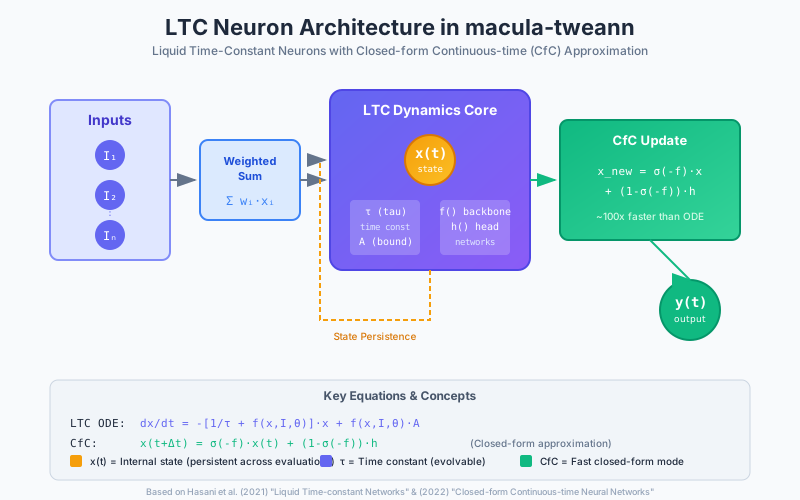
View SourceLiquid Time-Constant (LTC) neurons are a breakthrough in neural network design that enable adaptive temporal processing. Unlike traditional neurons that produce instantaneous outputs, LTC neurons maintain internal state that evolves continuously based on input dynamics.
macula-tweann is the first TWEANN library to implement LTC neurons in Erlang/OTP.
Quick Selection Guide
Which neuron type should you use? Use this decision tree:
Is your task temporal (time-series, sequences, control)?
├── NO → Use Traditional neurons (fastest, simplest)
└── YES → Do you need production-grade speed?
    ├── NO → Use LTC (ODE) for maximum accuracy during research
└── YES → Use CfC (100x faster, equivalent expressivity)| If your problem involves... | Use | Why |
|---|---|---|
| Static classification (images, patterns) | Traditional | No temporal dynamics needed |
| Real-time control (robotics, games) | CfC | Fast response with temporal memory |
| Time-series prediction | CfC | Adaptive dynamics, production speed |
| Research/training on temporal tasks | LTC (ODE) | Maximum accuracy for learning |
| Maximum inference throughput | Traditional | Lowest computational overhead |
Key Insight: CfC is the practical choice for most temporal tasks. It provides equivalent expressivity to LTC-ODE at ~100x the speed. Reserve Traditional neurons for non-temporal tasks, and LTC-ODE for research where accuracy matters more than speed.
Why LTC Neurons?
Traditional neural networks struggle with:
- Temporal sequences: Cannot naturally model time-varying signals
- Adaptive response: Fixed response speed regardless of input
- Temporal memory: No built-in mechanism for remembering past inputs
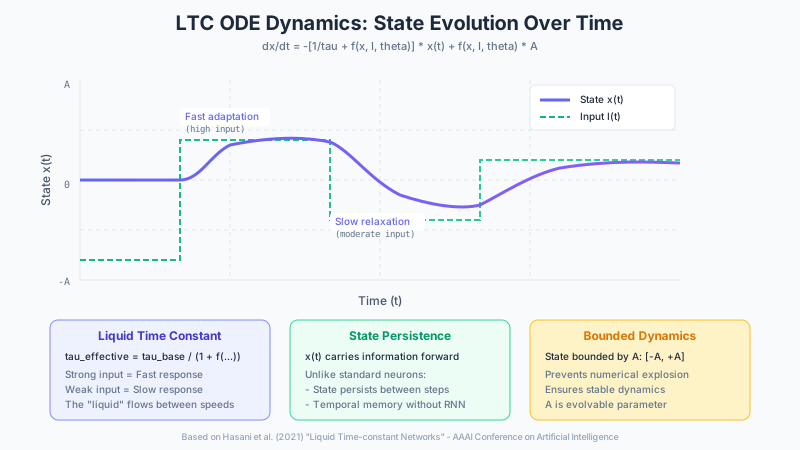
LTC neurons solve these problems with input-dependent time constants that allow the network to automatically adjust how quickly it responds to different inputs.
The Mathematics
Standard Neuron
A standard neuron computes an instantaneous output:
y = f(sum(w_i * x_i) + bias)This is memoryless - the output depends only on current inputs.
LTC Neuron
An LTC neuron maintains internal state x(t) governed by an ODE:
dx(t)/dt = -[1/tau + f(x, I, theta)] * x(t) + f(x, I, theta) * AWhere:
x(t)= internal state at time ttau= base time constant (learnable)f(...)= nonlinear function producing the "liquid" time constantA= state bound (prevents explosion)I(t)= input at time t
The liquid aspect comes from the time constant varying based on both input and state - the neuron "flows" between fast and slow response modes.
CfC Closed-Form Approximation
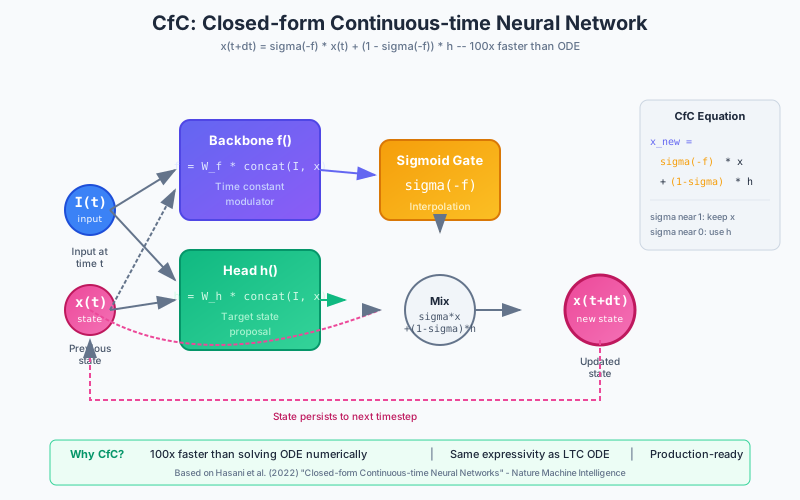
Solving the ODE numerically is computationally expensive. The Closed-form Continuous-time (CfC) approximation provides equivalent expressivity with ~100x speedup:
x(t+dt) = sigma(-f) * x(t) + (1 - sigma(-f)) * hWhere:
sigma= sigmoid gatef= backbone network output (time constant modulator)h= head network output (target state)
This closed-form solution is what macula-tweann uses for production inference.
Neuron Types Comparison
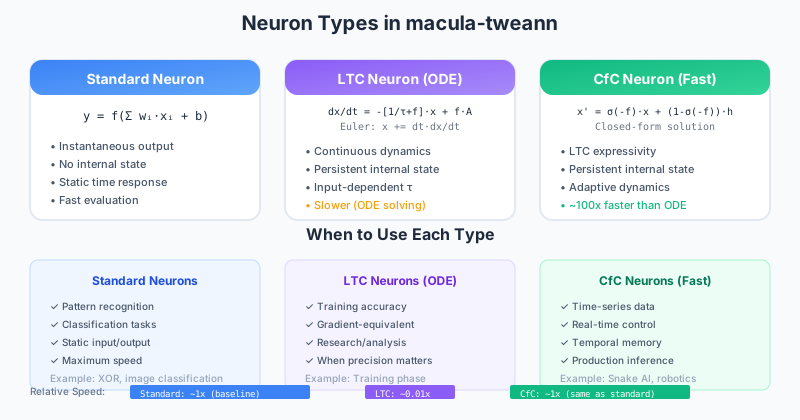
| Feature | Standard | LTC (ODE) | CfC (Fast) |
|---|---|---|---|
| Internal State | No | Yes | Yes |
| Temporal Memory | No | Yes | Yes |
| Adaptive Dynamics | No | Yes | Yes |
| Speed | Fast | Slow | Fast (~100x vs ODE) |
| Use Case | Pattern recognition | Training/research | Production inference |
Implementation in macula-tweann
Core Modules
ltc_dynamics.erl - Core LTC/CfC computation:
%% CfC evaluation (fast, closed-form)
ltc_dynamics:evaluate_cfc(Input, State, Tau, Bound) -> {NewState, Output}.

%% ODE evaluation (accurate, slower)
ltc_dynamics:evaluate_ode(Input, State, Tau, Bound, Dt) -> {NewState, Output}.
neuron_ltc.erl - LTC neuron process:
%% Spawn an LTC neuron
neuron_ltc:start_link(#{
    id => NeuronId,
    neuron_type => cfc,           %% or 'ltc' for ODE mode
    time_constant => 1.0,         %% tau
    state_bound => 1.0,           %% A
    ltc_backbone_weights => [],
    ltc_head_weights => [],
    internal_state => 0.0
}).
Extended Neuron Record
The #neuron record has been extended with LTC fields:
-record(neuron, {
    %% ... standard fields ...

    %% LTC Extension Fields
    neuron_type = standard,       %% standard | ltc | cfc
    time_constant = 1.0,          %% tau (evolvable)
    state_bound = 1.0,            %% A (bounds)
    ltc_backbone_weights = [],    %% f() backbone
    ltc_head_weights = [],        %% h() head
    internal_state = 0.0          %% x(t) persistent
}).
Constructor Integration
The constructor.erl module automatically spawns the appropriate neuron type:
%% Neurons with neuron_type = cfc spawn as neuron_ltc
%% Neurons with neuron_type = ltc spawn as neuron_ltc (ODE mode)
%% Neurons with neuron_type = standard spawn as neuron
Key Properties
State Persistence
Unlike standard neurons, LTC neurons maintain state between evaluations:
%% First evaluation
{State1, _} = ltc_dynamics:evaluate_cfc(1.0, 0.0, 1.0, 1.0).
%% State1 is now non-zero

%% Second evaluation uses State1
{State2, _} = ltc_dynamics:evaluate_cfc(0.0, State1, 1.0, 1.0).
%% State2 influenced by State1
This enables temporal memory without explicit recurrent connections.
Bounded Dynamics
The state bound A ensures numerical stability:
%% State always clamped to [-A, A]
clamp_state(State, Bound) when State > Bound -> Bound;
clamp_state(State, Bound) when State < -Bound -> -Bound;
clamp_state(State, _Bound) -> State.
Adaptive Time Constants
The "liquid" time constant varies with input:
compute_liquid_tau(Input, State, BaseTau, Params) ->
    %% Modulation based on input magnitude
    Modulation = 1.0 + sigmoid(Input),
    EffectiveTau = BaseTau * Modulation,
    %% Clamp to reasonable range
    max(0.001, min(EffectiveTau, 100.0)).
When to Use LTC Neurons
Ideal Use Cases
- Time-series prediction: Stock prices, sensor data, weather
- Real-time control: Robotics, game AI, autonomous systems
- Sequence modeling: Natural language, audio, video
- Adaptive response: Systems that need different response speeds
Snake AI Example
For the Snake Duel game, LTC neurons enable:
- Temporal awareness: Remember recent moves and food positions
- Adaptive hunting: Fast response when prey is near, cautious when threatened
- Pattern learning: Recognize opponent behavior patterns over time
Not Ideal For
- Static classification: Use standard neurons for pure pattern matching
- Maximum speed critical: Standard neurons have less overhead
- Simple problems: XOR doesn't need temporal dynamics
Academic References
The LTC implementation in macula-tweann is based on peer-reviewed research:
Hasani, R., Lechner, M., et al. (2021) "Liquid Time-constant Networks" Proceedings of the AAAI Conference on Artificial Intelligence
Hasani, R., Lechner, M., et al. (2022) "Closed-form Continuous-time Neural Networks" Nature Machine Intelligence
Beer, R.D. (1995) "On the Dynamics of Small Continuous-Time Recurrent Neural Networks" Adaptive Behavior, 3(4)
Research Opportunities
LTC neurons in an evolutionary context open exciting research directions:
Temporal Dynamics Evolution
Unlike fixed architectures like LSTMs, macula-tweann evolves LTC parameters:
- Tau Evolution: Networks discover optimal time constants for different temporal scales
- Multi-timescale Systems: Single networks can evolve neurons with different tau values, capturing both fast reactions and slow trends
- Adaptive Plasticity: Combine LTC dynamics with Hebbian learning for biologically plausible temporal learning
Hybrid Architectures
The ability to mix standard and LTC neurons enables novel architectures:
- Temporal Gating: Standard neurons for pattern recognition, LTC for temporal integration
- Hierarchical Timing: Fast LTC neurons at input, slow LTC at decision layers
- Emergent Temporal Structure: Let evolution discover which neurons need temporal dynamics
Comparative Studies
macula-tweann provides a unique platform for comparing temporal approaches:
- LTC vs LSTM: Evolved LTC networks vs manually-designed recurrent architectures
- CfC Efficiency: When does the ~100x speedup justify the closed-form approximation?
- Temporal Necessity: Which problems truly require temporal dynamics vs simple feedforward?
Application Domains
High-potential research applications:
- Robotics: Evolved LTC controllers for locomotion with natural rhythm emergence
- Time-series: Financial prediction, sensor anomaly detection, predictive maintenance
- Game AI: Agents that adapt response timing to opponent behavior
- Edge Computing: Lightweight temporal models for embedded systems
Publishing Opportunities
If you use macula-tweann LTC neurons in research, consider contributing:
- Evolved network architectures that solve interesting problems
- Performance comparisons with other temporal network approaches
- Novel morphologies designed for specific temporal tasks
Next Steps
- See the LTC Usage Guide for practical examples
- Explore Custom Morphologies to create LTC-based morphologies
- Check the
ltc_dynamicsmodule documentation for detailed function reference