Cluster membership
View SourceBarrel P2P does not maintain a full mesh. Each node keeps a small, bounded set of gossip peers; the cluster as a whole remains reachable through OTP's demand-driven dist auto-connect. The membership protocol that keeps the gossip topology coherent is HyParView.
This page explains the protocol from a developer's point of view: the two views it maintains, how a node joins, how failures are handled, and how the picture is kept fresh.
The two views
Every node maintains two ordered sets of peers:
- The active view is the small bounded set (default size 5)
of peers this node currently exchanges gossip with. The links
are symmetric: if A has B in its active view, B has A in its
active view. The size is
active_sizein sys.config. - The passive view is a larger bounded cache (default size
- of known peers that this node is not currently
connected to. The passive view is a reserve: when an active
link drops, a passive peer is promoted to replace it. The
size is
passive_size.
- of known peers that this node is not currently
connected to. The passive view is a reserve: when an active
link drops, a passive peer is promoted to replace it. The
size is
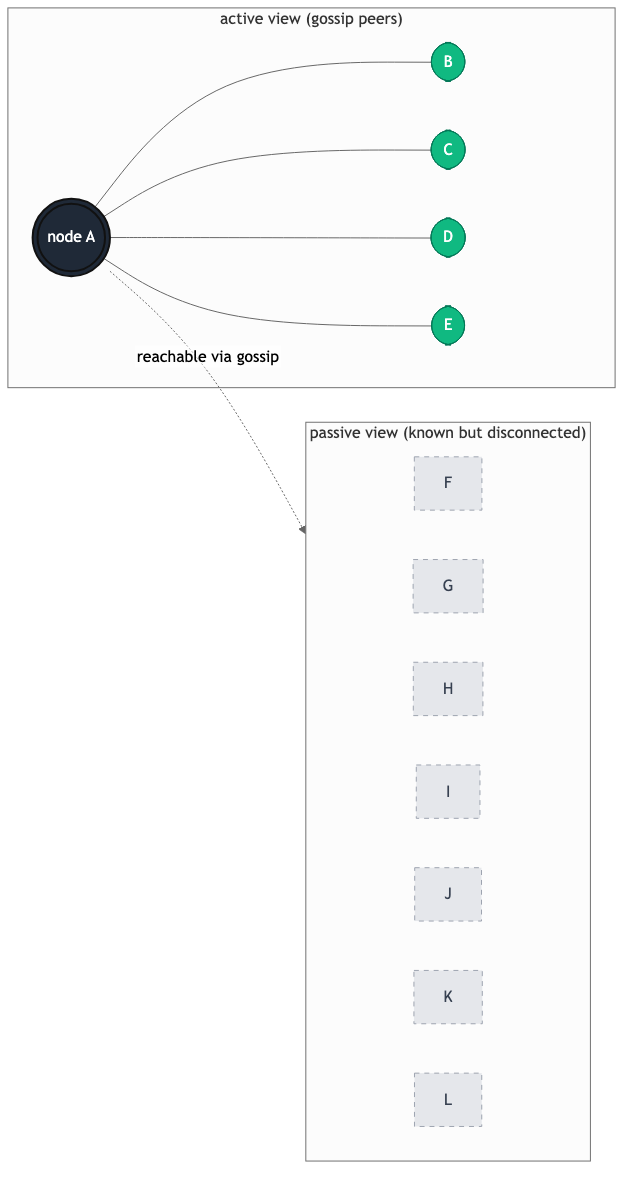
The crucial property: the active view does not need to grow with the cluster. A node with a thousand peers in its passive view still keeps only five active links. The protocol guarantees that any peer is reachable from any starting point by repeatedly forwarding through these small bounded views.
Joining the cluster
When a new node joins, it sends a JOIN message to one contact
node it knows about. The contact node is either named explicitly
via barrel_p2p:join/1 or configured in sys.config:
{barrel_p2p, [
    {contact_nodes, ['seed1@host', 'seed2@host']}
]}.
The protocol flow:
NewNode ----JOIN----> ContactNode
                            |
                            +-- adds NewNode to its active view
                            |
                            +-- sends FORWARD_JOIN(TTL=ARWL) to a
                                random active peer (which forwards
                                again, until TTL=0)
Forwarding has two purposes:
- Knowledge of the new node spreads beyond the contact node.
- Each receiving node either adds the new node to its own active view (small probability, decreasing with TTL) or to its passive view (at TTL=0). The passive entry is a warm spare for future use.
The TTL is the active random walk length (arwl, default 6).
A smaller value confines the join to the contact node's
neighbourhood; a larger value spreads the new node more widely
at the cost of more messages.
Failure handling
A peer failure is detected through the dist channel:
net_kernel reports a nodedown event, barrel_p2p translates it
into a HyParView failure, and the protocol takes over:
- The failed peer is moved from active to a transient "failed" state with an exponential backoff timer.
- After
max_fail_countconsecutive failures (default 5), the peer is moved out of the active view entirely and into the passive view. - A replacement is picked from the passive view and sent a
NEIGHBORrequest. If the candidate accepts, the active view is back to its target size.
Backoff prevents reconnection storms during network partitions. If half the cluster becomes unreachable at once, each surviving node retries its neighbours on staggered timers rather than simultaneously.
Shuffle: keeping passive views fresh
Every shuffle_period ms (default 10s), a node picks a random
active peer and exchanges a small sample of its active and
passive views. This is how:
- A node learns about peers that joined after it did and that
the contact-node
FORWARD_JOINdid not reach. - The passive view stays fresh enough that there is always a spare to replace a failed active peer.
The exchange is bounded: a fixed-size random sample
(shuffle_length, default 8), never the full views.
Active view eviction
When the active view is full and a new peer wants to enter (via
JOIN or NEIGHBOR), the protocol evicts an existing active
peer to make room. The evicted peer goes to the passive view; the
HyParView-level connection (a disconnect protocol message) is
sent so the peer learns we no longer treat it as gossip-active.
The dist channel between us and the evicted peer stays up. The
peer is still reachable for Pid ! Msg; it just is not in the
gossip topology any more. The idle dist GC will eventually reap
the channel if no traffic flows over it.
The relationship with erlang:nodes/0
Two important calls return different things:
barrel_p2p:active_view/0returns the small HyParView gossip topology. It is bounded byactive_size. This is the set used for gossip and for the broadcast tree.erlang:nodes/0returns every node this BEAM currently has a dist channel with. It includes the active view and any on-demand channels opened byPid ! Msg.
The two sets can differ. After a Pid ! Msg to a peer outside
the active view, that peer appears in erlang:nodes/0 but not
in barrel_p2p:active_view/0. Once the idle GC reaps the channel,
it disappears from erlang:nodes/0 too.
Configuration knobs
| Key | Default | Purpose |
|---|---|---|
active_size | 5 | Maximum concurrent gossip peers. |
passive_size | 30 | Maximum known-but-disconnected peers. |
arwl | 6 | Active random walk length (join propagation TTL). |
prwl | 3 | Passive random walk length (when a forward-join lands in passive). |
shuffle_length | 8 | Peers exchanged per shuffle round. |
shuffle_period | 10000 ms | Time between shuffle rounds. |
max_fail_count | 5 | Failures before a peer is demoted to passive. |
base_backoff_ms | 1000 | Initial backoff after a failure (doubles up to 5 min). |
passive_max_age_ms | 300000 | Maximum age before a passive entry is dropped. |
For sizing recommendations by cluster size, see run in production.
API
The relevant entry points in barrel_p2p.erl:
barrel_p2p:join(ContactNode) -> ok | {error, term()}.
barrel_p2p:leave() -> ok.
barrel_p2p:active_view() -> [node()].
barrel_p2p:passive_view() -> [node()].

%% Subscribe to membership transitions.
barrel_p2p:subscribe() -> ok.
barrel_p2p:subscribe(Pid) -> ok.
barrel_p2p:unsubscribe(Pid) -> ok.

%% Events delivered as:
%%   {barrel_p2p_event, {peer_up, Node}}
%%   {barrel_p2p_event, {peer_down, Node, Reason}}
%%   {barrel_p2p_event, joined}
%%   {barrel_p2p_event, left}
subscribe/0 is the right entry point if your application needs
to react to cluster changes (cache invalidation, lease renewal,
metric updates).
Related
- Gossip broadcast is the protocol that uses the active view for message dissemination.
- Dist channel describes how on-demand channels open when sending to a peer outside the active view.
- Run in production has the operational sizing table.
- Architecture has the supervision-tree-level picture.