Barrel P2P
View SourceBarrel P2P is an Erlang/OTP library for peer-to-peer clusters.
It keeps the Erlang programming model: Pid ! Msg, gen_server,
rpc, links, monitors, and the usual supervision habits. It changes
what happens underneath:
- distribution runs over QUIC, not TCP;
- nodes authenticate with Ed25519;
- membership is bounded with HyParView, not full mesh;
- services are discovered through a CRDT registry;
- EPMD is not required.
The result is a cluster where each node keeps a small number of gossip connections, while any process can still talk to any process in the cluster.
Why Erlang developers may care
Standard Erlang distribution is simple and good. It becomes harder to operate when the cluster grows, when every node must connect to every other node, when EPMD is not welcome, or when nodes move between network paths.
Barrel P2P keeps your application code close to normal OTP code. You still register processes, call servers, monitor pids, and send messages. The library takes care of the cluster shape, peer identity, service discovery, and the QUIC dist carrier.
The cluster shape
Read this graph from node A. The green nodes are the active view: the small set of peers node A uses for gossip and membership maintenance. The grey nodes are known peers kept in the passive view. They are not connected now, but they are warm spares when the topology changes.
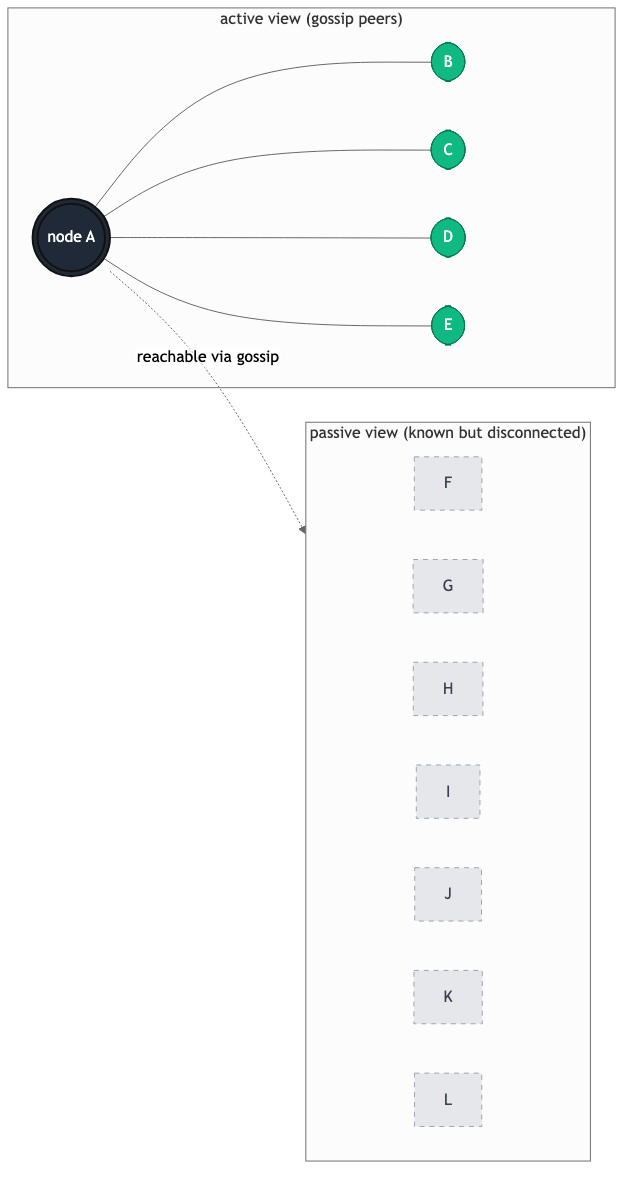
The important point: the active view is not the cluster. It is not the list of nodes your application may talk to. It is only the maintenance topology.
Application traffic is different. If code on node A sends to a pid on node E, OTP can open a dist channel on demand. Barrel P2P authenticates that channel, then the normal Erlang message is delivered.
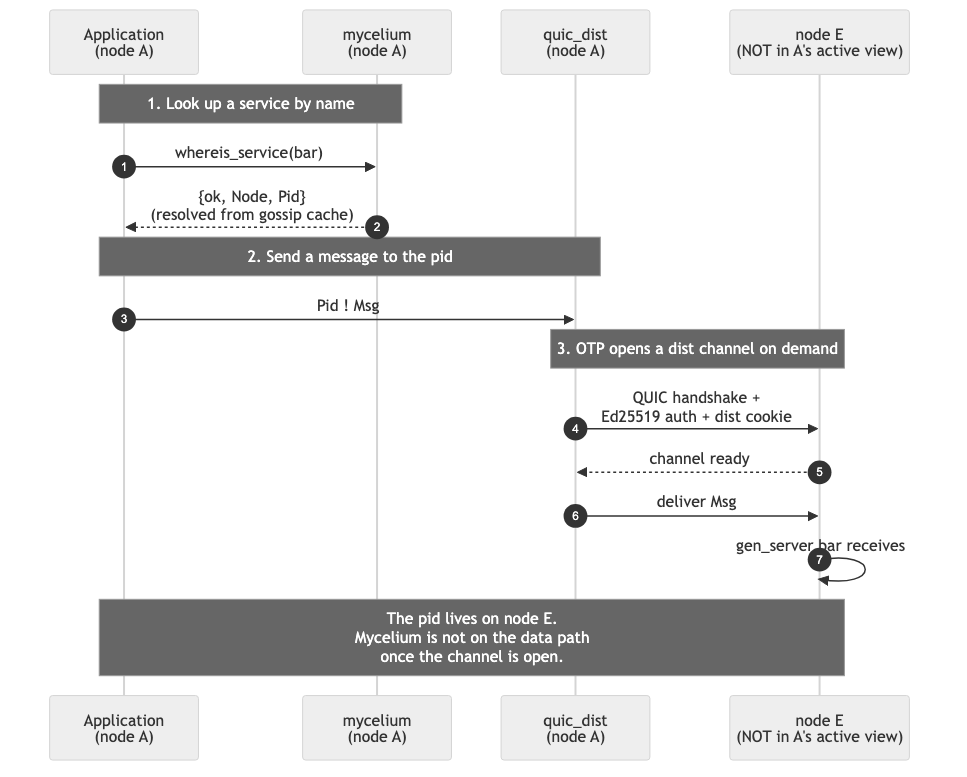
Once you hold the pid, Barrel P2P is no longer on the application data path. You use Erlang.
Project status
Barrel P2P is experimental and pre-1.0. APIs may change between minor
releases until a 1.0 tag.
The cryptographic and transport layers, Ed25519 dist auth and the QUIC carrier, have unit and multi-node test coverage. They have not been independently audited. Do not use Barrel P2P where a transport compromise would be costly without doing your own review first.
Bug reports and PRs are welcome. Security reports go through SECURITY.md.
Five-minute start
Add Barrel P2P to rebar.config:
{deps, [
    {barrel_p2p, "0.1.0"}
]}.
Use Barrel P2P as the Erlang distribution carrier:
-proto_dist barrel_p2p
-epmd_module barrel_p2p_epmd
-start_epmd false
Start the application and join a seed:
application:ensure_all_started(barrel_p2p).
ok = barrel_p2p:join('seed@192.168.1.10').
Register the current process as a service:
ok = barrel_p2p:register_service(worker_pool, #{shard => 1}).Find it from another node:
{ok, _Node, Worker} = barrel_p2p:whereis_service(worker_pool),
Worker ! {work, <<"payload">>}.
That send is a standard Erlang send. whereis_service/1 returns
{ok, Pid} for a local service and {ok, Node, Pid} for a remote
one. If the target node is not already connected, the dist channel is
opened on demand over QUIC.
Configuration
A small development config:
{barrel_p2p, [
    {active_size, 5},
    {passive_size, 30},
    {listen_port, 9100},
    {contact_nodes, ['seed@192.168.1.10']},
    {auth_enabled, true},
    {auth_trust_mode, tofu}
]}.
The defaults are intentionally narrow:
active_sizebounds the number of gossip peers.passive_sizebounds the known-but-disconnected peer cache.listen_portis the UDP port for QUIC distribution.contact_nodesgives the node a first place to join.auth_trust_modeistofuorstrict.
For production notes, see run in production.
What is included
- QUIC distribution.
-proto_dist barrel_p2pplugs into Erlang's alternative distribution layer. No stock EPMD daemon is required. - HyParView membership. Each node keeps a bounded active view instead of a full mesh.
- Service registry. Processes can be registered by name and found from any node through a CRDT-backed registry.
- Replicated state.
barrel_p2p_mapis a gossiped, last-write-wins key-value map for cluster-wide config, flags, and routing tables; thebarrel_p2p_replicabehaviour underneath is public for custom merge. - Plumtree broadcast. Registry changes and gossip move through an efficient epidemic broadcast tree.
- Ed25519 peer identity. Nodes prove their identity after the QUIC TLS handshake and before application traffic flows.
- Tagged QUIC streams. Applications can open tagged streams for large or byte-oriented transfers.
- Operational tools. Helpers exist for one-shot RPC, TLS material, key rotation, metrics, migration, and test clusters.
Documentation
The docs are organised into five sections. Each section has a hub page that lists its children; the hub pages are linked below.
Overview
Read this first if barrel_p2p is new to you.
- What is barrel_p2p? — the project in one page, with the architecture diagram and the load-bearing ideas.
- Benefits and trade-offs — why pick barrel_p2p, and what you give up.
- Introduction — the long narrative through every layer.
- Getting started — boot two nodes and send a real message.
Core concepts
How each subsystem works, explained one page at a time.
- Cluster membership — HyParView's bounded active and passive views.
- Service registry — OR-Map CRDT, eventual consistency, the registration lifecycle.
- Gossip broadcast — Plumtree push-lazy-push trees, self-healing graft/prune.
- Dist channel —
-proto_dist barrel_p2pover QUIC, the discovery chain, the idle GC. - Authentication — Ed25519 mutual challenge-response, trust modes.
- Streams — tagged user-stream multiplex over the same QUIC connection.
- Connection migration — RFC 9000 §9 path rebind.
- Hybrid logical clocks — the timestamps the CRDT uses.
Tutorials
End-to-end walkthroughs.
- Hello, cluster — the smallest two-node walkthrough.
- Distributed chat — a small application that uses the service registry and service events.
How-to guides
Task-focused recipes for operating a cluster.
- Run in production — sizing, network surface, secrets, shutdown.
- Configure authentication — TOFU and strict modes, provisioning, rotation.
- Observe a cluster — metrics catalogue and exporter wiring.
- Troubleshoot — symptom-cause-fix tables.
- Migrate connections — a watchdog recipe for path migration.
- Route through a relay — wiring an external tunnel or proxy adapter.
- Run the tests — EUnit, Common Test, docker, and soak suites.
Reference
Authoritative material when you know what you are looking for.
- API overview — every public
function in
barrel_p2p.erl, grouped by subsystem. - Configuration — every key
under
{barrel_p2p, [...]}in sys.config. - Architecture — the full supervision tree and protocol-level details.
- Comparison with Partisan — side-by-side, when to pick which library.
- Feature stability — public API tiers and coverage.
Example application
A small distributed chat app lives under
examples/chat.
cd examples/chat
./scripts/run-demo.sh seed
./scripts/run-demo.sh node 1
The demo starts Erlang nodes with -proto_dist barrel_p2p, generates
local TLS and Ed25519 material on first boot, and uses the service
registry to find chat rooms across the cluster.
Testing
Run the local suites:
rebar3 eunit
rebar3 ct
The Docker scripts under docker/scripts/ exercise multi-node
clusters. See run the tests for the
full command list.
API reference
Generate HTML documentation:
rebar3 ex_doc
Versioning
Barrel P2P is still in 0.x.
- Minor bumps,
0.xto0.y, may change documented public APIs. - Patch bumps,
0.x.yto0.x.y+1, are non-breaking. 1.0will come after an external audit of the dist auth and transport layers, and after public user feedback on a0.xrelease.
Public API stability tiers are tracked in docs/features.md. Anything not listed there is internal.
License
Apache-2.0