Schema Evolution
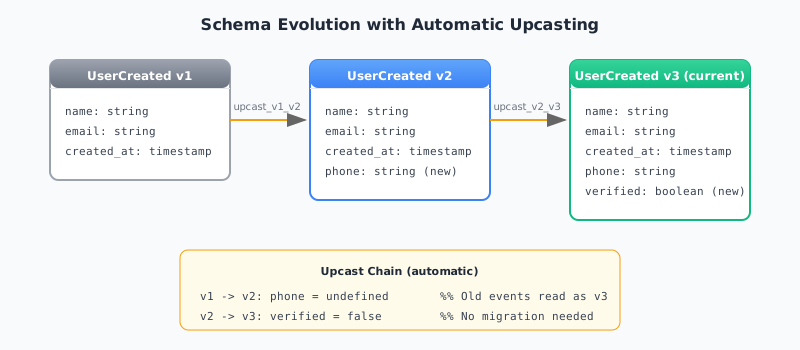
View SourceThis guide explains how to evolve event schemas over time while maintaining backward compatibility. Old events are automatically "upcasted" to the current schema version when read.
Prerequisites
Before reading this guide, you should understand:
- Event sourcing concepts (Event Sourcing Guide)
- The immutable nature of events (events are never modified after being written)
- Why backward compatibility matters in event-driven systems
The Problem: Business Requirements Change
In event sourcing, events are immutable facts. But business requirements evolve:
- New fields are added (
phoneadded toUserCreated) - Field names are renamed (
amount_cents→amount) - Data formats change (cents as integer → dollars as decimal)
- Fields are split (
full_name→first_name+last_name)
You cannot migrate events - they're immutable historical records. Changing them would break the audit trail.
The Solution: Schema Registry + Upcasting
Instead of migrating events, we transform them on read:
Write (immutable):           Read (transformed):
┌──────────────────┐         ┌──────────────────┐
│ UserCreated v1   │         │ UserCreated v3   │
│ {                │ ──────→ │ {                │
│   name: "Alice", │ upcast  │   name: "Alice", │
│   email: "..."   │         │   email: "...",  │
│ }                │         │   phone: null,   │
└──────────────────┘         │   verified: false│
                             │ }                │
                             └──────────────────┘
Key insight: Events stay as written. Transformation happens at read time. Consumers always see the current schema.
Where Does This Code Run?
| Operation | Location | Module |
|---|---|---|
| Register schema | Your Application | esdb_gater_api |
| Define upcast functions | Your Application | Your schema module |
| Store schema definitions | erl-esdb Server | erl_esdb_schema_store |
| Apply upcasting on read | erl-esdb Server | erl_esdb_upcaster |
API Reference
Register a Schema
%%--------------------------------------------------------------------
%% This code runs in: YOUR APPLICATION
%% Purpose: Register initial schema version for an event type
%%--------------------------------------------------------------------

esdb_gater_api:register_schema(my_store, <<"UserCreated">>, #{
    version => 1,
    fields => [
        #{name => <<"name">>, type => string, required => true},
        #{name => <<"email">>, type => string, required => true}
    ]
}).
Register New Version with Upcast
%%--------------------------------------------------------------------
%% This code runs in: YOUR APPLICATION
%% Purpose: Add new schema version with transformation from v1
%%--------------------------------------------------------------------

esdb_gater_api:register_schema(my_store, <<"UserCreated">>, #{
    version => 2,
    fields => [
        #{name => <<"name">>, type => string, required => true},
        #{name => <<"email">>, type => string, required => true},
        #{name => <<"phone">>, type => string, required => false}  %% New field
    ],
    upcast_from => #{
        1 => fun(V1Data) ->
            %% Transform v1 → v2: add missing phone field
            V1Data#{<<"phone">> => undefined}
        end
    }
}).
Get Schema Information
%%--------------------------------------------------------------------
%% This code runs in: YOUR APPLICATION
%% Purpose: Query registered schemas
%%--------------------------------------------------------------------

%% Get current schema for an event type
{ok, Schema} = esdb_gater_api:get_schema(my_store, <<"UserCreated">>).

%% Get current version number
{ok, Version} = esdb_gater_api:get_schema_version(my_store, <<"UserCreated">>).
%% => {ok, 2}

%% List all registered schemas
{ok, Schemas} = esdb_gater_api:list_schemas(my_store).
%% => [
%%     #{event_type => <<"UserCreated">>, version => 2},
%%     #{event_type => <<"OrderPlaced">>, version => 3},
%%     ...
%% ]
Upcast Events Explicitly
%%--------------------------------------------------------------------
%% This code runs in: YOUR APPLICATION
%% Purpose: Manually upcast events to current schema version
%%--------------------------------------------------------------------

%% Read old events
{ok, OldEvents} = esdb_gater_api:stream_forward(my_store, StreamId, 0, 100),

%% Upcast to current schema versions
{ok, UpcastedEvents} = esdb_gater_api:upcast_events(my_store, OldEvents).

%% Events are now in current schema version
Unregister Schema
%%--------------------------------------------------------------------
%% This code runs in: YOUR APPLICATION
%% Purpose: Remove a deprecated event type's schema
%%--------------------------------------------------------------------

esdb_gater_api:unregister_schema(my_store, <<"DeprecatedEvent">>).
Upcast Chain
When multiple schema versions exist, upcasting chains automatically:
v1 event → upcast_v1_v2() → v2 data → upcast_v2_v3() → v3 data (current)Example with 3 versions:
%%--------------------------------------------------------------------
%% This code runs in: YOUR APPLICATION
%% Purpose: Register schema with full upcast chain
%%--------------------------------------------------------------------

esdb_gater_api:register_schema(my_store, <<"OrderPlaced">>, #{
    version => 3,
    fields => [
        #{name => <<"order_id">>, type => string},
        #{name => <<"amount">>, type => decimal},       %% Changed from cents in v1
        #{name => <<"currency">>, type => string},      %% Added in v2
        #{name => <<"customer_id">>, type => string}    %% Added in v3
    ],
    upcast_from => #{
        1 => fun(V1) ->
            %% v1 had amount_cents (integer), no currency
            #{
                <<"order_id">> => maps:get(<<"order_id">>, V1),
                <<"amount">> => maps:get(<<"amount_cents">>, V1) / 100,
                <<"currency">> => <<"USD">>,  %% Default for old events
                <<"customer_id">> => undefined
            }
        end,
        2 => fun(V2) ->
            %% v2 had amount + currency, no customer
            V2#{<<"customer_id">> => undefined}
        end
    }
}).
Common Transformation Patterns
Adding Fields (Most Common)
%%--------------------------------------------------------------------
%% This code runs in: YOUR APPLICATION
%% Purpose: Add new field with default value
%%--------------------------------------------------------------------

upcast_from => #{
    1 => fun(V1) ->
        V1#{<<"new_field">> => default_value}
    end
}
Renaming Fields
%%--------------------------------------------------------------------
%% This code runs in: YOUR APPLICATION
%% Purpose: Rename a field while preserving data
%%--------------------------------------------------------------------

upcast_from => #{
    1 => fun(V1) ->
        OldValue = maps:get(<<"old_name">>, V1),
        maps:remove(<<"old_name">>, V1#{<<"new_name">> => OldValue})
    end
}
Changing Data Types
%%--------------------------------------------------------------------
%% This code runs in: YOUR APPLICATION
%% Purpose: Convert data format (cents → dollars)
%%--------------------------------------------------------------------

upcast_from => #{
    1 => fun(V1) ->
        %% Convert cents (integer) to dollars (decimal)
        Cents = maps:get(<<"amount_cents">>, V1),
        maps:remove(<<"amount_cents">>, V1#{<<"amount">> => Cents / 100})
    end
}
Splitting Fields
%%--------------------------------------------------------------------
%% This code runs in: YOUR APPLICATION
%% Purpose: Split one field into multiple fields
%%--------------------------------------------------------------------

upcast_from => #{
    1 => fun(V1) ->
        %% Split "full_name" into "first_name" and "last_name"
        FullName = maps:get(<<"full_name">>, V1),
        [First | Rest] = binary:split(FullName, <<" ">>),
        Last = iolist_to_binary(lists:join(<<" ">>, Rest)),
        maps:remove(<<"full_name">>, V1#{
            <<"first_name">> => First,
            <<"last_name">> => Last
        })
    end
}
Merging Fields
%%--------------------------------------------------------------------
%% This code runs in: YOUR APPLICATION
%% Purpose: Combine multiple fields into one
%%--------------------------------------------------------------------

upcast_from => #{
    1 => fun(V1) ->
        Street = maps:get(<<"street">>, V1),
        City = maps:get(<<"city">>, V1),
        Combined = <<Street/binary, ", ", City/binary>>,
        maps:without([<<"street">>, <<"city">>], V1#{<<"address">> => Combined})
    end
}
Common Pitfalls
1. Modifying Existing Schema Version
%% BAD: Changing v1 schema after events are written
esdb_gater_api:register_schema(Store, <<"Event">>, #{
    version => 1,
    fields => [...different fields...]  %% Breaks existing v1 events!
}).

%% GOOD: Create new version instead
esdb_gater_api:register_schema(Store, <<"Event">>, #{
    version => 2,
    fields => [...new fields...],
    upcast_from => #{1 => fun(V1) -> ... end}
}).
2. Upcast Functions with Side Effects
%% BAD: Side effects in upcast function
upcast_from => #{
    1 => fun(V1) ->
        log("Upcasting event!"),  %% Side effect!
        http:post(webhook, V1),   %% Network call!
        V1#{<<"new_field">> => fetch_from_db()}  %% Database read!
    end
}

%% GOOD: Pure transformation only
upcast_from => #{
    1 => fun(V1) ->
        V1#{<<"new_field">> => <<"default">>}  %% Deterministic
    end
}
3. Lossy Transformations Without Documentation
%% BAD: Silent data loss
upcast_from => #{
    1 => fun(V1) ->
        %% Precision loss: cents truncated
        Cents = maps:get(<<"amount_cents">>, V1),
        V1#{<<"amount_dollars">> => Cents div 100}  %% 199 cents → 1 dollar
    end
}

%% GOOD: Document and minimize loss
%% @doc Converts cents to dollars. Note: sub-dollar precision is preserved.
upcast_from => #{
    1 => fun(V1) ->
        Cents = maps:get(<<"amount_cents">>, V1),
        V1#{<<"amount">> => Cents / 100.0}  %% 199 cents → 1.99
    end
}
4. Missing Schema Version in Event
%% BAD: No way to know which version this event uses
Event = #{
    event_type => <<"UserCreated">>,
    data => #{name => <<"Alice">>}
}.

%% GOOD: Include schema version in metadata
Event = #{
    event_type => <<"UserCreated">>,
    data => #{name => <<"Alice">>},
    metadata => #{schema_version => 2}
}.
Best Practices
- Always increment versions - Never modify existing schema versions
- Keep upcast functions pure - No side effects, deterministic results
- Test upcast chains - Verify v1→v3 produces correct results
- Document breaking changes - Note when upcasting loses information
- Store version in event metadata - Makes debugging easier
- Register schemas at application startup - Ensure schemas are available before reads
Event Metadata with Schema Version
Include version in event metadata for traceability:
%%--------------------------------------------------------------------
%% This code runs in: YOUR APPLICATION
%% Purpose: Include schema version when creating events
%%--------------------------------------------------------------------

create_event(Type, Data, Metadata) ->
    {ok, Version} = esdb_gater_api:get_schema_version(my_store, Type),
    #{
        event_type => Type,
        data => Data,
        metadata => Metadata#{schema_version => Version}
    }.
When NOT to Use Schema Evolution
- Breaking changes requiring re-processing - If you need to change the meaning of old events, consider creating a new event type instead
- Simple field additions - If all consumers can handle missing fields, you might not need formal schemas
- Performance-critical hot paths - Upcasting adds processing overhead
Related Guides
- Event Sourcing - Core concepts
- Subscriptions - Events are upcasted on delivery
- Snapshots - Snapshots use current schema