Stream Links
View SourceThis guide explains how to create derived streams from source streams using filters and transformations, enabling specialized views without duplicating event storage.
Prerequisites
Before reading this guide, you should understand:
- Event sourcing concepts (Event Sourcing Guide)
- Stream subscriptions (Subscriptions Guide)
- CQRS and read model patterns (CQRS Guide)
The Problem: Filtering Events Across Streams
In a real application, you often need to work with subsets of events:
- "Show me all high-value orders across all order streams"
- "Give me all payment events regardless of which stream they're in"
- "I only care about events from US customers"
Without stream links, you'd need to:
- Subscribe to all source streams
- Filter events in your application code
- Build and maintain your own derived storage
This is complex, error-prone, and duplicates effort across applications.
The Solution: Stream Links
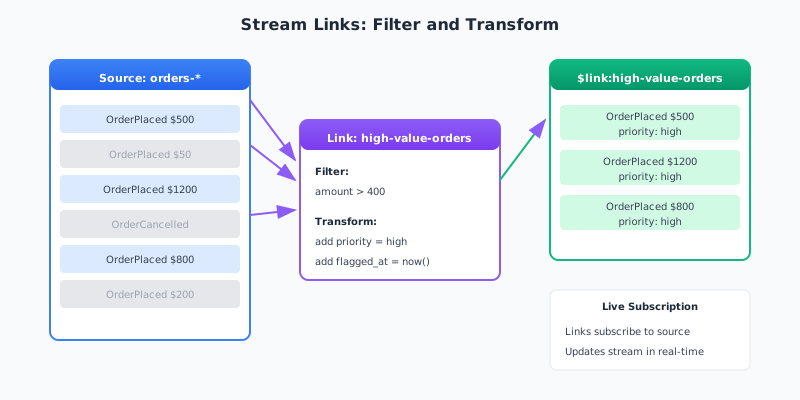
Stream links create derived streams that:
- Subscribe to source streams (with pattern matching)
- Filter events based on criteria
- Optionally transform/enrich events
- Make results available as a regular stream
Source Streams:              Link:                    Derived Stream:
┌──────────────────┐
│ orders-001       │─────┐   ┌───────────────────┐   ┌──────────────────┐
│ amount: 500      │     │   │                   │   │ $link:high-value │
├──────────────────┤     ├──→│ filter:           │──→│                  │
│ orders-002       │     │   │   amount > 1000   │   │ orders-002       │
│ amount: 2500     │─────┤   │                   │   │ orders-003       │
├──────────────────┤     │   │ transform:        │   │                  │
│ orders-003       │─────┘   │   add priority    │   └──────────────────┘
│ amount: 1500     │         │                   │
└──────────────────┘         └───────────────────┘
Where Does This Code Run?
| Operation | Location | Module |
|---|---|---|
| Create/configure links | Your Application | esdb_gater_api |
| Store link definitions | erl-esdb Server | erl_esdb_links |
| Filter/transform processing | erl-esdb Server | erl_esdb_link_worker |
| Subscribe to derived stream | Your Application | esdb_gater_api |
API Reference
Create a Link
%%--------------------------------------------------------------------
%% This code runs in: YOUR APPLICATION
%% Purpose: Create a derived stream for high-value orders
%%--------------------------------------------------------------------

esdb_gater_api:create_link(my_store, #{
    name => <<"high-value-orders">>,
    source => #{
        type => stream_pattern,
        pattern => <<"orders-*">>     %% Watch all order streams
    },
    filter => #{
        field => <<"amount">>,
        op => '>',
        value => 1000
    },
    transform => #{
        add_fields => #{
            <<"priority">> => <<"high">>,
            <<"flagged_at">> => {fn, fun() -> erlang:system_time(microsecond) end}
        }
    }
}).
Get Link Info
%%--------------------------------------------------------------------
%% This code runs in: YOUR APPLICATION
%% Purpose: Check link configuration and status
%%--------------------------------------------------------------------

{ok, Link} = esdb_gater_api:get_link(my_store, <<"high-value-orders">>).
%% => #{
%%     name => <<"high-value-orders">>,
%%     source => #{type => stream_pattern, pattern => <<"orders-*">>},
%%     filter => #{...},
%%     status => running,
%%     events_processed => 12345
%% }
List All Links
%%--------------------------------------------------------------------
%% This code runs in: YOUR APPLICATION
%% Purpose: Get all configured links for a store
%%--------------------------------------------------------------------

{ok, Links} = esdb_gater_api:list_links(my_store).
Start/Stop a Link
%%--------------------------------------------------------------------
%% This code runs in: YOUR APPLICATION
%% Purpose: Pause and resume link processing
%%--------------------------------------------------------------------

%% Stop processing (link remains configured, will resume from last position)
esdb_gater_api:stop_link(my_store, <<"high-value-orders">>).

%% Resume processing
esdb_gater_api:start_link(my_store, <<"high-value-orders">>).
Delete a Link
%%--------------------------------------------------------------------
%% This code runs in: YOUR APPLICATION
%% Purpose: Remove a link and its derived stream
%%--------------------------------------------------------------------

esdb_gater_api:delete_link(my_store, <<"high-value-orders">>).
Detailed Link Statistics
%%--------------------------------------------------------------------
%% This code runs in: YOUR APPLICATION
%% Purpose: Get detailed processing statistics
%%--------------------------------------------------------------------

{ok, Info} = esdb_gater_api:link_info(my_store, <<"high-value-orders">>).
%% => #{
%%     status => running,
%%     events_processed => 12345,      %% Events that matched filter
%%     events_filtered => 45678,       %% Events that didn't match
%%     last_processed_at => 1703001600000000,
%%     lag => 0,                       %% Events behind real-time
%%     source_streams => [<<"orders-001">>, <<"orders-002">>, ...]
%% }
Subscribing to Links
Links create streams prefixed with $link::
%%--------------------------------------------------------------------
%% This code runs in: YOUR APPLICATION
%% Purpose: Subscribe to derived stream events
%%--------------------------------------------------------------------

%% Subscribe to the derived stream via gateway (just like any other stream)
ok = esdb_gater_api:save_subscription(
    my_store,
    stream,
    <<"$link:high-value-orders">>,
    <<"my-handler">>,
    self(),
    #{}
).

%% Read from the derived stream
{ok, Events} = esdb_gater_api:stream_forward(
    my_store,
    <<"$link:high-value-orders">>,
    0,
    100
).
Filter Operators
| Operator | Description | Example |
|---|---|---|
= | Equals | #{field => <<"status">>, op => '=', value => <<"active">>} |
!= | Not equals | #{field => <<"type">>, op => '!=', value => <<"test">>} |
> | Greater than | #{field => <<"amount">>, op => '>', value => 100} |
>= | Greater or equal | #{field => <<"count">>, op => '>=', value => 5} |
< | Less than | #{field => <<"age">>, op => '<', value => 30} |
<= | Less or equal | #{field => <<"priority">>, op => '<=', value => 3} |
in | In list | #{field => <<"country">>, op => in, value => [<<"US">>, <<"UK">>]} |
contains | String contains | #{field => <<"email">>, op => contains, value => <<"@company.com">>} |
matches | Regex match | #{field => <<"sku">>, op => matches, value => <<"^SKU-\\d+">>} |
Compound Filters
%%--------------------------------------------------------------------
%% This code runs in: YOUR APPLICATION
%% Purpose: Combine multiple filter conditions
%%--------------------------------------------------------------------

%% AND filter (all conditions must match)
filter => #{
    type => 'and',
    filters => [
        #{field => <<"amount">>, op => '>', value => 1000},
        #{field => <<"status">>, op => '=', value => <<"completed">>}
    ]
}

%% OR filter (any condition matches)
filter => #{
    type => 'or',
    filters => [
        #{field => <<"priority">>, op => '=', value => <<"high">>},
        #{field => <<"amount">>, op => '>', value => 5000}
    ]
}
Transform Options
Add Static Fields
transform => #{
    add_fields => #{
        <<"processed_by">> => <<"link-worker">>,
        <<"link_version">> => 1
    }
}
Add Dynamic Fields
transform => #{
    add_fields => #{
        <<"processed_at">> => {fn, fun() -> erlang:system_time(microsecond) end},
        <<"random_id">> => {fn, fun() -> crypto:strong_rand_bytes(16) end}
    }
}
Remove Fields (Sanitize)
transform => #{
    remove_fields => [<<"internal_id">>, <<"debug_info">>, <<"password_hash">>]
}
Rename Fields
transform => #{
    rename_fields => #{
        <<"old_name">> => <<"new_name">>,
        <<"legacy_field">> => <<"modern_field">>
    }
}
Use Cases
1. Category-Based Views
Create per-category views from a mixed stream:
%%--------------------------------------------------------------------
%% This code runs in: YOUR APPLICATION
%% Purpose: Separate streams by product category
%%--------------------------------------------------------------------

%% Electronics orders
esdb_gater_api:create_link(my_store, #{
    name => <<"electronics-orders">>,
    source => #{type => stream_pattern, pattern => <<"orders-*">>},
    filter => #{field => <<"category">>, op => '=', value => <<"electronics">>}
}).

%% Clothing orders
esdb_gater_api:create_link(my_store, #{
    name => <<"clothing-orders">>,
    source => #{type => stream_pattern, pattern => <<"orders-*">>},
    filter => #{field => <<"category">>, op => '=', value => <<"clothing">>}
}).
2. Event Type Aggregation
Group events by type across all streams:
%%--------------------------------------------------------------------
%% This code runs in: YOUR APPLICATION
%% Purpose: All payment events in one stream
%%--------------------------------------------------------------------

esdb_gater_api:create_link(my_store, #{
    name => <<"all-payments">>,
    source => #{type => stream_pattern, pattern => <<"*">>},
    filter => #{field => <<"event_type">>, op => in, value => [
        <<"PaymentReceived">>,
        <<"PaymentFailed">>,
        <<"RefundIssued">>
    ]}
}).
3. Compliance Flagging
Automatically flag events for review:
%%--------------------------------------------------------------------
%% This code runs in: YOUR APPLICATION
%% Purpose: Flag high-value transactions for compliance review
%%--------------------------------------------------------------------

esdb_gater_api:create_link(my_store, #{
    name => <<"flagged-transactions">>,
    source => #{type => stream_pattern, pattern => <<"transactions-*">>},
    filter => #{field => <<"amount">>, op => '>', value => 10000},
    transform => #{
        add_fields => #{
            <<"requires_review">> => true,
            <<"flagged_at">> => {fn, fun() -> erlang:system_time(microsecond) end},
            <<"review_queue">> => <<"compliance">>
        }
    }
}).
Common Pitfalls
1. Overly Broad Patterns
%% BAD: Watching everything can be expensive
source => #{type => stream_pattern, pattern => <<"*">>}

%% GOOD: Be specific about what you need
source => #{type => stream_pattern, pattern => <<"orders-*">>}
2. Complex Filters on Hot Paths
%% BAD: Regex on every event is expensive
filter => #{field => <<"data">>, op => matches, value => complex_regex}

%% GOOD: Use simple equality checks when possible
filter => #{field => <<"type">>, op => '=', value => <<"payment">>}
3. Not Monitoring Lag
%% BAD: Ignoring link health
esdb_gater_api:create_link(my_store, #{...}).
%% ... never check if it's keeping up

%% GOOD: Monitor lag for real-time requirements
check_link_health(LinkName) ->
    {ok, Info} = esdb_gater_api:link_info(my_store, LinkName),
    Lag = maps:get(lag, Info),
    if Lag > 1000 ->
        logger:warning("Link ~p is ~p events behind", [LinkName, Lag]);
       true -> ok
    end.
4. Transforming Critical Data
%% BAD: Removing fields you might need later
transform => #{remove_fields => [<<"metadata">>]}

%% GOOD: Be conservative about data removal
transform => #{
    remove_fields => [<<"internal_debug">>, <<"temp_marker">>]
    %% Keep metadata, causation_id, correlation_id, etc.
}
When NOT to Use Stream Links
- Simple subscriptions - If you just need to react to events, use regular subscriptions
- One-time queries - For ad-hoc analysis, use temporal queries instead
- Complex transformations - If transformation logic is complex, build a proper projection
- Cross-store aggregation - Links work within a single store
Performance Considerations
- Links process events asynchronously (won't block writers)
- Backpressure-aware (won't overwhelm consumers)
- Can be paused/resumed for maintenance
- Monitor
lagmetric for real-time requirements - Use specific patterns over wildcards when possible
Related Guides
- Subscriptions - Subscribe to derived streams
- Event Sourcing - Core concepts
- CQRS - Links as lightweight projections