State Modules
View SourceState modules separate the aggregate's data shape and event folding from its command validation and business rules. The aggregate decides WHAT happens; the state module decides HOW the data changes.
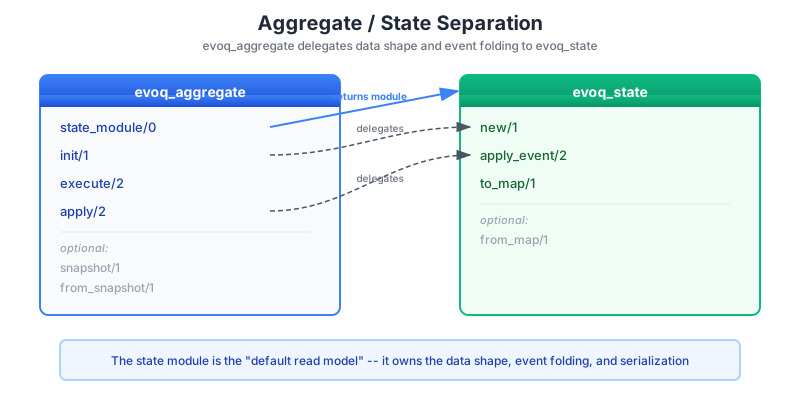
The "Default Read Model"
The aggregate state IS the complete truth about one process instance. It is the "default read model" -- the authoritative representation of everything that has happened to a single aggregate, built by replaying every event in order.
This matters because:
- Event payloads are a subset of aggregate state plus new data from the command
- Command payloads are a subset of aggregate state plus enrichment from outside (read models, user input)
- Data from outside the bounded context enters ONLY through enriched command payloads
- Inside the CMD flow (aggregate state, events, process managers) there are NO external lookups
The practical test: "Can I delete all read models, replay events, and get the same aggregate state?" If yes, the state module is correctly self-contained.
Why Separate State?
Without separation, the aggregate handles three concerns:
- Command validation and business rules
- Data shape and field access
- Event folding and serialization
Pulling the last two into a dedicated state module gives you:
| Concern | Aggregate | State Module |
|---|---|---|
| Command validation | Yes | No |
| Business rules | Yes | No |
| Data shape (record) | No | Yes |
| Field access | No | Yes |
| Event folding | No | Yes |
| Serialization | No | Yes |
The aggregate becomes a pure decision-maker. The state module becomes a pure data transformer.
The evoq_state Behaviour
The behaviour is defined in evoq_state and provides three required callbacks plus one optional.
Required Callbacks
new/1 -- Create initial (empty) state for a new aggregate.
-callback new(AggregateId :: binary()) -> State :: term().Called when an aggregate is first created. Returns the initial state before any events have been applied.
apply_event/2 -- Apply a single event to update state.
-callback apply_event(State :: term(), Event :: map()) -> State :: term().Must be pure and deterministic. Called for each event produced by execute/2 and during replay. Same input must always produce same output, with no side effects.
to_map/1 -- Serialize state to a map.
-callback to_map(State :: term()) -> map().Used for session-level consistency feedback (dispatch_with_state/2), snapshot serialization, and programmatic state inspection.
Optional Callbacks
from_map/1 -- Deserialize state from a map.
-callback from_map(Map :: map()) -> {ok, State :: term()} | {error, Reason :: term()}.Used for snapshot loading and state reconstruction from external sources. If not implemented, snapshot loading is not available.
Declaring the State Module
Every aggregate MUST declare which state module it uses via the state_module/0 callback:
-module(counter_aggregate).
-behaviour(evoq_aggregate).

state_module() -> counter_state.
The aggregate then delegates state operations to the state module:
init(AggregateId) ->
    {ok, counter_state:new(AggregateId)}.

apply(State, Event) ->
    counter_state:apply_event(State, Event).
Complete Example
A counter aggregate that supports increment and decrement operations.
The State Record
%% include/counter_state.hrl

-record(counter_state, {
    id        :: binary(),
    value = 0 :: integer(),
    status = 0 :: non_neg_integer()  %% bit flags
}).
The State Module
-module(counter_state).
-behaviour(evoq_state).

-include("counter_state.hrl").

-export([new/1, apply_event/2, to_map/1, from_map/1]).

%% --- evoq_state callbacks ---

new(AggregateId) ->
    #counter_state{id = AggregateId}.

apply_event(State, #{event_type := <<"CounterInitiated">>, data := Data}) ->
    State#counter_state{
        value = maps:get(initial_value, Data, 0),
        status = evoq_bit_flags:set(0, 1)  %% flag 1 = initiated
    };
apply_event(#counter_state{value = V} = State, #{event_type := <<"CounterIncremented">>, data := #{amount := Amount}}) ->
    State#counter_state{value = V + Amount};
apply_event(#counter_state{value = V} = State, #{event_type := <<"CounterDecremented">>, data := #{amount := Amount}}) ->
    State#counter_state{value = V - Amount}.

to_map(#counter_state{id = Id, value = Value, status = Status}) ->
    #{
        id => Id,
        value => Value,
        status => Status
    }.

from_map(#{id := Id, value := Value, status := Status}) ->
    {ok, #counter_state{id = Id, value = Value, status = Status}};
from_map(_) ->
    {error, invalid_state_map}.
The Aggregate
-module(counter_aggregate).
-behaviour(evoq_aggregate).

-include("counter_state.hrl").

-export([state_module/0, init/1, execute/2, apply/2]).

state_module() -> counter_state.

init(AggregateId) ->
    {ok, counter_state:new(AggregateId)}.

%% --- Command validation and business rules ---

execute(#counter_state{status = 0}, #{command_type := initiate_counter, initial_value := Value}) ->
    {ok, [#{event_type => <<"CounterInitiated">>, data => #{initial_value => Value}}]};
execute(#counter_state{status = 0}, _Command) ->
    {error, counter_not_initiated};

execute(#counter_state{}, #{command_type := increment, amount := Amount}) when Amount > 0 ->
    {ok, [#{event_type => <<"CounterIncremented">>, data => #{amount => Amount}}]};
execute(#counter_state{}, #{command_type := increment, amount := Amount}) when Amount =< 0 ->
    {error, {invalid_amount, Amount}};

execute(#counter_state{value = V}, #{command_type := decrement, amount := Amount})
  when Amount > 0, V >= Amount ->
    {ok, [#{event_type => <<"CounterDecremented">>, data => #{amount => Amount}}]};
execute(#counter_state{value = V}, #{command_type := decrement, amount := Amount})
  when Amount > 0, V < Amount ->
    {error, {would_go_negative, V, Amount}};

execute(_State, _Command) ->
    {error, unknown_command}.

%% --- Delegate event folding to state module ---

apply(State, Event) ->
    counter_state:apply_event(State, Event).
Notice how the aggregate focuses entirely on command validation (business rules, guards, preconditions) while the state module handles data transformation. The aggregate pattern-matches on state to enforce rules but never directly modifies the record.
Conventions
Naming
State modules follow the pattern: the noun that the aggregate manages, suffixed with _state.
| Aggregate | State Module | Header |
|---|---|---|
| venture_aggregate | venture_state | venture_state.hrl |
| order_aggregate | order_state | order_state.hrl |
| counter_aggregate | counter_state | counter_state.hrl |
Record and Header
The state record is defined in a header file named after the state module. Both the aggregate and the state module include it:
%% In counter_state.erl
-include("counter_state.hrl").

%% In counter_aggregate.erl
-include("counter_state.hrl").
This allows the aggregate to pattern-match on state fields for command validation without duplicating the record definition.
Purity
apply_event/2 MUST be pure and deterministic:
- No side effects (no I/O, no process messaging, no ETS writes)
- No calls to erlang:system_time or other non-deterministic functions
- Same event applied to same state always produces same result
- This guarantees correct replay from the event store
Serialization
to_map/1 serves three purposes:
- Session-level consistency -- dispatch_with_state/2 returns the aggregate state as a map to the caller, enabling immediate feedback without waiting for projections
- Snapshot serialization -- Snapshots store the aggregate state for faster loading
- Programmatic inspection -- Debugging, monitoring, and tooling can inspect state without knowing the record structure
Status as Bit Flags
Status fields in state records MUST be integers treated as bit flags. Use evoq_bit_flags for all status manipulation:
-define(INITIATED,  1).  %% 2^0
-define(ACTIVE,     2).  %% 2^1
-define(SUSPENDED,  4).  %% 2^2
-define(ARCHIVED,   8).  %% 2^3

apply_event(State, #{event_type := <<"CounterInitiated">>} = _Event) ->
    State#counter_state{
        status = evoq_bit_flags:set(0, ?INITIATED)
    }.
Testing State Modules
State modules are easy to test in isolation since they are pure functions:
-module(counter_state_tests).
-include_lib("eunit/include/eunit.hrl").
-include("counter_state.hrl").

new_test() ->
    State = counter_state:new(<<"test-1">>),
    ?assertEqual(<<"test-1">>, State#counter_state.id),
    ?assertEqual(0, State#counter_state.value).

apply_increment_test() ->
    State0 = counter_state:new(<<"test-1">>),
    Event = #{event_type => <<"CounterIncremented">>, data => #{amount => 5}},
    State1 = counter_state:apply_event(State0, Event),
    ?assertEqual(5, State1#counter_state.value).

roundtrip_serialization_test() ->
    State0 = counter_state:new(<<"test-1">>),
    Map = counter_state:to_map(State0),
    {ok, State1} = counter_state:from_map(Map),
    ?assertEqual(State0, State1).
Because apply_event/2 is pure, you can test every event type without standing up any infrastructure. Compose events to test complex state transitions:
full_lifecycle_test() ->
    State0 = counter_state:new(<<"test-1">>),
    Events = [
        #{event_type => <<"CounterInitiated">>, data => #{initial_value => 10}},
        #{event_type => <<"CounterIncremented">>, data => #{amount => 5}},
        #{event_type => <<"CounterDecremented">>, data => #{amount => 3}}
    ],
    Final = lists:foldl(fun counter_state:apply_event/2, State0, Events),
    ?assertEqual(12, Final#counter_state.value).
Next Steps
- Aggregates -- Command validation and business rules
- Projections -- Build read models from events
- Integration Actors -- Move facts across boundaries
- Bit Flags -- Status field conventions