Macula Clustering Guide
View SourceThis guide covers Macula's LAN clustering capabilities, including gossip-based discovery, the Cluster API, distribution management, and cookie management.
Note: Clustering via gossip/mDNS is designed for LAN environments (same subnet). For WAN connectivity across networks, use the relay mesh (see the Dist Over Mesh guide).
Overview
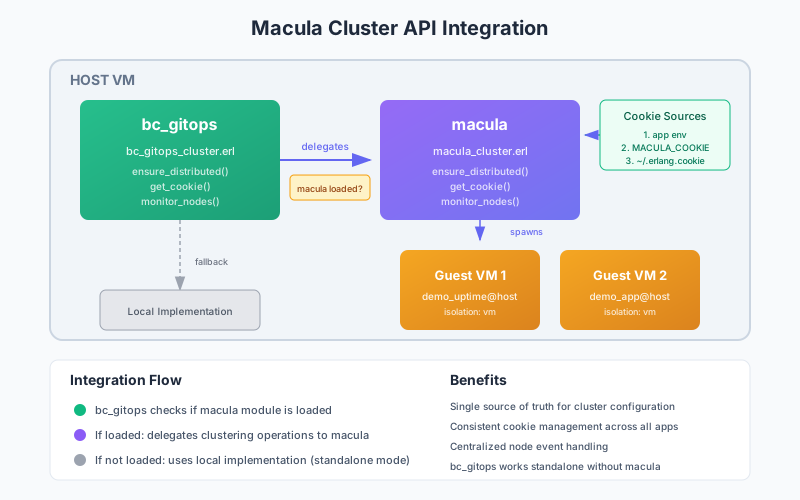
The Macula Cluster API (macula_cluster.erl) provides a standardized interface for:
- Cluster Formation - Starting clusters with various discovery strategies
- Distribution Management - Starting and verifying Erlang distribution
- Cookie Management - Resolving, setting, and persisting cluster cookies
- Node Monitoring - Subscribing to node join/leave events
Cluster Strategies
| Strategy | Discovery | Configuration | Network | Use Case |
|---|---|---|---|---|
| gossip | Automatic (UDP multicast) | Zero-config | LAN multicast | Development, same-subnet production |
| static | Manual | Node list required | Any | Known node sets, cross-subnet |
| mdns | Automatic (mDNS/Bonjour) | Zero-config | LAN mDNS | macOS/Linux local development |
Quick Start
Via macula_cluster API (Recommended)
%% Start with gossip strategy (default)
ok = macula_cluster:start_cluster(#{strategy => gossip}).

%% With shared secret for cluster isolation
ok = macula_cluster:start_cluster(#{
    strategy => gossip,
    secret => <<"my_cluster_secret">>
}).

%% With static node list
ok = macula_cluster:start_cluster(#{
    strategy => static,
    nodes => ['node1@host1', 'node2@host2']
}).
Erlang (Direct Gossip)
%% Start with defaults
{ok, _Pid} = macula_cluster_gossip:start_link(#{}).

%% With custom configuration
{ok, _Pid} = macula_cluster_gossip:start_link(#{
    multicast_addr => {230, 1, 1, 251},
    port => 45892,
    broadcast_interval => 1500,
    secret => <<"my_cluster_secret">>
}).
Elixir (Phoenix Application)
def start(_type, _args) do
  :macula_cluster.start_cluster(%{strategy: :gossip})

  children = [
    # ... your supervision tree
  ]

  Supervisor.start_link(children, strategy: :one_for_one)
end
Gossip Clustering
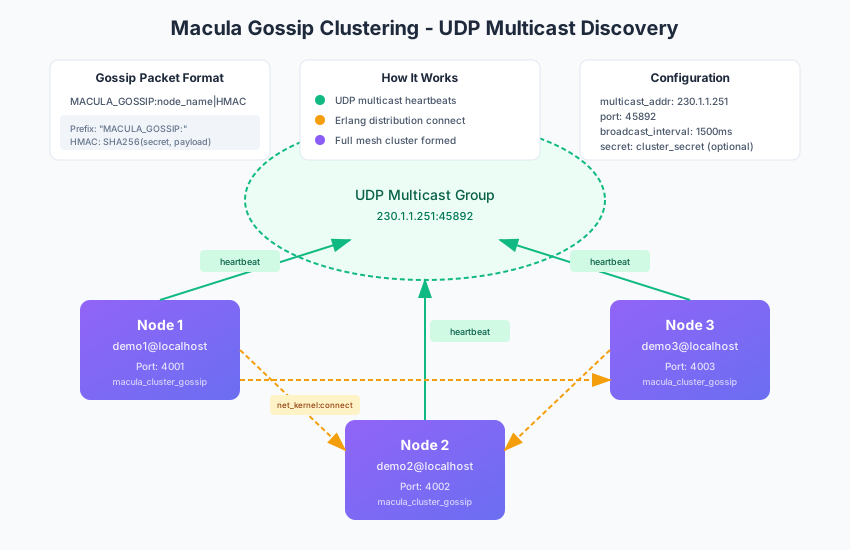
The macula_cluster_gossip module provides automatic cluster discovery using UDP multicast, implemented natively in Erlang.
How It Works
- Join Multicast Group: Each node joins the UDP multicast group (default:
230.1.1.251:45892) - Broadcast Heartbeats: Nodes periodically broadcast their Erlang node name
- Discover Peers: When a heartbeat is received from an unknown node, it's added to discovered set
- Connect via Distribution: Newly discovered nodes are connected using
net_kernel:connect_node/1 - Full Mesh: All nodes eventually connect to form a full mesh cluster
Configuration Options
| Option | Type | Default | Description |
|---|---|---|---|
multicast_addr | {A,B,C,D} | {230,1,1,251} | Multicast group address |
port | integer() | 45892 | UDP port for gossip |
broadcast_interval | integer() | 1500 | Milliseconds between heartbeats |
multicast_ttl | integer() | 1 | Time-to-live (1 = same subnet) |
secret | binary() | undefined | Shared secret for HMAC authentication |
callback | pid() | {M,F} | undefined | Callback for cluster events |
HMAC Authentication
When a secret is configured, all gossip packets include an HMAC-SHA256 signature:
MACULA_GOSSIP:node_name|<HMAC-SHA256>- Without secret: Nodes accept any valid-looking gossip packet
- With secret: Nodes verify HMAC before accepting the packet
Environment Variables
MACULA_GOSSIP_ADDR=230.1.1.251
MACULA_GOSSIP_PORT=45892
MACULA_GOSSIP_SECRET=my_cluster_secret
CLUSTER_STRATEGY=gossip
CLUSTER_SECRET=my_cluster_secret
Gossip Query API
%% Get all discovered nodes (may not be connected yet)
Discovered = macula_cluster_gossip:get_discovered().

%% Get connected nodes
Connected = macula_cluster_gossip:get_connected().

%% Force immediate broadcast (useful for testing)
ok = macula_cluster_gossip:broadcast_now().
Distribution Management
Ensure Distributed Mode
ok = macula:ensure_distributed().If the node is already distributed, returns ok immediately. Otherwise, starts distribution with a generated node name in the format macula_host@hostname.
Cookie Management
macula:get_cookie/0
Resolves the cookie from sources in priority order:
- Application env:
{macula, [{cookie, CookieValue}]} - Environment variable:
MACULA_COOKIEorRELEASE_COOKIEorERLANG_COOKIE - Cookie file:
~/.erlang.cookie - Auto-generated: Creates and persists a new cookie
Cookie = macula:get_cookie().macula:set_cookie/1
Sets the Erlang cookie for this node and persists it.
ok = macula:set_cookie(my_secret_cookie).
ok = macula:set_cookie(<<"my_secret_cookie">>).
Configuration
%% sys.config
[{macula, [{cookie, 'my_cluster_cookie'}]}].
export MACULA_COOKIE="my_cluster_cookie"
export RELEASE_COOKIE="my_cluster_cookie"
Node Monitoring
Subscribe to Events
ok = macula:monitor_nodes().

receive
    {nodeup, Node} -> io:format("Node joined: ~p~n", [Node]);
    {nodedown, Node} -> io:format("Node left: ~p~n", [Node])
end.
Unsubscribe
ok = macula:unmonitor_nodes().Gossip-Specific Callbacks
%% Using a PID
{ok, _} = macula_cluster_gossip:start_link(#{callback => self()}).

receive
    {macula_cluster, nodeup, Node} -> handle_join(Node);
    {macula_cluster, nodedown, Node} -> handle_leave(Node)
end.

%% Using module/function callback
{ok, _} = macula_cluster_gossip:start_link(#{
    callback => {my_module, handle_cluster_event}
}).
Integration with bc_gitops
bc_gitops uses an optional dependency pattern to delegate to Macula when available:
%% In bc_gitops_cluster.erl
ensure_distributed() ->
    case macula_exports(ensure_distributed, 0) of
        true -> apply(macula, ensure_distributed, []);
        false -> do_ensure_distributed()
    end.

macula_exports(Function, Arity) ->
    macula_available() andalso
    erlang:function_exported(macula, Function, Arity).

macula_available() ->
    case code:ensure_loaded(macula) of
        {module, macula} -> true;
        {error, _} -> false
    end.
This ensures bc_gitops works standalone (without Macula) and delegates when Macula is present.
Docker Compose Example
services:
  node1:
    image: my-app:latest
    network_mode: host  # Required for UDP multicast
    environment:
      - RELEASE_NODE=node1@localhost
      - RELEASE_COOKIE=my_secret_cookie
      - CLUSTER_STRATEGY=gossip
      - CLUSTER_SECRET=demo_secret

  node2:
    image: my-app:latest
    network_mode: host
    environment:
      - RELEASE_NODE=node2@localhost
      - RELEASE_COOKIE=my_secret_cookie
      - CLUSTER_STRATEGY=gossip
      - CLUSTER_SECRET=demo_secret
Network Requirements
Firewall Rules
# Allow UDP multicast traffic
iptables -A INPUT -p udp --dport 45892 -j ACCEPT
iptables -A OUTPUT -p udp --dport 45892 -j ACCEPT

# For Erlang distribution (EPMD and distribution ports)
iptables -A INPUT -p tcp --dport 4369 -j ACCEPT
iptables -A INPUT -p tcp --dport 9100:9200 -j ACCEPT
Docker Networking
Host Networking (Recommended for development):
network_mode: hostMacvlan (Production):
networks:
  macvlan_net:
    driver: macvlan
    driver_opts:
      parent: eth0
    ipam:
      config:
        - subnet: 192.168.1.0/24
Troubleshooting
Nodes Not Discovering Each Other
- Check multicast support:
ping -c 3 230.1.1.251 Verify UDP port is open:
ss -ulnp | grep 45892- Check Docker networking: Must use host networking for multicast
- Verify cookie matches:
erlang:get_cookie().
Authentication Failures
If nodes have mismatched secrets:
[warning] [macula_cluster_gossip] Invalid HMAC from <IP> (authentication failed)Ensure all nodes use the same CLUSTER_SECRET environment variable.
High CPU Usage
If broadcast_interval is too low, increase it:
{ok, _} = macula_cluster_gossip:start_link(#{broadcast_interval => 5000}).Security Best Practices
- Always use a secret in production - Prevents unauthorized nodes from joining
- Rotate secrets periodically - Coordinate rotation across all nodes
- Use network segmentation - Limit multicast scope with VLANs
- Set TTL appropriately -
multicast_ttl => 1limits to same subnet
Testing
# Run gossip clustering tests
rebar3 eunit --module=macula_cluster_gossip_tests

# Run cluster API tests
rebar3 eunit --module=macula_cluster_tests

# Run full cluster test suite
rebar3 eunit --dir=test/macula_dist_system
Related Documentation
- Dist Over Mesh Guide - WAN connectivity via relay mesh
- Erlang Distribution Protocol