The World Wide BEAM Computer
View SourceYour BEAM nodes can find each other anywhere on the planet.
Macula turns the internet into a single Erlang cluster. Any node
connected to the relay mesh can net_adm:ping, gen_server:call,
pg:join, and monitor any other node — across NATs, firewalls,
datacenters, and continents. Same OTP primitives you already know.
No VPN. No port forwarding. No static IPs. Just connect to a relay and your node is part of the world-wide BEAM computer.
3 Lines to Join
Start your node with Macula as the distribution protocol:
erl -proto_dist macula -no_epmd -start_epmd false \
    -kernel net_ticktime 120 \
    -name mynode@myhost -setcookie MYSECRET
Then join the mesh:
ok = macula:join_mesh(#{
    relays => [<<"https://relay-de-berlin.macula.io:4433">>]
}).
That's it. Now ping any other node on the mesh:
pong = net_adm:ping('othernode@otherhost').

%% Everything works:
gen_server:call({my_server, 'othernode@otherhost'}, hello).
pg:join(my_group, self()).
monitor(process, {my_server, 'othernode@otherhost'}).
rpc:call('othernode@otherhost', erlang, node, []).
How It Works
When you call macula:join_mesh/1, three things happen:
- Connect to relay — your node establishes an outbound QUIC connection to a relay in the mesh (NAT-friendly, firewall-friendly)
- Enable relay distribution — Erlang's distribution protocol is tunneled through the relay mesh instead of direct TCP
- Advertise — your node registers itself so other nodes can find it
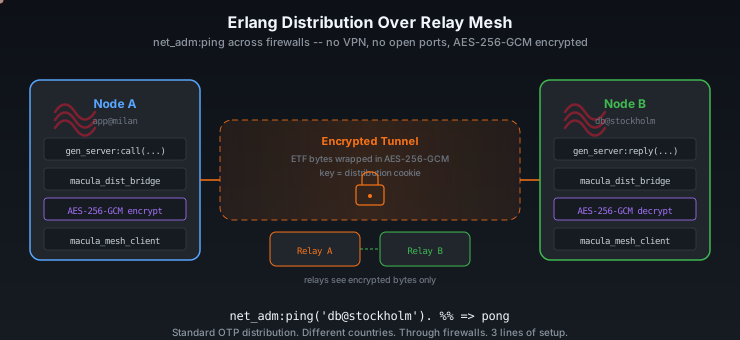
When you net_adm:ping('other@host'), Macula:
- Sends a tunnel request via the relay mesh to
other@host - Both sides create encrypted AES-256-GCM tunnels (key derived from cookie)
- OTP's
dist_utilhandshake flows through the tunnel - Post-handshake: standard distribution traffic, tick keepalive, everything
The relay sees encrypted bytes — it cannot read your Erlang terms.
join_mesh Options
macula:join_mesh(#{
    relays => [<<"https://relay-de-berlin.macula.io:4433">>,
               <<"https://relay-fi-helsinki.macula.io:4433">>],
    realm => <<"io.macula">>,           %% default
    identity => <<"myapp-prod-1">>,     %% default: node name
    tls_verify => none                  %% default: none (dev mode)
}).| Option | Default | Description |
|---|---|---|
relays | required | List of relay URLs to connect to |
realm | <<"io.macula">> | Mesh realm (nodes must share a realm) |
identity | node name | How this node identifies itself |
tls_verify | none | none for dev, verify_peer for production |
What Nodes Need to Share
| Requirement | Why |
|---|---|
| Same cookie | Erlang authentication + tunnel encryption key |
| Same realm | Relay mesh routing scope |
| Connected to peered relays | Relays must be able to reach each other |
-proto_dist macula | Use Macula as the distribution protocol |
That's it. No shared network, no VPN, no port forwarding.
When to Use This
| Scenario | Approach |
|---|---|
| Nodes on same LAN | Direct QUIC (-proto_dist macula) |
| Nodes behind NATs/firewalls | Relay mesh — macula:join_mesh/1 |
| Nodes in different datacenters | Relay mesh |
| Nodes on different relays | Relay mesh (cross-relay via peering) |
| Mnesia replication | Direct QUIC (relay adds latency) |
Cross-Relay Distribution
Nodes don't need to be on the same relay. If Node A is on
relay-it-milan (Nuremberg box) and Node B is on relay-se-stockholm
(Helsinki box), the relays forward tunnel traffic through their
peering connections.
Node A → relay-it-milan ──peering──► relay-se-stockholm → Node BSWIM protocol detects relay health. Bloom filter routing ensures tunnel topics are forwarded between relays.
Architecture Details
Tunnel Bridge
Each tunnel is managed by a supervised macula_dist_bridge gen_server.
The bridge owns a gen_tcp loopback socket pair — one end goes to
OTP's dist_util, the other is bridged to the relay mesh.
macula_dist_system (one_for_one)
  ├── macula_dist_bridge_sup (simple_one_for_one)
  │     └── macula_dist_bridge (gen_server, per tunnel, temporary)
  │           ├── owns BridgeSock (gen_tcp, {packet, raw})
  │           ├── linked reader process (gen_tcp:recv → encrypt → publish)
  │           ├── handle_info: tunnel_in → decrypt → gen_tcp:send
  │           ├── monitors relay client (reconnects on DOWN)
  │           └── per-tunnel counters (bytes/msgs in/out)
  ├── macula_dist_discovery (DHT node discovery)
  └── macula_cluster_strategy (optional auto-clustering)
Encryption
All tunnel bytes are encrypted with AES-256-GCM. The key is derived from the Erlang distribution cookie:
Key = SHA-256("macula-dist-tunnel:" ++ cookie)Each message gets a random 12-byte nonce (prepended to ciphertext).
A wrong cookie produces decrypt_failed warnings.
Relay Reconnection
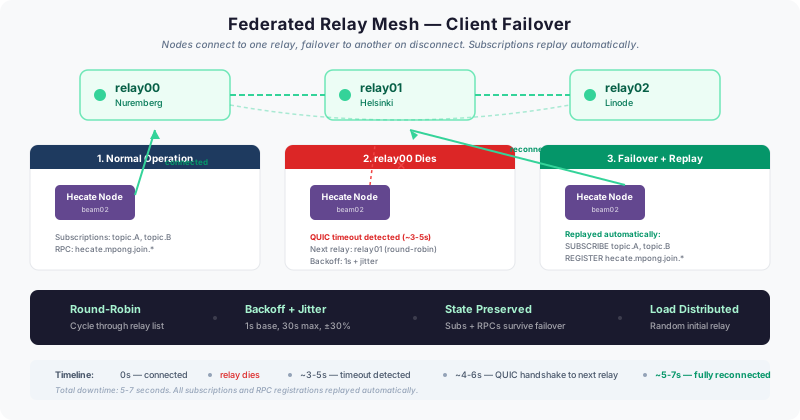
If the relay drops (QUIC disconnect, relay restart), the bridge:
- Detects
DOWNmonitor signal - Re-acquires relay client from
persistent_term - Re-subscribes to tunnel topics
- Retries every 2s, up to 15 attempts (30s window)
If reconnection completes within net_ticktime (default: 120s),
the distribution connection survives transparently.
Metrics
macula_dist_relay:get_tunnel_metrics().
%% => [{<<"abc123">>, #{bytes_out => 4096, bytes_in => 2048,
%%                       msgs_out => 12, msgs_in => 8}}]
Limitations
- Latency: Every message goes through the relay (2 extra hops)
- Mnesia: Not recommended over WAN latency
- global module: May have convergence issues over high-latency links
- Throughput: Limited by relay bandwidth and pub/sub overhead
Troubleshooting
ping returns pang
- Verify both nodes started with
-proto_dist macula -no_epmd - Verify both called
macula:join_mesh/1(or the manual setup) - Verify cookies match (
-setcookie) - Verify relays are peered (check SWIM logs)
- Node names are case-sensitive
Connection drops after handshake
- Increase
net_ticktimeto 120+ (-kernel net_ticktime 120) - Check
macula_dist_relay:get_tunnel_metrics()for active tunnels
Configuration Reference
| Env Variable | Default | Description |
|---|---|---|
MACULA_DIST_MODE | (unset) | Set to relay automatically by join_mesh/1 |
| Module Define | Value | Description |
|---|---|---|
DIST_TIMEOUT | 25000ms | Tunnel negotiation timeout |
BRIDGE_RECV_TIMEOUT | 60000ms | Bridge reader/writer timeout |
CONTROLLER_TIMEOUT | 30000ms | Kernel controller timeout |
BACKPRESSURE_HWM | 64 | Relay client queue depth before pause |
RECONNECT_INTERVAL | 2000ms | Retry interval when relay client is down |
RECONNECT_MAX_ATTEMPTS | 15 | Max retries (15 x 2s = 30s window) |