Communication Silo Guide
View SourceThe Communication Silo manages signaling and language evolution: signal repertoires, protocol evolution, coordination messages, and deception detection. Multi-agent systems need communication to coordinate, and evolved communication is more robust than hard-coded protocols.
Overview
Traditional multi-agent systems use fixed communication protocols. The Communication Silo enables evolved communication:
- Signal invention - Agents create new signals with meanings
- Signal adoption - Successful signals spread through population
- Coordination - Agents coordinate through messaging
- Honesty/deception - Honest signaling evolves under pressure
- Dialect formation - Subgroups develop distinct languages
Why Evolved Communication?
| Hard-coded Protocols | Evolved Communication |
|---|---|
| Fixed signal meanings | Adaptive semantics |
| No coordination discovery | Protocols emerge |
| Cannot handle novelty | Adapts to new situations |
| Opaque agent behavior | Interpretable signals |
| Single global language | Dialect specialization |
Architecture
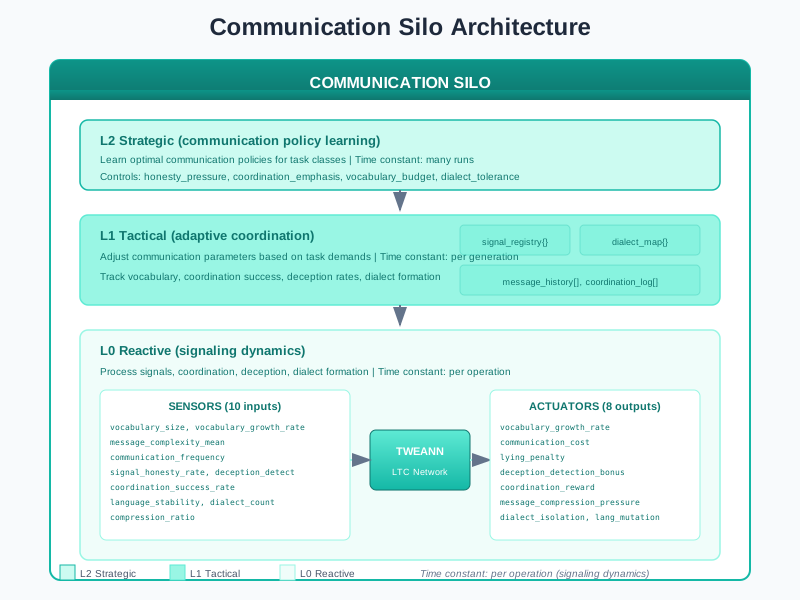
The Communication Silo uses TWEANN controllers at three levels:
| Level | Time Constant | Controls |
|---|---|---|
| L2 Strategic | Many runs | Optimal communication policies for task classes |
| L1 Tactical | Per generation | Adapt parameters based on coordination success |
| L0 Reactive | Per operation | Process signals, coordination, deception |
Sensors (10 inputs)
The L0 controller receives 10 communication measurements:
| Sensor | Range | Description |
|---|---|---|
vocabulary_size | [0.0, 1.0] | Distinct signals / max possible |
vocabulary_growth_rate | [-1.0, 1.0] | Rate of new signal creation |
message_complexity_mean | [0.0, 1.0] | Average message length/structure |
communication_frequency | [0.0, 1.0] | Messages per interaction |
signal_honesty_rate | [0.0, 1.0] | Proportion of honest signals |
deception_detection_rate | [0.0, 1.0] | Success at detecting lies |
coordination_success_rate | [0.0, 1.0] | Success of coordinated actions |
language_stability | [0.0, 1.0] | How stable the language is |
dialect_count | [0.0, 1.0] | Number of distinct dialects (normalized) |
compression_ratio | [0.0, 1.0] | Information per signal unit |
Actuators (8 outputs)
The controller adjusts 8 communication parameters:
| Actuator | Range | Default | Effect |
|---|---|---|---|
vocabulary_growth_rate | [0.0, 0.1] | 0.02 | Speed of vocabulary expansion |
communication_cost | [0.0, 0.2] | 0.05 | Energy cost per message |
lying_penalty | [0.0, 0.5] | 0.2 | Fitness penalty for detected lies |
deception_detection_bonus | [0.0, 0.3] | 0.1 | Bonus for catching liars |
coordination_reward | [0.0, 0.5] | 0.2 | Bonus for successful coordination |
message_compression_pressure | [0.0, 0.5] | 0.1 | Pressure to compress messages |
dialect_isolation | [0.0, 1.0] | 0.3 | How isolated dialects become |
language_mutation_rate | [0.0, 0.1] | 0.02 | Rate of signal meaning change |
Communication Dynamics
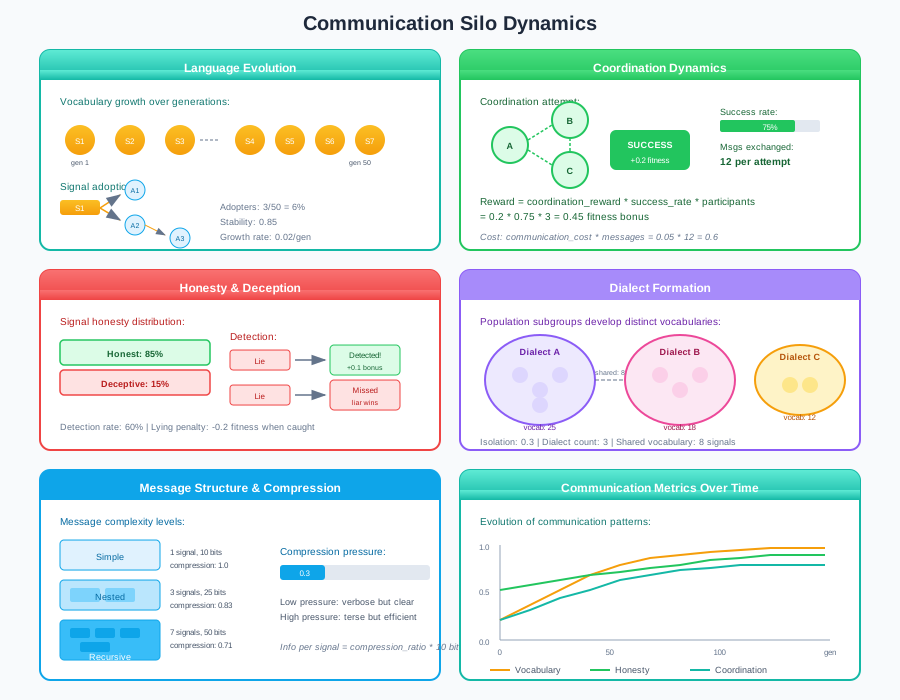
Signal Evolution
Signals evolve meanings through invention and adoption:
| Phase | Description | Example |
|---|---|---|
| Invention | Agent creates new signal | Agent A invents "food here" signal |
| Use | Inventor uses signal | A sends signal when finding food |
| Adoption | Others learn meaning | B, C observe and adopt |
| Stabilization | Signal becomes standard | Whole population uses signal |
Vocabulary growth:
%% New signals created per generation
new_signals = vocabulary_growth_rate * population_size
%% Signal stabilizes when adopted by >50% of population
Coordination
Agents coordinate through message exchange:
| Step | Action | Result |
|---|---|---|
| 1 | Agent A proposes action | Sends coordination message |
| 2 | Agents B, C respond | Agreement/disagreement signals |
| 3 | Action executed | All participants act together |
| 4 | Outcome recorded | Success/failure tracked |
Coordination reward:
reward = coordination_reward * success_rate * num_participants
%% Cost of coordination:
cost = communication_cost * messages_exchanged
Honesty and Deception
Evolutionary pressure shapes honest signaling:
| Behavior | Effect | Selection Pressure |
|---|---|---|
| Honest signaling | Builds trust | Coordination benefits |
| Deception | Short-term gain | Lying penalty if caught |
| Detection | Catches liars | Detection bonus reward |
Equilibrium:
- High lying penalty + high detection = honest population
- Low lying penalty + low detection = deceptive population
- Balance emerges from evolutionary dynamics
Dialect Formation
Subgroups develop distinct languages:
| Factor | Effect on Dialects |
|---|---|
| Geographic isolation | Groups drift apart linguistically |
| Coalition structure | Coalitions develop secret codes |
| Specialization | Task-specific vocabularies |
| Cultural diversity | Multiple communication styles |
Dialect isolation:
%% Shared vocabulary between dialects
shared_vocab = total_vocab * (1 - dialect_isolation)
%% Higher isolation = more distinct dialects
Integration with Other Silos
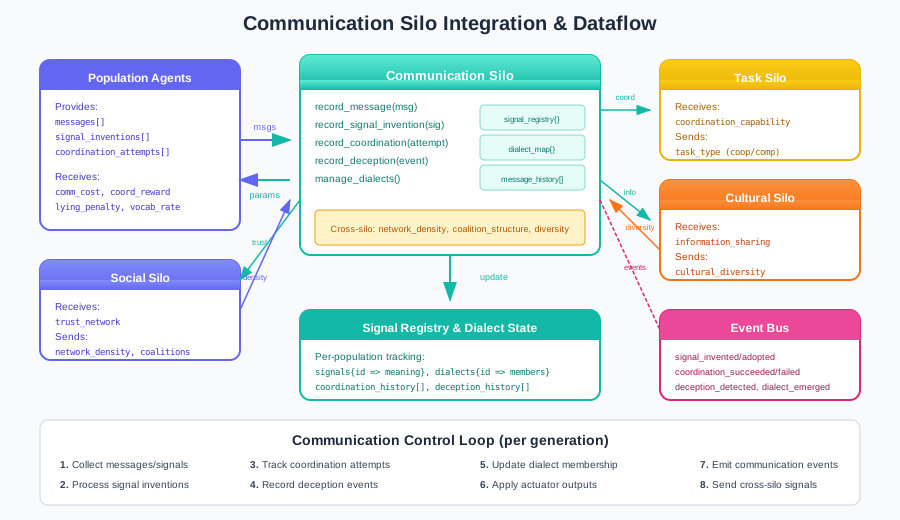
Outgoing Signals
| Signal | To Silo | Trigger |
|---|---|---|
coordination_capability | Task | Based on coordination success rate |
information_sharing | Cultural | Based on communication frequency |
trust_network | Social | Based on signal honesty rate |
language_complexity | Developmental | Based on message complexity |
trade_communication | Economic | Coordination * frequency |
Incoming Signals
| Signal | From Silo | Effect |
|---|---|---|
social_network_density | Social | Dense networks = more communication |
coalition_structure | Social | Coalitions develop shared signals |
cultural_diversity | Cultural | Diversity creates dialects |
population_structure | Distribution | Isolated groups form dialects |
stress_level | Ecological | Stress may increase honest signaling |
Signal Examples
%% Receive social network density from social silo
handle_cast({cross_silo, social_network_density, Density}, State) ->
    %% Dense networks increase communication baseline
    NewFrequency = State#state.base_frequency * (1 + Density * 0.5),
    {noreply, State#state{communication_frequency = NewFrequency}};

%% Send coordination capability to task silo
send_cross_silo_signals(SensorValues, State) ->
    PopId = State#communication_state.population_id,
    CoordSuccess = maps:get(coordination_success_rate, SensorValues, 0.5),
    task_silo:receive_signal(PopId, coordination_capability, CoordSuccess).
Events Emitted
| Event | Payload | Trigger |
|---|---|---|
signal_invented | {inventor_id, signal, meaning} | New signal created |
signal_adopted | {adopter_id, signal, source_id} | Signal spread to another |
message_sent | {sender_id, receiver_ids, signal_count} | Communication occurred |
deception_detected | {detector_id, liar_id, signal} | Lie caught |
coordination_succeeded | {participant_ids, action, outcome} | Team action worked |
coordination_failed | {participant_ids, action, reason} | Team action failed |
dialect_emerged | {dialect_id, members, vocabulary} | New dialect formed |
language_merged | {dialect_a, dialect_b, result} | Dialects combined |
Practical Examples
Example 1: Cooperative Task
Configure for high coordination and honest signaling:
Config = #{
    coordination_reward => 0.4,          % High coordination reward
    lying_penalty => 0.4,                % Strong penalty for deception
    deception_detection_bonus => 0.15,   % Reward catching liars
    communication_cost => 0.02,          % Low message cost
    dialect_isolation => 0.1             % Encourage shared language
}.
Expected outcomes:
- High coordination success rate
- Honest population
- Unified vocabulary
- Efficient team actions
Example 2: Competitive Task
Configure for strategic signaling in competition:
Config = #{
    coordination_reward => 0.1,          % Low coordination emphasis
    lying_penalty => 0.1,                % Allow strategic deception
    deception_detection_bonus => 0.2,    % Reward detecting enemy lies
    communication_cost => 0.05,          % Medium message cost
    dialect_isolation => 0.7             % Allow secret codes
}.
Expected outcomes:
- Strategic deception emerges
- Coalition-specific languages
- Arms race between lying and detection
- Information warfare dynamics
Example 3: Mixed Environment
Configure for adaptive communication:
Config = #{
    coordination_reward => 0.25,
    lying_penalty => 0.2,
    deception_detection_bonus => 0.1,
    communication_cost => 0.03,
    dialect_isolation => 0.4,
    vocabulary_growth_rate => 0.03,      % Moderate invention
    message_compression_pressure => 0.15 % Some efficiency pressure
}.
Expected outcomes:
- Context-dependent behavior
- Honest within groups, strategic across groups
- Moderate dialect formation
- Balanced vocabulary growth
Tuning Guide
Trade-offs
| Goal | Settings |
|---|---|
| High coordination | High coordination_reward, low communication_cost |
| Honest population | High lying_penalty, high detection_bonus |
| Rich vocabulary | High vocabulary_growth_rate, low compression |
| Efficient signals | High compression_pressure, low growth rate |
| Unified language | Low dialect_isolation, high stability |
Common Issues
| Problem | Likely Cause | Fix |
|---|---|---|
| No coordination | Low reward | Increase coordination_reward |
| Rampant lying | Low penalty | Increase lying_penalty |
| Vocabulary explosion | High growth | Decrease vocabulary_growth_rate |
| No dialects forming | Low isolation | Increase dialect_isolation |
| Too costly messaging | High cost | Decrease communication_cost |
Recommended Starting Point
DefaultConfig = #{
    vocabulary_growth_rate => 0.02,
    communication_cost => 0.05,
    lying_penalty => 0.2,
    deception_detection_bonus => 0.1,
    coordination_reward => 0.2,
    message_compression_pressure => 0.1,
    dialect_isolation => 0.3,
    language_mutation_rate => 0.02
}.
Control Loop
The Communication Silo executes per generation:
- Collect messages/signals - Gather communication data from agents
- Process signal inventions - Add new signals to registry
- Track coordination attempts - Record success/failure
- Record deception events - Track lying and detection
- Update dialect membership - Manage subgroup languages
- Apply actuator outputs - Set communication parameters
- Emit communication events - Notify listeners
- Send cross-silo signals - Update dependent silos
Configuration Reference
Full Configuration Record
-record(communication_config, {
    %% Enable/disable
    enabled = true :: boolean(),

    %% Vocabulary limits
    max_vocabulary_size = 1000 :: pos_integer(),
    max_message_complexity = 100 :: pos_integer(),

    %% Dialect limits
    max_dialects = 10 :: pos_integer(),

    %% Frequency tracking
    frequency_window_ms = 60000 :: pos_integer(),
    max_frequency = 100 :: pos_integer(),

    %% History limits
    history_limit = 1000 :: pos_integer(),

    %% L2 update interval
    l2_update_interval_ms = 30000 :: pos_integer()
}).
API Functions
%% Start the communication silo
communication_silo:start_link(Config)

%% Record a message
communication_silo:record_message(PopId, Message)

%% Record signal invention
communication_silo:record_signal_invention(PopId, Signal)

%% Record coordination attempt
communication_silo:record_coordination_attempt(PopId, Attempt)

%% Record deception event
communication_silo:record_deception_event(PopId, Event)

%% Get signal registry
Registry = communication_silo:get_signal_registry(PopId)

%% Get dialect info
Dialects = communication_silo:get_dialect_info(PopId)

%% Enable/disable silo
communication_silo:enable(PopId)
communication_silo:disable(PopId)
Biological Inspiration
The Communication Silo mirrors biological communication:
| Biology | Communication Silo |
|---|---|
| Animal signals | Signal repertoire |
| Honest signaling theory | Lying penalty/detection |
| Language evolution | Vocabulary growth |
| Dialects/accents | Dialect formation |
| Cooperative communication | Coordination reward |
| Deceptive mimicry | Strategic deception |
Source Code Reference
Core implementation files:
| File | Purpose |
|---|---|
src/lc_silos/communication_silo.erl | Main silo gen_server |
src/lc_silos/communication_silo_sensors.erl | L0 sensor implementation |
src/lc_silos/communication_silo_actuators.erl | L0 actuator implementation |
src/lc_silos/communication_silo.hrl | Record definitions |
References
- PLAN_COMMUNICATION_SILO.md - Full specification
- "The Evolution of Language" - Nowak & Krakauer
- "Signals: Evolution, Learning, and Information" - Skyrms
- "Modeling the Cultural Evolution of Language" - Steels
See Also
- Social Silo Guide - Social networks affect communication
- Cultural Silo Guide - Cultural learning and transmission
- Task Silo Guide - Coordination capability for tasks
- Competitive Silo Guide - Strategic signaling in competition