Regulatory Silo Guide
View SourceThe Regulatory Silo manages gene expression and network activation - which parts of the genome are expressed in which contexts. Like biological gene regulation, this enables the same genotype to produce different phenotypes based on environmental conditions, supporting multi-modal behavior and graceful degradation.
Overview
Traditional neuroevolution treats networks as static expressions of genotype. The Regulatory Silo introduces dynamic control:
- Context-dependent expression - Different genes active in different contexts
- Module activation - Functional gene groups switch on/off together
- Dormant capabilities - Hidden genes available for future activation
- Epigenetic inheritance - Expression patterns passed across generations
- Transcription factors - Regulatory signals controlling gene expression
Why Gene Regulation?
| Static Networks | Regulated Networks |
|---|---|
| All genes always expressed | Context-appropriate expression |
| Single behavioral mode | Multi-modal behavior |
| No hidden capabilities | Dormant genes for adaptation |
| Wasteful resources | Energy-efficient operation |
| Fixed phenotype | Dynamic phenotype switching |
Architecture
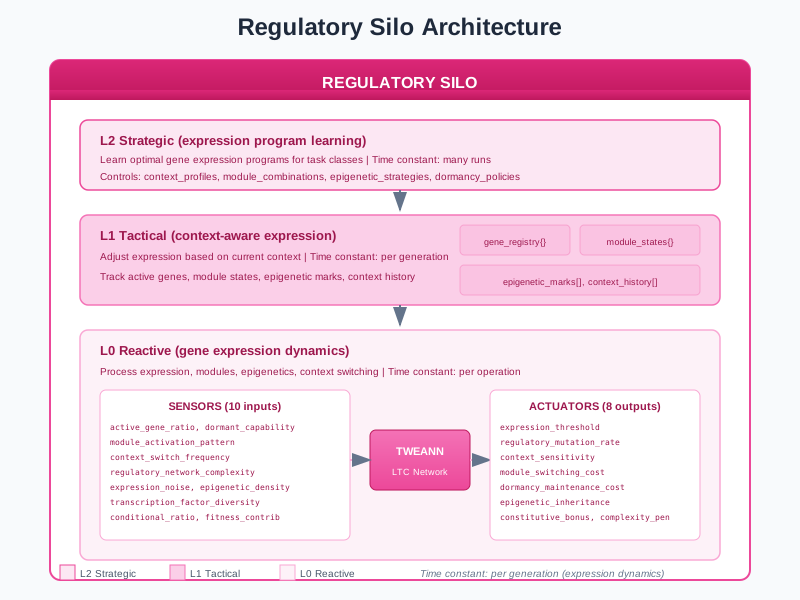
The Regulatory Silo uses TWEANN controllers at three levels:
| Level | Time Constant | Controls |
|---|---|---|
| L2 Strategic | Many runs | Optimal expression programs for task classes |
| L1 Tactical | Per generation | Adapt parameters based on context history |
| L0 Reactive | Per operation | Process expression, switching, epigenetics |
Sensors (10 inputs)
The L0 controller receives 10 regulatory measurements:
| Sensor | Range | Description |
|---|---|---|
active_gene_ratio | [0.0, 1.0] | Expressed genes / total genes |
dormant_capability_count | [0.0, 1.0] | Unexpressed but available capabilities |
module_activation_pattern | [0.0, 1.0] | Entropy of module activation |
context_switch_frequency | [0.0, 1.0] | How often context changes |
regulatory_network_complexity | [0.0, 1.0] | Complexity of regulation logic |
expression_noise | [0.0, 1.0] | Stochasticity in expression |
epigenetic_mark_density | [0.0, 1.0] | Epigenetic marks per gene |
transcription_factor_diversity | [0.0, 1.0] | Variety of regulatory signals |
conditional_expression_ratio | [0.0, 1.0] | Context-dependent vs constitutive |
regulatory_fitness_contribution | [0.0, 1.0] | How much regulation helps fitness |
Actuators (8 outputs)
The controller adjusts 8 regulatory parameters:
| Actuator | Range | Default | Effect |
|---|---|---|---|
expression_threshold | [0.0, 1.0] | 0.5 | Signal needed for gene expression |
regulatory_mutation_rate | [0.0, 0.1] | 0.02 | Rate of regulation changes |
context_sensitivity | [0.0, 1.0] | 0.5 | How responsive to context changes |
module_switching_cost | [0.0, 0.5] | 0.1 | Fitness cost of switching modules |
dormancy_maintenance_cost | [0.0, 0.1] | 0.01 | Cost per dormant gene |
epigenetic_inheritance_strength | [0.0, 1.0] | 0.5 | How much marks inherit |
constitutive_expression_bonus | [0.0, 0.2] | 0.05 | Bonus for always-on genes |
regulatory_complexity_penalty | [0.0, 0.1] | 0.02 | Cost of complex regulation |
Regulatory Dynamics
Gene Expression States
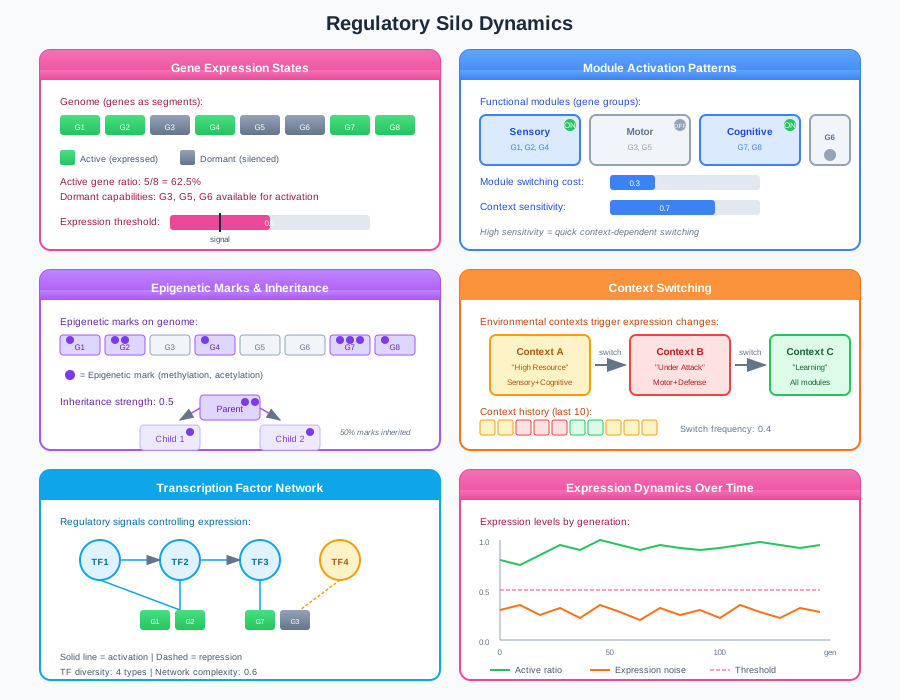
Each gene in the genome exists in one of several states:
| State | Description | Example |
|---|---|---|
| Expressed | Gene is active, contributing to phenotype | Sensory processing gene |
| Silenced | Gene is off, not contributing | Motor gene during sensing |
| Dormant | Gene is off but can be activated later | Defense capability |
| Constitutive | Gene is always expressed | Core metabolism gene |
| Conditional | Gene expression depends on context | Context-specific behavior |
Expression threshold:
%% Gene is expressed if signal exceeds threshold
expressed = signal >= expression_threshold
Module Activation
Modules group related genes for coordinated activation:
| Module Type | Description | Genes |
|---|---|---|
| Sensory | Input processing | G1, G2, G4 |
| Motor | Output generation | G3, G5 |
| Cognitive | Internal processing | G7, G8 |
| Defense | Stress response | G6 (dormant) |
Module switching:
- Modules activate/deactivate as a unit
- Switching incurs fitness cost (
module_switching_cost) - Context preference determines activation
Context Switching
Networks change behavior based on environmental context:
| Context | Active Modules | Expression Pattern |
|---|---|---|
| High Resource | Sensory + Cognitive | Exploration mode |
| Under Attack | Motor + Defense | Response mode |
| Learning | All modules | Full capability |
| Low Energy | Core only | Conservation mode |
Context history:
- Last 10 contexts tracked
- Switch frequency measured
- High switching = volatile environment
Epigenetic Inheritance
Expression patterns can be inherited across generations:
%% Epigenetic inheritance
inherited_marks = parent_marks * inheritance_strength
%% With inheritance_strength = 0.5, half of marks pass to offspring| Mark Type | Effect | Inheritance |
|---|---|---|
| Methylation | Silences genes | 50% (default) |
| Acetylation | Activates genes | 50% (default) |
| Phosphorylation | Temporary activation | 30% |
Transcription Factors
Regulatory signals that control gene expression:
| Factor Type | Effect | Target |
|---|---|---|
| Activator | Increases expression | Specific genes |
| Repressor | Decreases expression | Specific genes |
| Context-dependent | Varies by context | Gene groups |
Network complexity:
- Simple: few factors, direct control
- Complex: many factors, cascading effects
- Complexity penalized (
regulatory_complexity_penalty)
Integration with Other Silos
Outgoing Signals
| Signal | To Silo | Trigger |
|---|---|---|
expression_flexibility | Cultural | Conditional gene ratio |
dormant_potential | Competitive | Dormant gene count |
context_awareness | Task | Sensitivity + switch rate |
expression_cost | Morphological | Active gene energy |
energy_requirement | Economic | Total expression load |
Incoming Signals
| Signal | From Silo | Effect |
|---|---|---|
environmental_context | Ecological | Sets current context |
stress_level | Ecological | Stress > 0.7 activates dormant genes |
task_complexity | Task | Complexity > 0.7 lowers threshold |
developmental_stage | Developmental | Stage affects expression patterns |
energy_available | Economic | Low energy limits expression |
Signal Examples
%% Receive stress from ecological silo
handle_cast({cross_silo, stress_level, Stress}, State) when Stress > 0.7 ->
    %% High stress activates dormant genes
    NewGenes = activate_dormant_genes(State#regulatory_state.genes, Stress),
    {noreply, State#regulatory_state{genes = NewGenes}};

%% Send flexibility signal to cultural silo
signal_expression_flexibility(Pid) ->
    Genes = maps:values(State#regulatory_state.genes),
    Conditional = length([G || G <- Genes, not G#gene.is_constitutive]),
    Flexibility = Conditional / length(Genes),
    clamp(Flexibility, 0.0, 1.0).
Events Emitted
| Event | Payload | Trigger |
|---|---|---|
gene_expressed | {gene_id, trigger} | Gene turned on |
gene_silenced | {gene_id, reason} | Gene turned off |
module_activated | {module_id, context} | Module switched on |
module_deactivated | {module_id} | Module switched off |
context_switch_occurred | {old_context, new_context} | Context changed |
dormant_capability_awakened | {gene_id, trigger} | Hidden gene expressed |
epigenetic_mark_acquired | {gene_id, mark_type} | Mark added |
regulatory_mutation | {gene_id, old_regulation, new_regulation} | Regulation changed |
Practical Examples
Example 1: Multi-Task Agent
Configure for context-switching multi-task behavior:
Config = #{
    expression_threshold => 0.4,         % Easy expression
    context_sensitivity => 0.8,          % High sensitivity
    module_switching_cost => 0.05,       % Low switching cost
    dormancy_maintenance_cost => 0.005,  % Low dormancy cost
    epigenetic_inheritance_strength => 0.3
}.
Expected outcomes:
- Quick mode switching between tasks
- Multiple behavioral modes
- Low overhead for maintaining capabilities
Example 2: Specialist Agent
Configure for deep specialization in one context:
Config = #{
    expression_threshold => 0.7,         % High threshold
    context_sensitivity => 0.2,          % Low sensitivity
    module_switching_cost => 0.3,        % High switching cost
    constitutive_expression_bonus => 0.15,% Reward always-on
    regulatory_complexity_penalty => 0.05
}.
Expected outcomes:
- Stable, specialized behavior
- Few modules active
- High efficiency in primary context
Example 3: Adaptive Agent
Configure for stress-responsive adaptation:
Config = #{
    expression_threshold => 0.5,
    context_sensitivity => 0.6,
    dormancy_maintenance_cost => 0.005,  % Keep dormant capabilities
    epigenetic_inheritance_strength => 0.7,% Strong inheritance
    regulatory_mutation_rate => 0.03     % Some exploration
}.
Expected outcomes:
- Dormant genes activate under stress
- Expression patterns inherit to offspring
- Gradual adaptation to environment
Tuning Guide
Trade-offs
| Goal | Settings |
|---|---|
| Quick switching | Low switching cost, high sensitivity |
| Stable behavior | High switching cost, low sensitivity |
| Energy efficiency | High threshold, dormancy cost |
| Flexibility | Low threshold, low dormancy cost |
| Heritage | High epigenetic inheritance |
Common Issues
| Problem | Likely Cause | Fix |
|---|---|---|
| Too much switching | Low switching cost | Increase module_switching_cost |
| No context response | Low sensitivity | Increase context_sensitivity |
| All genes always on | Low threshold | Increase expression_threshold |
| Dormant genes never used | High dormancy cost | Decrease dormancy_maintenance_cost |
| Complex regulation | Low penalty | Increase regulatory_complexity_penalty |
Recommended Starting Point
DefaultConfig = #{
    expression_threshold => 0.5,
    regulatory_mutation_rate => 0.02,
    context_sensitivity => 0.5,
    module_switching_cost => 0.1,
    dormancy_maintenance_cost => 0.01,
    epigenetic_inheritance_strength => 0.5,
    constitutive_expression_bonus => 0.05,
    regulatory_complexity_penalty => 0.02
}.
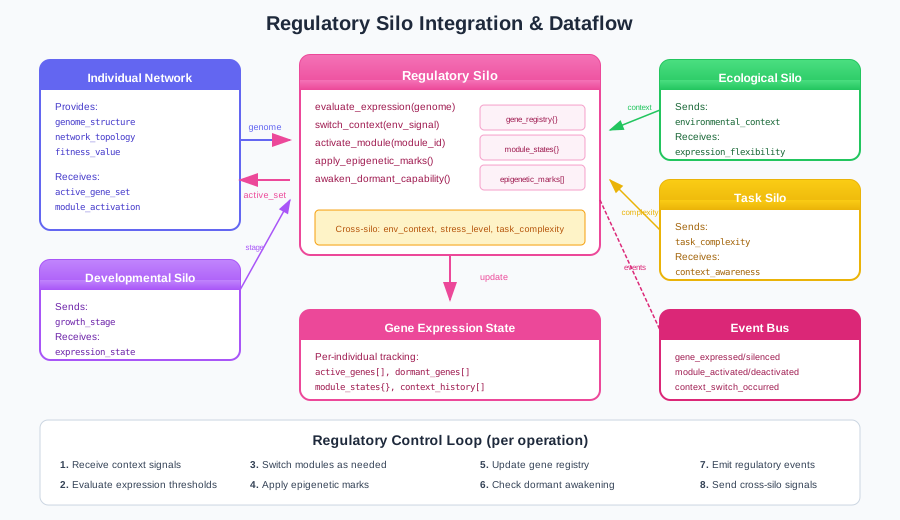
Control Loop
The Regulatory Silo executes per operation:
- Receive context signals - Get environment from Ecological Silo
- Evaluate expression thresholds - Determine which genes should be active
- Switch modules as needed - Activate/deactivate gene groups
- Apply epigenetic marks - Update expression modifiers
- Update gene registry - Record current expression state
- Check dormant awakening - Activate hidden genes if triggered
- Emit regulatory events - Notify listeners of changes
- Send cross-silo signals - Update dependent silos
Configuration Reference
Full Configuration Record
-record(regulatory_config, {
    %% Enable/disable
    enabled = true :: boolean(),

    %% Gene configuration
    max_genes = 1000 :: pos_integer(),
    max_modules = 50 :: pos_integer(),

    %% Epigenetics
    enable_epigenetics = true :: boolean(),
    max_marks_per_gene = 10 :: pos_integer(),

    %% Context
    available_contexts = [default] :: [context_id()],

    %% Event emission
    emit_events = true :: boolean()
}).
API Functions
%% Start the regulatory silo
regulatory_silo:start_link(Config)

%% Context management
regulatory_silo:set_context(Pid, ContextId)
regulatory_silo:update_context(Pid, RegContext)

%% Gene expression
ok = regulatory_silo:express_gene(Pid, GeneId)
ok = regulatory_silo:silence_gene(Pid, GeneId)
Expressed = regulatory_silo:get_expressed_genes(Pid)

%% Module activation
ok = regulatory_silo:activate_module(Pid, ModuleId)
ok = regulatory_silo:deactivate_module(Pid, ModuleId)
Active = regulatory_silo:get_active_modules(Pid)

%% Epigenetics
ok = regulatory_silo:add_epigenetic_mark(Pid, GeneId, Mark)
regulatory_silo:inherit_marks(Pid, ParentGeneId, ChildGeneId)

%% Get regulatory parameters
Params = regulatory_silo:get_regulatory_params(Pid)

%% Enable/disable silo
regulatory_silo:enable(Pid)
regulatory_silo:disable(Pid)
Biological Inspiration
The Regulatory Silo mirrors biological gene regulation:
| Biology | Regulatory Silo |
|---|---|
| Gene promoters | Expression threshold |
| Transcription factors | Regulatory signals |
| Epigenetic marks | Inherited expression patterns |
| Cell differentiation | Module specialization |
| Stress response genes | Dormant capabilities |
| Tissue-specific expression | Context-dependent activation |
Source Code Reference
Core implementation files:
| File | Purpose |
|---|---|
src/lc_silos/regulatory_silo.erl | Main silo gen_server |
src/lc_silos/regulatory_silo_sensors.erl | L0 sensor implementation |
src/lc_silos/regulatory_silo_actuators.erl | L0 actuator implementation |
src/lc_silos/regulatory_silo.hrl | Record definitions |
References
- PLAN_REGULATORY_SILO.md - Full specification
- "The Logic of Gene Regulation" - Ptashne
- "Epigenetics" - Allis, Jenuwein, Reinberg
- "Gene Regulatory Networks" - Davidson
See Also
- Ecological Silo Guide - Environmental context source
- Developmental Silo Guide - Stage affects expression
- Cultural Silo Guide - Expression flexibility for learning
- Competitive Silo Guide - Dormant capabilities for counter-strategies