Ecological Silo Guide
View SourceThe Ecological Silo manages environmental dynamics that shape evolution: resources, carrying capacity, diseases, catastrophes, and environmental cycles. It simulates the selective pressures of nature.
Overview
The Ecological Silo creates a dynamic environment that prevents populations from merely optimizing for a static fitness landscape. Instead, populations must adapt to:
- Resource scarcity and abundance - Boom and bust cycles
- Carrying capacity pressure - Population size limits
- Disease outbreaks - Pathogen spread and immunity evolution
- Catastrophic events - Mass extinctions and recovery
- Environmental cycles - Seasonal and periodic changes
- Niche competition - Specialization pressure
Why Ecological Pressure?
Without environmental pressure, evolution finds solutions that work only in idealized conditions. Real-world deployment faces:
| Static Environment | Dynamic Ecology |
|---|---|
| Overfits to conditions | Stress-tested robustness |
| Brittle under change | Adapts to variation |
| Single-niche specialists | Multi-niche generalists |
| Poor generalization | Strong transfer learning |
The Ecological Silo ensures evolved solutions can handle real-world variability.
Architecture
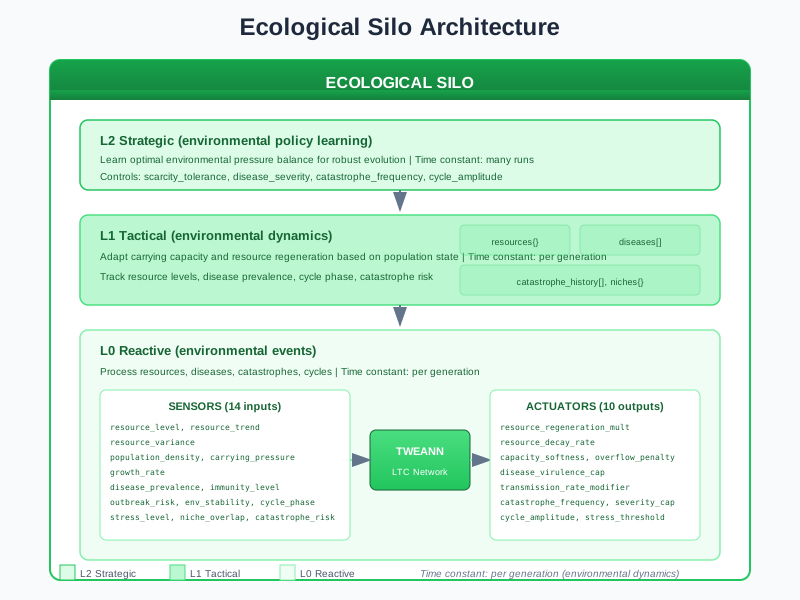
The Ecological Silo uses TWEANN controllers at three levels:
| Level | Time Constant | Controls |
|---|---|---|
| L2 Strategic | Many runs | Environmental pressure philosophy |
| L1 Tactical | Per generation | Adapt parameters to population state |
| L0 Reactive | Per operation | Process resources, diseases, catastrophes |
Sensors (14 inputs)
The L0 controller receives 14 environmental measurements:
| Sensor | Range | Description |
|---|---|---|
resource_level | [0.0, 1.0] | Current resource availability |
resource_trend | [-1.0, 1.0] | Resource change direction |
resource_variance | [0.0, 1.0] | Resource distribution variance |
population_density | [0.0, 2.0] | Population relative to carrying capacity |
carrying_pressure | [0.0, 1.0] | Proximity to capacity limit |
growth_rate | [-1.0, 1.0] | Population growth rate |
disease_prevalence | [0.0, 1.0] | Proportion infected |
immunity_level | [0.0, 1.0] | Average population immunity |
outbreak_risk | [0.0, 1.0] | Risk of new disease outbreak |
environmental_stability | [0.0, 1.0] | How stable conditions are |
cycle_phase | [0.0, 1.0] | Position in environmental cycle |
stress_level | [0.0, 1.0] | Environmental stress on population |
niche_overlap | [0.0, 1.0] | Degree of niche competition |
catastrophe_risk | [0.0, 1.0] | Risk of catastrophic event |
Actuators (10 outputs)
The controller adjusts 10 environmental parameters:
| Actuator | Range | Default | Effect |
|---|---|---|---|
resource_regeneration_multiplier | [0.5, 2.0] | 1.0 | Resource replenishment speed |
resource_decay_rate | [0.0, 0.2] | 0.05 | Resource consumption rate |
capacity_softness | [0.0, 1.0] | 0.3 | How hard the capacity limit is |
overflow_penalty | [0.0, 0.5] | 0.1 | Fitness penalty for overcrowding |
disease_virulence_cap | [0.0, 1.0] | 0.8 | Maximum disease lethality |
transmission_rate_modifier | [0.5, 2.0] | 1.0 | Disease spread rate multiplier |
catastrophe_frequency | [0.0, 0.1] | 0.01 | Base catastrophe probability |
catastrophe_severity_cap | [0.3, 1.0] | 0.7 | Maximum catastrophe severity |
cycle_amplitude | [0.0, 1.0] | 0.3 | Strength of environmental cycles |
stress_threshold | [0.3, 0.9] | 0.6 | Stress level triggering epigenetic marks |
Ecological Dynamics
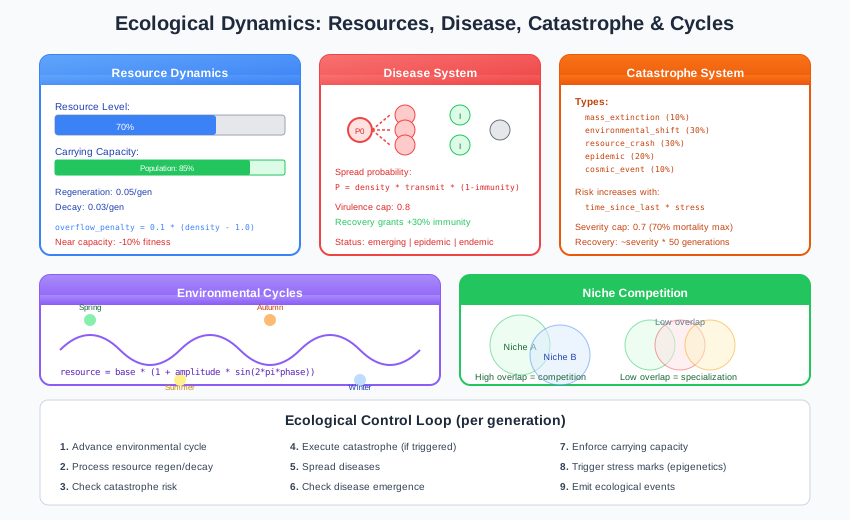
Resource Dynamics
Resources regenerate and decay according to environmental parameters:
resource_level(t+1) = resource_level(t)
                    * (1 + regeneration_multiplier * cycle_modifier)
                    * (1 - decay_rate * population_density)
When resources are scarce:
- Competition intensifies (→ Social Silo)
- Stress levels rise (→ triggers epigenetic marks)
- Innovation pressure increases (→ Cultural Silo)
Carrying Capacity
The carrying capacity enforces population size limits:
%% Fitness penalty when over capacity
penalty = overflow_penalty * (1 - exp(-(density - 1.0) / capacity_softness))| Softness | Effect |
|---|---|
| 0.0 | Hard limit - immediate death above capacity |
| 0.5 | Moderate - gradual penalty increase |
| 1.0 | Soft - slow penalty accumulation |
Disease System
Diseases emerge, spread, and drive immunity evolution:
Spread probability:
P(infection) = density * transmissibility * (1 - immunity)Disease status progression:
- Emerging - Patient zero infected
- Epidemic - Rapid spread (>5% infected)
- Endemic - Stable prevalence
- Declining - Immunity rising
- Eradicated - No active cases
Immunity acquisition:
- Recovery grants +30% immunity
- Immunity decays slowly over generations
- Creates immune diversity under selection
Catastrophe System
Catastrophic events create punctuated equilibrium:
| Type | Weight | Effect |
|---|---|---|
mass_extinction | 10% | Up to 80% mortality |
environmental_shift | 30% | Niche disruption |
resource_crash | 30% | Resource depletion |
epidemic | 20% | Disease outbreak |
cosmic_event | 10% | Random destruction |
Risk calculation:
risk = base_frequency * (1 + generations_since_last/100) * (1 + stress_level)Catastrophe severity is capped by catastrophe_severity_cap to prevent total extinction.
Recovery period:
recovery_generations ≈ severity * 50Environmental Cycles
Sinusoidal cycles create seasonal variation:
resource_modifier = 1.0 + amplitude * sin(2π * phase)Cycle phases:
- Spring (0.0-0.25): Rising resources, growth opportunity
- Summer (0.25-0.5): Peak resources, population boom
- Autumn (0.5-0.75): Declining resources, competition rises
- Winter (0.75-1.0): Scarcity, stress, selection pressure
Niche Competition
Multiple niches create specialization pressure:
| Overlap | Effect |
|---|---|
| High (>0.7) | Intense competition, generalist disadvantage |
| Medium (0.3-0.7) | Balanced competition |
| Low (<0.3) | Niche specialization favored |
Symbiosis
Inter-individual relationships emerge:
| Type | Partner A | Partner B | Example |
|---|---|---|---|
| Mutualism | +benefit | +benefit | Both gain fitness |
| Commensalism | neutral | +benefit | One gains, other unaffected |
| Parasitism | +benefit | -cost | One exploits other |
Symbiotic relationships affect fitness calculations and can spread through the population.
Integration with Other Silos
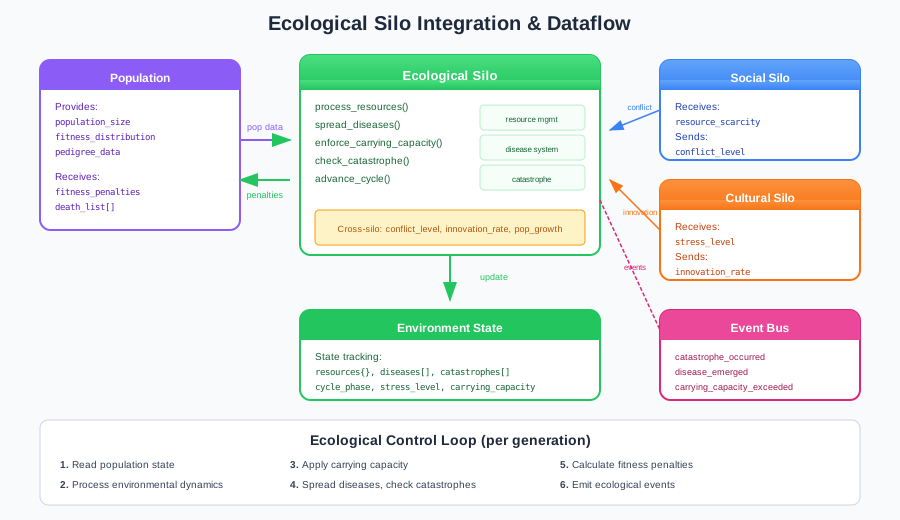
Outgoing Signals
| Signal | To Silo | Trigger |
|---|---|---|
resource_scarcity | Social | Resources below 30% |
stress_level | All (Epigenetics) | Stress above threshold |
catastrophe_recovery | Task | Post-catastrophe phase |
carrying_pressure | Distribution | Near capacity limit |
Incoming Signals
| Signal | From Silo | Effect |
|---|---|---|
conflict_level | Social | Conflict depletes resources faster |
innovation_rate | Cultural | Innovation improves resource efficiency |
population_growth | Task | Updates carrying pressure |
Signal Examples
%% Receiving social conflict
handle_cross_silo_signal({conflict_level, Level}, State) ->
    %% High conflict depletes resources
    ResourceMultiplier = 1.0 - (Level * 0.2),
    UpdatedEnv = State#state.environment#environment{
        resource_level = State#state.environment#environment.resource_level * ResourceMultiplier
    },
    {ok, State#state{environment = UpdatedEnv}};

%% Sending scarcity signal
maybe_emit_scarcity_signal(#environment{resource_level = Level} = Env)
  when Level < 0.3 ->
    lc_cross_silo:send_signal(resource_scarcity, #{
        level => 1.0 - (Level / 0.3),
        trend => calculate_resource_trend(Env)
    });
maybe_emit_scarcity_signal(_) -> ok.
Events Emitted
| Event | Payload | Trigger |
|---|---|---|
carrying_capacity_exceeded | {population_id, capacity, actual, deaths} | Population over capacity |
resource_depleted | {resource_type, level} | Resources exhausted |
resource_replenished | {resource_type, new_level} | Resources restored |
disease_emerged | {disease_id, patient_zero, virulence} | New disease appears |
disease_spread | {disease_id, new_infections, prevalence} | Infection spread |
epidemic_started | {disease_id, infection_rate} | Outbreak threshold crossed |
epidemic_ended | {disease_id, duration, peak} | Outbreak concluded |
immunity_developed | {individual_id, disease_id, level} | Resistance evolved |
catastrophe_occurred | {type, severity, mortality, recovery_est} | Major event |
recovery_began | {catastrophe_id, generation} | Post-catastrophe recovery |
environmental_cycle_shifted | {phase_name, phase_value} | Seasonal transition |
symbiosis_formed | {partners, type, benefits} | Relationship established |
Practical Examples
Example 1: Resource-Scarce Environment
Configure a harsh environment with limited resources:
Config = #{
    resource_regeneration_multiplier => 0.7,  % Slow regeneration
    resource_decay_rate => 0.15,              % Fast consumption
    capacity_softness => 0.2,                 % Hard capacity limit
    overflow_penalty => 0.3,                  % Severe overcrowding penalty
    catastrophe_frequency => 0.02,            % More frequent disasters
    cycle_amplitude => 0.5                    % Strong seasonal variation
}.
Expected outcomes:
- Smaller, more efficient networks
- Competition-driven innovation
- Robust stress tolerance
Example 2: Disease Pressure
Configure high disease pressure:
Config = #{
    disease_virulence_cap => 0.9,             % Deadly diseases possible
    transmission_rate_modifier => 1.5,        % Fast spread
    catastrophe_frequency => 0.005            % Lower base catastrophe
}.
Expected outcomes:
- Immune diversity in population
- Avoidance behaviors evolve
- Recovery speed becomes selected trait
Example 3: Stable Environment
For baseline comparison without ecological pressure:
Config = #{
    resource_regeneration_multiplier => 1.5,
    resource_decay_rate => 0.02,
    capacity_softness => 0.9,
    overflow_penalty => 0.02,
    disease_virulence_cap => 0.3,
    catastrophe_frequency => 0.001,
    cycle_amplitude => 0.1
}.
Note: Stable environments produce solutions that may not generalize well.
Tuning Guide
Training Velocity vs. Robustness
| Goal | Settings |
|---|---|
| Fast convergence | Low pressure (abundance) |
| Robust solutions | High pressure (scarcity, disease) |
| Generalization | High cycle amplitude, variable pressure |
Common Issues
| Problem | Likely Cause | Fix |
|---|---|---|
| Population extinction | Pressure too high | Lower catastrophe_severity_cap, increase capacity_softness |
| Stagnation | Environment too stable | Increase cycle_amplitude, catastrophe_frequency |
| Poor generalization | Static conditions | Enable cycles, increase variability |
| Disease wipes out population | Virulence too high | Lower disease_virulence_cap |
Recommended Starting Point
%% Balanced ecological pressure
DefaultConfig = #{
    resource_regeneration_multiplier => 1.0,
    resource_decay_rate => 0.05,
    capacity_softness => 0.3,
    overflow_penalty => 0.1,
    disease_virulence_cap => 0.8,
    transmission_rate_modifier => 1.0,
    catastrophe_frequency => 0.01,
    catastrophe_severity_cap => 0.7,
    cycle_amplitude => 0.3,
    stress_threshold => 0.6
}.
Control Loop
The Ecological Silo executes per generation:
- Advance environmental cycle - Update phase, calculate modifiers
- Process resource regeneration/decay - Update resource levels
- Check catastrophe risk - Probability increases over time
- Execute catastrophe (if triggered) - Apply mortality, resource impact
- Spread diseases - Process each active disease
- Check disease emergence - New pathogens may appear
- Enforce carrying capacity - Apply overcrowding deaths
- Trigger stress marks - Epigenetic effects if threshold exceeded
- Emit ecological events - Notify other systems
Configuration Reference
Full Configuration Record
-record(ecological_config, {
    %% Resource dynamics
    resource_regeneration_multiplier = 1.0 :: float(),
    resource_decay_rate = 0.05 :: float(),
    resource_capacity = 1.0 :: float(),

    %% Carrying capacity
    carrying_capacity = 1000 :: non_neg_integer(),
    capacity_softness = 0.3 :: float(),
    overflow_penalty = 0.1 :: float(),

    %% Disease
    disease_virulence_cap = 0.8 :: float(),
    transmission_rate_modifier = 1.0 :: float(),
    immunity_decay_rate = 0.01 :: float(),

    %% Catastrophe
    catastrophe_frequency = 0.01 :: float(),
    catastrophe_severity_cap = 0.7 :: float(),

    %% Environment
    cycle_period = 100 :: non_neg_integer(),
    cycle_amplitude = 0.3 :: float(),
    stress_threshold = 0.6 :: float(),

    %% Symbiosis
    symbiosis_formation_rate = 0.05 :: float(),
    symbiosis_decay_rate = 0.1 :: float(),

    %% Enable/disable
    enabled = true :: boolean()
}).
API Functions
%% Start the ecological silo
ecological_silo:start_link(#{population_id => PopId})

%% Read current environment state
{ok, Environment} = ecological_silo:get_environment(PopId)

%% Manually trigger a catastrophe (for testing)
ecological_silo:trigger_catastrophe(PopId, #{type => resource_crash, severity => 0.5})

%% Introduce a disease (for testing)
ecological_silo:introduce_disease(PopId, #{virulence => 0.6, transmissibility => 0.8})

%% Get full silo state
{ok, State} = ecological_silo:get_state(PopId)
Source Code Reference
Core implementation files:
| File | Purpose |
|---|---|
src/lc_silos/ecological_silo.erl | Main silo gen_server |
src/lc_silos/ecological_silo_sensors.erl | L0 sensor implementation |
src/lc_silos/ecological_silo_actuators.erl | L0 actuator implementation |
src/lc_silos/ecological_carrying.erl | Carrying capacity system |
src/lc_silos/ecological_disease.erl | Disease spread and immunity |
src/lc_silos/ecological_cycles.erl | Environmental cycles |
src/lc_silos/ecological_catastrophe.erl | Catastrophe system |
src/lc_silos/ecological_symbiosis.erl | Symbiotic relationships |
References
- PLAN_ECOLOGICAL_SILO.md - Full specification
- "Ecology: Concepts and Applications" - Molles
- "The Theory of Island Biogeography" - MacArthur & Wilson
- "Epidemiology" - Rothman
See Also
- Task Silo Guide - Population fitness management
- Social Silo Guide - Competition and cooperation
- Cultural Silo Guide - Innovation and learning
- Distribution Silo Guide - Population diversity