Developmental Silo Guide
View SourceThe Developmental Silo manages ontogeny - how individuals develop over their lifetime. Instead of networks being born fully formed, they grow through stages, experience critical periods, and can undergo metamorphosis. This mirrors biological development.
Overview
Traditional neuroevolution treats networks as static entities. The Developmental Silo introduces lifetime dynamics:
- Developmental stages - Progress from embryonic to adult to senescent
- Plasticity decay - Learning capacity decreases with age
- Critical periods - Time-limited windows for specific learning
- Metamorphosis - Radical structural reorganization
- Canalization - Traits become increasingly stable
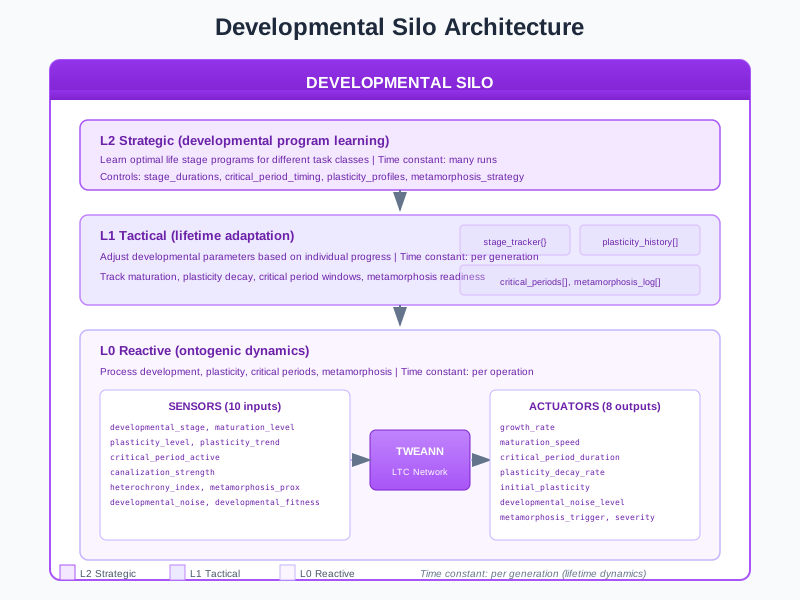
Why Developmental Dynamics?
| Static Networks | Developmental Networks |
|---|---|
| Fixed at birth | Grow and mature |
| Uniform learning rate | Age-appropriate plasticity |
| No critical periods | Focused learning windows |
| Cannot radically adapt | Metamorphosis enables transformation |
| Brittle to deployment change | Lifetime adaptation |
Architecture
The Developmental Silo uses TWEANN controllers at three levels:
| Level | Time Constant | Controls |
|---|---|---|
| L2 Strategic | Many runs | Optimal developmental programs for task classes |
| L1 Tactical | Per generation | Adapt parameters to individual progress |
| L0 Reactive | Per operation | Process aging, plasticity, stages |
Sensors (10 inputs)
The L0 controller receives 10 developmental measurements:
| Sensor | Range | Description |
|---|---|---|
developmental_stage | [0.0, 1.0] | Progress through development (0=birth, 1=mature) |
maturation_level | [0.0, 1.0] | Physiological maturity |
plasticity_level | [0.0, 1.0] | Current learning capacity |
plasticity_trend | [-1.0, 1.0] | Direction of plasticity change |
critical_period_active | [0.0, 1.0] | Intensity of active critical period |
canalization_strength | [0.0, 1.0] | Resistance to perturbation |
heterochrony_index | [0.0, 1.0] | Timing variation from population mean |
metamorphosis_proximity | [0.0, 1.0] | Distance to metamorphosis threshold |
developmental_noise | [0.0, 1.0] | Random variation in development |
developmental_fitness | [0.0, 1.0] | Fitness relative to developmental stage |
Actuators (8 outputs)
The controller adjusts 8 developmental parameters:
| Actuator | Range | Default | Effect |
|---|---|---|---|
growth_rate | [0.0, 0.2] | 0.05 | Speed of structural growth |
maturation_speed | [0.0, 0.1] | 0.02 | Speed of physiological maturation |
critical_period_duration | [1, 20] | 5 | Generations critical period lasts |
plasticity_decay_rate | [0.0, 0.2] | 0.05 | How fast plasticity decreases |
initial_plasticity | [0.5, 1.0] | 0.9 | Plasticity at birth |
developmental_noise_level | [0.0, 0.3] | 0.1 | Stochasticity in development |
metamorphosis_trigger | [0.5, 0.95] | 0.8 | Threshold for metamorphosis |
metamorphosis_severity | [0.0, 1.0] | 0.5 | How drastic metamorphosis is |
Developmental Dynamics

Developmental Stages
Individuals progress through five life stages:
| Stage | Duration | Plasticity | Characteristics |
|---|---|---|---|
| Embryonic | 5 gen | 0.9-1.0 | High growth, sensory critical periods |
| Juvenile | 15 gen | 0.7-0.9 | Sensory/motor critical periods |
| Adolescent | 20 gen | 0.4-0.7 | Cognitive/social critical periods |
| Adult | 40 gen | 0.2-0.4 | Stable, low plasticity |
| Senescent | 20 gen | 0.1-0.2 | Minimal plasticity, reduced mutation |
Each stage has:
- Different mutation rate modifiers
- Available critical period types
- Appropriate plasticity ranges
Plasticity Decay
Plasticity decreases with age, following exponential decay:
plasticity(t+1) = plasticity(t) * (1 - decay_rate)| Young Networks | Old Networks |
|---|---|
| High plasticity (0.9) | Low plasticity (0.1) |
| Fast learning | Slow learning |
| Unstable behavior | Stable behavior |
| High variability | Canalized traits |
The min_plasticity floor (typically 0.1) prevents complete rigidity.
Critical Periods
Critical periods are time-limited windows where learning is enhanced:
| Period Type | Stage | Effect |
|---|---|---|
| Sensory | Embryonic, Juvenile | 2x learning rate for sensory processing |
| Motor | Juvenile | 2x learning rate for motor control |
| Cognitive | Adolescent | 2x learning rate for reasoning |
| Social | Adolescent | 2x learning rate for social behavior |
During critical period:
effective_learning_rate = base_learning_rate * 2.0Critical periods:
- Open automatically based on stage
- Close after
critical_period_durationgenerations - Cannot be reopened once closed
- Record what learning was acquired
Metamorphosis
Metamorphosis allows radical transformation:
%% Metamorphosis resets plasticity and reduces canalization
new_plasticity = initial_plasticity * severity + old_plasticity * (1 - severity)
new_canalization = old_canalization * (1 - severity)| Before Metamorphosis | After Metamorphosis |
|---|---|
| Low plasticity (0.2) | High plasticity (0.7) |
| High canalization (0.8) | Low canalization (0.2) |
| Stable but rigid | Flexible and adaptable |
Metamorphosis triggers:
- Maturation progress exceeds
metamorphosis_triggerthreshold - Maximum 3 metamorphoses per lifetime (
max_metamorphoses) - 20% probability when conditions met
Canalization
Canalization measures resistance to perturbation:
| Low Canalization | High Canalization |
|---|---|
| High variability | Stable traits |
| Easy to modify | Difficult to change |
| Exploratory behavior | Exploitative behavior |
Canalization increases with age and successful behavior, but metamorphosis resets it.
Heterochrony
Heterochrony measures developmental timing relative to population:
- Precocious (early developers) - Mature faster, reach adult stage sooner
- Delayed (late developers) - Extended juvenile/adolescent periods
The heterochrony_index sensor tracks this:
z_score = abs(individual_age - population_mean_age) / population_std_age
heterochrony_index = clamp(z_score / 4.0 + 0.5, 0.0, 1.0)
Integration with Other Silos
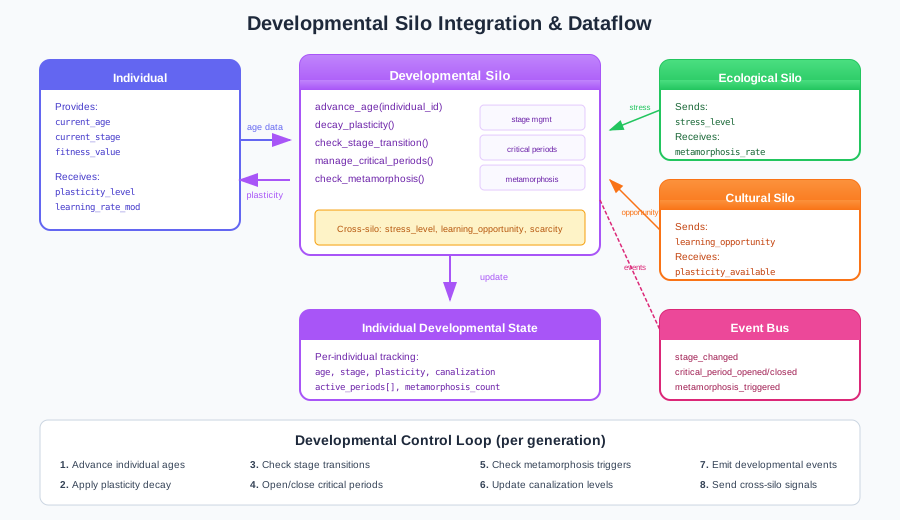
Outgoing Signals
| Signal | To Silo | Trigger |
|---|---|---|
maturity_distribution | Task | Average population maturity |
plasticity_available | Cultural | Average plasticity level |
metamorphosis_rate | Ecological | Metamorphoses per generation |
growth_stage | Morphological | Current developmental stage |
critical_timing | Temporal | Critical period activity |
Incoming Signals
| Signal | From Silo | Effect |
|---|---|---|
stress_level | Ecological | Stress > 0.7 accelerates maturation |
learning_opportunity | Cultural | Opportunity > 0.5 extends critical periods |
resource_scarcity | Resource | Scarcity > 0.6 accelerates growth |
social_mentoring | Social | Mentoring affects critical period learning |
Signal Examples
%% Receive stress from ecological silo
handle_cast({cross_silo, stress_level, Stress}, State) when Stress > 0.7 ->
    %% High stress accelerates maturation
    NewSpeed = State#developmental_state.maturation_speed * 1.5,
    {noreply, State#developmental_state{maturation_speed = min(0.1, NewSpeed)}};

%% Send plasticity signal to cultural silo
signal_plasticity_available(Pid) ->
    IndStates = maps:values(State#developmental_state.individual_states),
    Plasticities = [I#individual_dev_state.plasticity || I <- IndStates],
    AvgPlasticity = lists:sum(Plasticities) / length(Plasticities),
    clamp(AvgPlasticity, 0.0, 1.0).
Events Emitted
| Event | Payload | Trigger |
|---|---|---|
development_stage_changed | {individual_id, old_stage, new_stage} | Stage transition |
critical_period_opened | {individual_id, period_type, duration} | Period began |
critical_period_closed | {individual_id, period_type, learning_acquired} | Period ended |
plasticity_decreased | {individual_id, old_level, new_level} | Plasticity decayed |
maturation_completed | {individual_id, final_structure, age} | Fully mature |
metamorphosis_triggered | {individual_id, severity, new_plasticity} | Radical change |
developmental_milestone | {individual_id, milestone, age} | Key achievement |
canalization_established | {individual_id, trait, stability} | Trait fixed |
Practical Examples
Example 1: Fast-Maturing Population
Configure for rapid development and short critical periods:
Config = #{
    growth_rate => 0.15,                 % Fast structural growth
    maturation_speed => 0.08,            % Fast physiological maturation
    critical_period_duration => 3,        % Short learning windows
    plasticity_decay_rate => 0.12,        % Fast plasticity loss
    initial_plasticity => 0.95            % High starting plasticity
}.
Expected outcomes:
- Quick convergence to adult behavior
- Less lifetime adaptation
- Efficient for stable deployment environments
Example 2: Extended Learning
Configure for prolonged development and extended learning:
Config = #{
    growth_rate => 0.03,                 % Slow structural growth
    maturation_speed => 0.01,            % Slow maturation
    critical_period_duration => 15,       % Long learning windows
    plasticity_decay_rate => 0.02,        % Slow plasticity loss
    initial_plasticity => 0.9,
    metamorphosis_trigger => 0.9,         % High metamorphosis threshold
    metamorphosis_severity => 0.7         % Strong metamorphosis effect
}.
Expected outcomes:
- Extended learning periods
- High lifetime adaptation
- Better for changing deployment environments
Example 3: Deployment Adaptation
For networks that need to adapt in deployment:
Config = #{
    plasticity_decay_rate => 0.01,        % Very slow decay
    initial_plasticity => 0.8,
    metamorphosis_trigger => 0.5,         % Easy to trigger metamorphosis
    metamorphosis_severity => 0.4,        % Moderate reset
    developmental_noise_level => 0.15     % Some stochasticity
}.
Expected outcomes:
- Networks retain learning capacity in deployment
- Can adapt to environment-specific conditions
- Metamorphosis available for major adaptation
Tuning Guide
Trade-offs
| Goal | Settings |
|---|---|
| Fast training | High decay rate, short critical periods |
| Robustness | Low decay rate, extended critical periods |
| Stability | High canalization, low metamorphosis |
| Flexibility | Low canalization, high metamorphosis |
Common Issues
| Problem | Likely Cause | Fix |
|---|---|---|
| Networks don't mature | Low maturation speed | Increase maturation_speed |
| No learning after juvenile | Plasticity too low | Lower plasticity_decay_rate |
| Critical periods ineffective | Too short | Increase critical_period_duration |
| Stuck in local optima | High canalization | Enable metamorphosis, reduce trigger threshold |
| Too much variation | High developmental noise | Lower developmental_noise_level |
Recommended Starting Point
DefaultConfig = #{
    growth_rate => 0.05,
    maturation_speed => 0.02,
    critical_period_duration => 5,
    plasticity_decay_rate => 0.05,
    initial_plasticity => 0.9,
    developmental_noise_level => 0.1,
    metamorphosis_trigger => 0.8,
    metamorphosis_severity => 0.5
}.
Control Loop
The Developmental Silo executes per generation:
- Advance individual ages - Increment age counter
- Apply plasticity decay - Reduce plasticity based on decay rate
- Check stage transitions - Move to next stage if conditions met
- Open/close critical periods - Manage time-limited learning windows
- Check metamorphosis triggers - Initiate radical transformation if threshold met
- Update canalization levels - Track trait stability
- Emit developmental events - Notify other systems
- Send cross-silo signals - Update dependent silos
Configuration Reference
Full Configuration Record
-record(developmental_config, {
    %% Enable/disable
    enabled = true :: boolean(),

    %% Stage configuration
    num_stages = 5 :: pos_integer(),
    stage_definitions :: [developmental_stage()],

    %% Plasticity
    min_plasticity = 0.1 :: float(),
    max_plasticity = 1.0 :: float(),

    %% Critical periods
    enable_critical_periods = true :: boolean(),
    available_period_types = [sensory, motor, cognitive, social] :: [atom()],

    %% Metamorphosis
    enable_metamorphosis = true :: boolean(),
    max_metamorphoses = 3 :: pos_integer(),

    %% Event emission
    emit_events = true :: boolean()
}).
API Functions
%% Start the developmental silo
developmental_silo:start_link(Config)

%% Register a new individual
developmental_silo:register_individual(Pid, IndividualId)

%% Advance an individual's age
{ok, NewAge} = developmental_silo:advance_age(Pid, IndividualId)

%% Get plasticity level
Plasticity = developmental_silo:get_plasticity(Pid, IndividualId)

%% Open a critical period
ok = developmental_silo:open_critical_period(Pid, IndividualId, sensory)

%% Close a critical period
ok = developmental_silo:close_critical_period(Pid, IndividualId, sensory)

%% Trigger metamorphosis
ok = developmental_silo:trigger_metamorphosis(Pid, IndividualId)

%% Get individual developmental state
IndState = developmental_silo:get_individual_state(Pid, IndividualId)

%% Enable/disable silo
developmental_silo:enable(Pid)
developmental_silo:disable(Pid)
Source Code Reference
Core implementation files:
| File | Purpose |
|---|---|
src/lc_silos/developmental_silo.erl | Main silo gen_server |
src/lc_silos/developmental_silo_sensors.erl | L0 sensor implementation |
src/lc_silos/developmental_silo_actuators.erl | L0 actuator implementation |
src/lc_silos/developmental_silo.hrl | Record definitions |
References
- PLAN_DEVELOPMENTAL_SILO.md - Full specification
- "Developmental Plasticity and Evolution" - West-Eberhard
- "Critical Periods in Development" - Knudsen
- "Metamorphosis: Postembryonic Reprogramming" - Shi
See Also
- Cultural Silo Guide - Learning and imitation
- Ecological Silo Guide - Environmental stress effects
- Morphological Silo Guide - Network structure growth
- Temporal Silo Guide - Time management in development