LTC Meta-Controller: Adaptive Hyperparameter Optimization
View SourceThis guide explains the meta-controller system - LTC neural networks that dynamically control neuroevolution hyperparameters based on training dynamics, system resources, and mesh topology.
Liquid Conglomerate v2
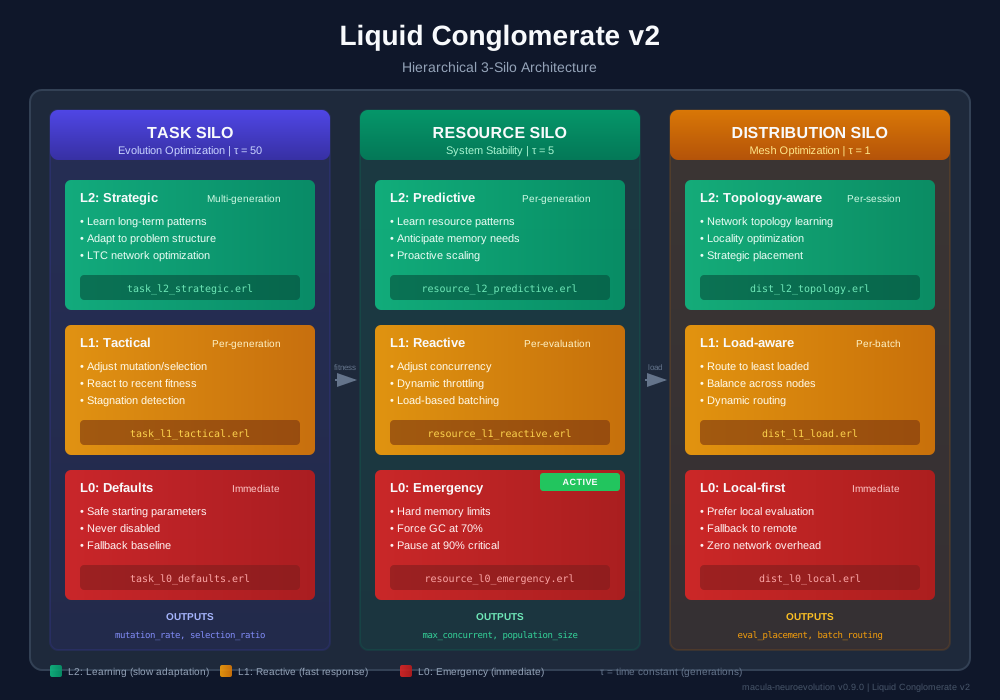
The Liquid Conglomerate v2 architecture replaces the monolithic meta-controller with 3 specialized hierarchical silos, each focused on a single optimization objective:
Why 3 Silos?
- Separation of Concerns - Each silo optimizes one aspect of the system
- Different Time Constants - Resource reacts fast (τ=5), Task learns slow (τ=50)
- Graceful Degradation - L0 always works, even if L1/L2 fail
- Independent Tuning - Can enable/disable levels per silo
- Clearer Rewards - Task→fitness, Resource→stability, Distribution→throughput
The Three Silos
| Silo | Purpose | Time Constant (τ) | Optimization Target |
|---|---|---|---|
| Task | Evolution optimization | 50 | Maximize fitness |
| Resource | System stability | 5 | Maintain stability |
| Distribution | Mesh optimization | 1 | Maximize throughput |
Hierarchical Levels
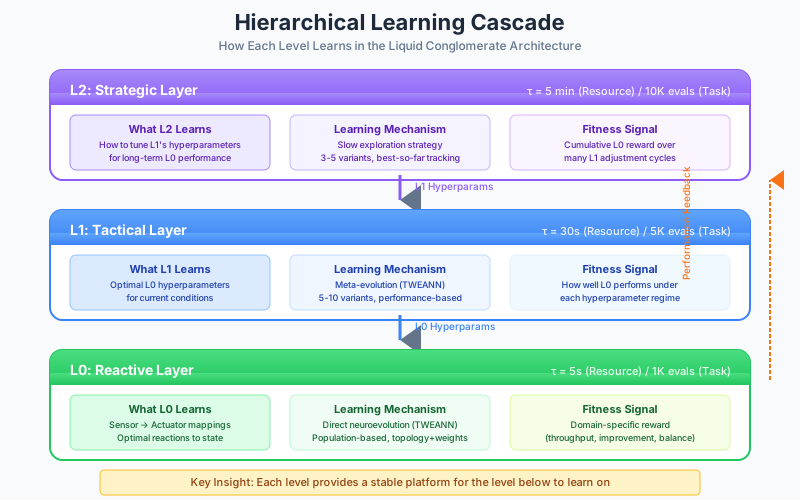
Each silo operates with 3 hierarchical levels (L0 → L1 → L2):
L0: Emergency/Immediate Response
- Always active, cannot be disabled
- Provides safe defaults and hard limits
- Responds immediately to critical conditions
- Zero learning, pure reactive logic
L1: Reactive Control
- Responds to recent observations
- Per-evaluation (Resource) or per-generation (Task) adjustments
- Fast feedback loop with simple heuristics
- Can be disabled for baseline operation
L2: Predictive/Strategic Learning
- LTC neural network for pattern learning
- Multi-generation or session-scale optimization
- Learns problem-specific strategies
- Optional, requires training data
Task Silo (Evolution Optimization)
Time Constant: τ = 50 (slow adaptation)
Purpose: Optimize neuroevolution hyperparameters for maximum fitness improvement.
| Level | Name | Response Time | Function |
|---|---|---|---|
| L0 | Defaults | Immediate | Safe starting params, never disabled |
| L1 | Tactical | Per-generation | Adjust mutation/selection based on recent fitness |
| L2 | Strategic | Multi-generation | Learn long-term patterns, adapt to problem structure |
Inputs
%% Task silo input features
-type task_input() :: #{
    best_fitness := float(),           % Current best fitness
    mean_fitness := float(),           % Population mean
    fitness_variance := float(),       % Population variance
    improvement_rate := float(),       % Fitness improvement rate
    stagnation_counter := integer(),   % Generations without improvement
    diversity_index := float(),        % Population diversity (0.0-1.0)
    entropy := float(),                % Population entropy
    generation_progress := float()     % Progress toward max_generations
}.
Outputs
%% Task silo controlled parameters
-type task_output() :: #{
    mutation_rate := float(),          % 0.01 - 0.5
    mutation_strength := float(),      % 0.05 - 1.0
    selection_ratio := float(),        % 0.10 - 0.50
    add_node_rate := float(),          % 0.0 - 0.10 (if topology control enabled)
    add_connection_rate := float()     % 0.0 - 0.20 (if topology control enabled)
}.
Files
task_silo.erl- Task silo gen_servertask_l0_defaults.erl- Safe defaultstask_l1_tactical.erl- Per-generation tuningtask_l2_strategic.erl- Long-term learning (LTC network)
Resource Silo (System Stability)
Time Constant: τ = 5 (fast adaptation)
Purpose: Maintain system stability by controlling resource usage.
| Level | Name | Response Time | Function |
|---|---|---|---|
| L0 | Emergency | Immediate | Hard limits, GC triggers, pause if critical |
| L1 | Reactive | Per-evaluation | Adjust concurrency based on current pressure |
| L2 | Predictive | Per-generation | Learn resource patterns, anticipate needs |
Implementation Status
L0: Emergency (IMPLEMENTED) - Active in neuroevolution_server.erl:
%% Emergency memory protection
check_memory_pressure() ->
    case resource_monitor:get_normalized_metrics() of
        #{memory_pressure := Pressure} when Pressure > 0.9 -> critical;
        #{memory_pressure := Pressure} when Pressure > 0.7 -> high;
        _ -> normal
    end.

handle_info(evaluate_generation, State) ->
    case check_memory_pressure() of
        critical ->
            %% CRITICAL: Pause evolution, force GC
            erlang:garbage_collect(),
            erlang:send_after(5000, self(), evaluate_generation),
            {noreply, State};
        high ->
            %% HIGH: Force GC, continue with reduced load
            erlang:garbage_collect(),
            do_evaluate_generation(State);
        normal ->
            do_evaluate_generation(State)
    end.
Inputs
%% Resource silo input features (from resource_monitor.erl)
-type resource_input() :: #{
    memory_pressure := float(),        % 0.0 - 1.0 (% of system memory)
    cpu_pressure := float(),           % 0.0 - 1.0 (scheduler utilization)
    process_pressure := float(),       % 0.0 - 1.0 (% of max processes)
    message_queue_pressure := float(), % 0.0 - 1.0 (queue length ratio)
    binary_memory := integer(),        % Binary heap size (often the culprit)
    gc_count := integer()              % Recent GC operations
}.
Outputs
%% Resource silo controlled parameters
-type resource_output() :: #{
    evaluations_per_individual := pos_integer(),   % 1 - 20
    max_concurrent_evaluations := pos_integer(),   % 1 - 50
    population_size := pos_integer()               % 10 - 200 (if enabled)
}.
Files
resource_silo.erl- Resource silo gen_serverresource_l0_emergency.erl- Hard limits, GC triggers (IMPLEMENTED)resource_l1_reactive.erl- Reactive concurrency controlresource_l2_predictive.erl- Pattern learning (LTC network)
Distribution Silo (Mesh Optimization)
Time Constant: τ = 1 (instant adaptation)
Purpose: Optimize evaluation placement across the Macula mesh.
| Level | Name | Response Time | Function |
|---|---|---|---|
| L0 | Local-first | Immediate | Prefer local evaluation, fallback only |
| L1 | Load-aware | Per-batch | Route to least loaded available nodes |
| L2 | Topology-aware | Per-session | Optimize for network topology, locality |
Inputs
%% Distribution silo input features
-type dist_input() :: #{
    node_count := integer(),           % Available mesh nodes
    node_latencies := [float()],       % RTT to each node (ms)
    node_loads := [float()],           % Load per node (0.0-1.0)
    network_health := float(),         % Overall mesh health
    evaluation_sizes := [integer()],   % Batch sizes pending
    local_queue_depth := integer()     % Local evaluation queue
}.
Outputs
%% Distribution silo controlled parameters
-type dist_output() :: #{
    evaluation_placement := local | distributed | hybrid,
    batch_routing := [{node_id(), weight()}],
    replication_factor := pos_integer()
}.
Files
distribution_silo.erl- Distribution silo gen_serverdist_l0_local.erl- Local-first evaluationdist_l1_load.erl- Load-balanced routingdist_l2_topology.erl- Topology-aware optimization
Why LTC for Meta-Learning?
LTC neurons are uniquely suited for hierarchical control:
Temporal Memory Without Recurrence
LTC neurons maintain internal state x(t) that evolves continuously:
dx/dt = -[1/tau + f(x,I)] * x + f(x,I) * AThis enables them to "remember" recent dynamics without explicit recurrence.
Adaptive Response Speed
The liquid time constant tau adapts to input magnitude:
- When system is stable (low signal), tau effectively increases -> cautious changes
- When system is changing rapidly (high signal), tau decreases -> fast adaptation
Smooth Transitions
Unlike discrete schedulers, LTC provides smooth, continuous parameter updates that prevent oscillation and instability.
File Structure
src/silos/
├── lc_supervisor.erl           # Supervises all 3 silos
├── task_silo/
│   ├── task_silo.erl           # Task silo gen_server
│   ├── task_l0_defaults.erl    # Safe defaults
│   ├── task_l1_tactical.erl    # Per-generation tuning
│   └── task_l2_strategic.erl   # Long-term learning (LTC network)
├── resource_silo/
│   ├── resource_silo.erl       # Resource silo gen_server
│   ├── resource_l0_emergency.erl  # Hard limits, GC (IMPLEMENTED)
│   ├── resource_l1_reactive.erl   # Reactive concurrency control
│   └── resource_l2_predictive.erl # Pattern learning (LTC network)
└── distribution_silo/
    ├── distribution_silo.erl   # Distribution silo gen_server
    ├── dist_l0_local.erl       # Local-first evaluation
    ├── dist_l1_load.erl        # Load-balanced routing
    └── dist_l2_topology.erl    # Topology-aware optimization
Usage
Basic Setup (Task Silo Only)
%% Configure neuroevolution with meta-controller
Config = neuro_config:from_map(#{
    network_topology => {8, [16], 4},
    evaluator_module => my_evaluator,
    meta_controller_config => #{
        network_topology => {8, [16, 8], 5},
        time_constant => 50.0,
        learning_rate => 0.001,
        enabled_levels => [l0, l1, l2]  % Enable all task levels
    }
}),

{ok, Pid} = neuroevolution_server:start_link(Config).
Resource-Aware Configuration
%% Enable resource silo with emergency protection
Config = neuro_config:from_map(#{
    network_topology => {8, [16], 4},
    evaluator_module => my_evaluator,

    %% Resource silo configuration
    resource_silo_config => #{
        enabled_levels => [l0, l1],     % L0 + L1, no learning yet
        memory_critical_pct => 0.9,     % Pause at 90%
        memory_high_pct => 0.7,         % GC at 70%
        max_concurrent_default => 10    % Default concurrency
    }
}).
Distributed Configuration
%% Enable distribution silo for mesh evaluation
Config = neuro_config:from_map(#{
    network_topology => {8, [16], 4},
    evaluator_module => my_evaluator,
    evaluation_mode => distributed,

    %% Distribution silo configuration
    distribution_silo_config => #{
        enabled_levels => [l0, l1],     % Local-first + load-aware
        fallback_to_local => true,      % Use local if mesh unavailable
        batch_size => 10                % Evaluation batch size
    }
}).
Reward Signals
Each silo has its own reward signal:
Task Silo Reward
%% Multi-objective fitness reward
task_reward(Stats) ->
    #{
        fitness_improvement => improvement_reward(Stats),
        convergence_speed => convergence_reward(Stats),
        diversity_maintenance => diversity_reward(Stats),
        efficiency => efficiency_reward(Stats)
    }.
Resource Silo Reward
%% Stability reward
resource_reward(Metrics) ->
    #{
        stability => 1.0 - variance(memory_history),
        throughput => evaluations_per_second,
        headroom => 1.0 - peak_memory_pressure
    }.
Distribution Silo Reward
%% Throughput reward
distribution_reward(Stats) ->
    #{
        throughput => total_evaluations / wall_clock_time,
        latency => 1.0 / mean_evaluation_latency,
        utilization => mean_node_utilization
    }.
Migration from v1
If you're using the monolithic meta-controller, migration is straightforward:
Before (v1)
MetaConfig = #meta_config{
    network_topology = {8, [16, 8], 4},
    time_constant = 50.0,
    %% ... all parameters in one config
}.
After (v2)
Config = neuro_config:from_map(#{
    %% Task silo (replaces meta_controller_config)
    meta_controller_config => #{
        network_topology => {8, [16, 8], 5},
        time_constant => 50.0
    },

    %% NEW: Resource silo
    resource_silo_config => #{
        enabled_levels => [l0, l1]
    },

    %% NEW: Distribution silo (when using mesh)
    distribution_silo_config => #{
        enabled_levels => [l0]
    }
}).
Theoretical Foundation
Multi-Timescale Separation
The 3-silo architecture exploits separation of timescales:
- Distribution (τ=1): React instantly to network conditions
- Resource (τ=5): Adapt quickly to system pressure
- Task (τ=50): Learn slowly for stable evolution
Each silo provides stability to faster systems while being regulated by slower ones.
Hierarchical Control Theory
The L0/L1/L2 hierarchy follows control theory principles:
- L0 (Safety): Guaranteed bounds, no learning required
- L1 (Feedback): Reactive control based on current state
- L2 (Feedforward): Predictive control based on learned models
Graceful Degradation
If L2 fails or produces bad outputs:
- L1 provides reasonable reactive behavior
- L0 guarantees safe operation
This is critical for production deployments.
Academic References
LTC Networks
- Hasani, R., Lechner, M., et al. (2021). "Liquid Time-constant Networks." AAAI 2021.
- Hasani, R., Lechner, M., et al. (2022). "Closed-form Continuous-time Neural Networks." Nature Machine Intelligence.
Hierarchical Control
- Sutton, R. S., Precup, D., Singh, S. (1999). "Between MDPs and semi-MDPs: A framework for temporal abstraction."
- Barto, A. G., Mahadevan, S. (2003). "Recent advances in hierarchical reinforcement learning."
Meta-Learning
- Finn, C., Abbeel, P., Levine, S. (2017). "Model-Agnostic Meta-Learning for Fast Adaptation." ICML.
Related Modules
Core
neuroevolution_server.erl- Main evolution serverresource_monitor.erl- System resource metricsneuro_config.erl- Configuration builder
Task Silo
meta_controller.erl- Legacy/L2 implementationmeta_trainer.erl- Gradient-based trainingmeta_reward.erl- Multi-objective reward
Resource Silo
resource_monitor.erl- Metrics collectionresource_l0_emergency.erl- Emergency protection (inline in neuroevolution_server)
Distribution Silo
neuroevolution_events.erl- Event publishing for distributed evaluationevaluator_worker.erl- Distributed evaluation worker
Implementation Roadmap
Phase 1: Foundation (COMPLETE)
- [x]
neuro_config:from_map/1for Elixir integration - [x]
meta_config:from_map/1for Elixir integration - [x]
resource_monitor.erlfor system metrics - [x] Nil→undefined conversion
Phase 2: Resource Silo L0 (COMPLETE)
- [x] Emergency memory protection in neuroevolution_server
- [x] Memory pressure check before each generation
- [x] GC trigger at high pressure
- [x] Pause evolution at critical pressure
Phase 3: LC v2 Morphology & Sensors (COMPLETE)
- [x]
resource_l0_morphology.erl- 13 sensors, 8 actuators - [x]
task_l0_morphology.erl- 16 sensors, 12 actuators - [x]
distribution_l0_morphology.erl- 14 sensors, 10 actuators - [x] Sensor/actuator implementation for all silos
- [x] L0/L1 hyperparameter defaults and bounds
Phase 4: Cross-Silo Communication (COMPLETE)
- [x]
lc_cross_silo.erl- Signal routing between silos - [x] Signal validation and decay
- [x] Effective evals computation
- [x]
lc_reward.erl- Cooperative reward signals
Phase 5: L1/L2 Controllers (COMPLETE)
- [x]
lc_l1_controller.erl- Generic L1 hyperparameter tuning - [x]
lc_l2_controller.erl- Strategic meta-tuning - [x]
lc_supervisor.erl- Supervises all LC v2 children - [x] Performance observation and trend analysis
Phase 6: Testing & Documentation (COMPLETE)
- [x] Unit tests for all morphology modules (43 tests)
- [x] Unit tests for reward computation (34 tests)
- [x] Unit tests for L1/L2 controllers (31 tests)
- [x] SVG architecture diagrams for hexdocs
- [x] Cooperative Silos guide
Phase 7: L0 TWEANN Evolution (FUTURE)
- [ ] Wire L0 TWEANN evolution into neuroevolution_server
- [ ] Integrate L1/L2 controllers into supervisor tree
- [ ] Add integration tests for cross-silo communication
- [ ] Benchmark hierarchical control performance