The Liquid Conglomerate: Hierarchical Meta-Learning
View SourceIntroduction
The Liquid Conglomerate is a novel architecture for adaptive neuroevolution that uses hierarchical Liquid Time-Constant (LTC) neural networks to create a self-optimizing training system. Instead of manually tuning hyperparameters, the system learns how to learn at multiple timescales.
This guide explains:
- What the Liquid Conglomerate is and why it matters
- How LTC dynamics enable multi-timescale learning
- The effects on neuroevolution training
- How to implement and use this architecture
The Problem: Hyperparameter Sensitivity
Neuroevolution is notoriously sensitive to hyperparameters:
| Hyperparameter | Too Low | Too High |
|---|---|---|
| Mutation rate | Premature convergence | Genetic chaos |
| Mutation strength | Slow exploration | Destructive changes |
| Selection pressure | No progress | Loss of diversity |
| Population size | Limited diversity | Wasted computation |
Traditional solutions:
- Manual tuning - Time-consuming, domain-specific, often suboptimal
- Grid search - Exponentially expensive, static throughout training
- Bayesian optimization - Good but doesn't adapt during training
- Schedules - Pre-defined, can't respond to training dynamics
The Liquid Conglomerate offers a fourth way: learned, adaptive control.
The Liquid Conglomerate Vision
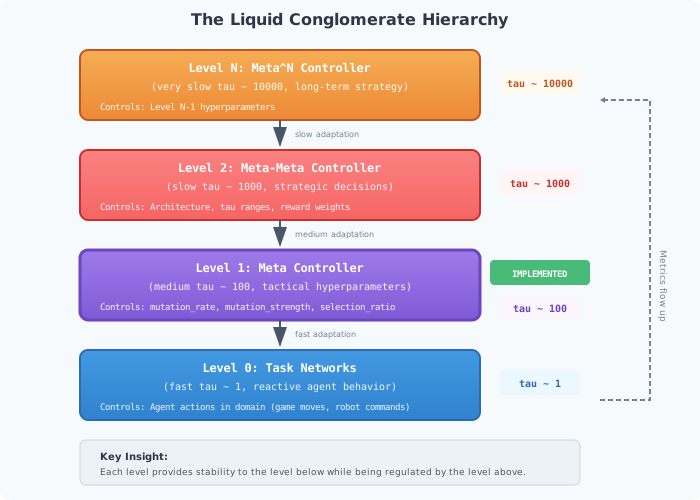
The architecture consists of hierarchical LTC networks, each operating at a different timescale:
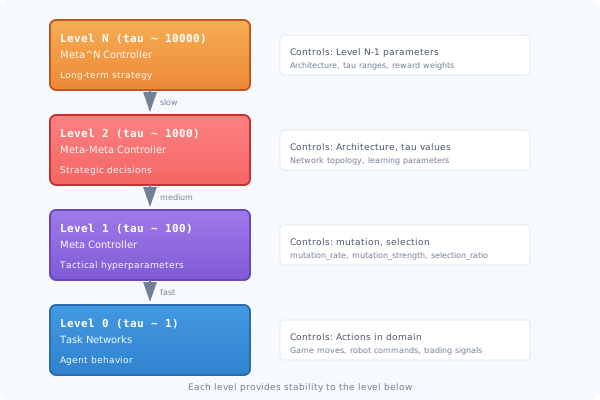
Each level provides stability to the level below while being regulated by the level above.
Why "Liquid"?
The name comes from Liquid Time-Constant (LTC) neurons, which have a key property: their time constant adapts to input magnitude.
Standard Neuron
output = activation(weights · inputs + bias)No temporal memory - responds instantly to inputs.
LTC Neuron
dx/dt = -[1/tau + f(x,I)] · x + f(x,I) · A
output = g(x)
Where:
xis internal state that persists across timetauis the base time constantf(x,I)modulates the effective time constant based on inputsAbounds the state
Key insight: When inputs are strong (rapid training progress), the effective tau decreases - the neuron responds quickly. When inputs are weak (stagnation), tau increases - the neuron is cautious.
This is exactly what you want for hyperparameter control.
Why "Conglomerate"?
The system is a conglomerate of interacting controllers at different timescales:
- Fast (tau ~ 1): Task networks react to immediate game/robot state
- Medium (tau ~ 100): Meta-controller adapts hyperparameters per generation
- Slow (tau ~ 1000): Meta-meta-controller adjusts the meta-controller itself
- Glacial (tau ~ 10000+): Highest levels learn meta-strategies across experiments
Like a biological organism with nervous system, endocrine system, and genetic adaptation - each operating at different speeds but forming a coherent whole.
Effects on Neuroevolution Training
1. Self-Tuning Hyperparameters
Without Liquid Conglomerate:
Generation 1-100:   mutation_rate = 0.1    (too high? too low? who knows)
Generation 101-200: mutation_rate = 0.1    (still the same)
Generation 201+:    mutation_rate = 0.1    (forever the same)
With Liquid Conglomerate:
Generation 1-10:    mutation_rate adapts 0.3→0.15  (exploring)
Generation 11-50:   mutation_rate adapts 0.15→0.08 (found promising region)
Generation 51-80:   mutation_rate adapts 0.08→0.20 (stuck, increase exploration)
Generation 81-100:  mutation_rate adapts 0.20→0.05 (converging on solution)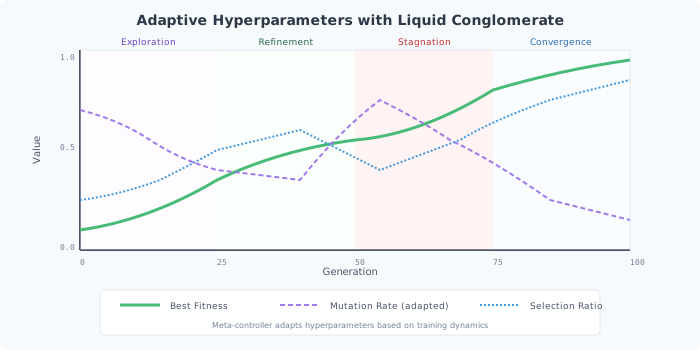
2. Automatic Stagnation Recovery
When training stagnates, the meta-controller detects this through:
- Fitness plateau (low improvement rate)
- Decreasing population diversity
- High fitness variance with no progress
And responds by:
- Increasing mutation rate
- Reducing selection pressure
- Potentially changing network topology
%% Meta-controller observation
Inputs = [
    FitnessDelta / HistoricalAvg,     % Is improvement slowing?
    PopulationDiversity / Threshold,  % Is population homogeneous?
    StagnationCount / MaxStagnation,  % How long stuck?
    GenerationProgress / TotalGen     % Where in training?
],

%% Meta-controller outputs adaptive response
[MutationRate, MutationStrength, SelectionRatio] =
    meta_controller:get_params(MetaNetwork, Inputs),

%% When stagnating: MutationRate increases, SelectionRatio decreases
3. Phase-Appropriate Strategies
Different phases of training need different strategies:
| Phase | Strategy | Meta-Controller Learns |
|---|---|---|
| Early | High exploration | Large mutation, low selection pressure |
| Middle | Balanced | Moderate parameters, diversity maintenance |
| Late | Exploitation | Low mutation, high selection pressure |
| Stuck | Shock therapy | Sudden parameter changes to escape |
The Liquid Conglomerate learns these phase transitions from training dynamics.
4. Transfer Learning of Training Strategies
A meta-controller trained on one domain carries learned "how to train" knowledge:
%% Train meta-controller on CartPole
{ok, MetaNetwork1} = train_meta_controller(cartpole_experiments),

%% Apply to new domain - starts much better than random
{ok, MetaNetwork2} = fine_tune_meta_controller(MetaNetwork1, new_domain_experiments).
The meta-controller has learned patterns like:
- "When diversity drops below X, increase mutation"
- "When improvement accelerates, reduce exploration"
- "Different network topologies need different mutation strengths"
These patterns often transfer across domains.
5. Emergent Training Behaviors
With sufficient training, meta-controllers can exhibit sophisticated emergent behaviors:
- Punctuated equilibrium: Long periods of stability interrupted by rapid adaptation
- Diversity cycling: Periodic expansion and contraction of population diversity
- Anticipatory adjustment: Changing parameters before stagnation based on learned patterns
- Coordinated control: Adjusting multiple parameters together (not independently)
Silo Training Velocity & Inference Impact
The Liquid Conglomerate can incorporate multiple specialized silos - each managing a distinct aspect of evolution. Understanding their performance impact helps decide which to enable:
| Silo | Training Velocity | Inference Overhead | Key Trade-off |
|---|---|---|---|
| Task | Baseline (1.0x) | Minimal | Core fitness evaluation |
| Resource | +20-40% faster | +1-2ms | Prevents wasted compute |
| Distribution | Neutral | +2-5ms | Population structure control |
| Temporal | +++ (2-4x faster) | Minimal | Eliminates wasted evaluation time |
| Economic | ++ (1.5-2x faster) | +5-10ms | Budget constraints force efficiency |
| Cultural | + (1.2-1.5x faster) | +1-3ms | Cultural ratchet accelerates learning |
| Morphological | Neutral (0.9-1.0x) | Reduced (smaller networks) | Size constraints → faster inference |
| Regulatory | + (1.1-1.2x) | +2-5ms | Context switching enables multi-task |
| Social | Neutral (0.9-1.0x) | +2-5ms | Better selection targets offset overhead |
| Ecological | Variable (0.7-1.3x) | +3-8ms | Dynamic pressure → robust solutions |
| Competitive | Neutral | +10-20ms (matchmaking) | Arms race maintains pressure |
| Developmental | − (0.8-0.9x) | +5-10ms | Lifetime learning adds evaluation time |
| Communication | Slight overhead (0.85-0.95x) | +5-15ms | Language evolution overhead |
Recommended Enablement Order
Based on training velocity impact:
- Fastest to enable: Temporal, Economic, Cultural (immediate velocity gains)
- Neutral to enable: Morphological, Social, Competitive, Regulatory, Task, Resource
- Slower but more robust: Ecological (variable), Developmental, Communication
Silo Selection Strategy
%% Example: Configure LC with velocity-optimized silo selection
SiloConfig = #{
    %% Always enable (core functionality)
    task => enabled,
    resource => enabled,

    %% Enable for training velocity
    temporal => enabled,      % +++ velocity
    economic => enabled,      % ++ velocity
    cultural => enabled,      % + velocity

    %% Enable based on domain requirements
    competitive => case Domain of
        adversarial -> enabled;
        _ -> disabled
    end,

    communication => case Domain of
        multi_agent -> enabled;
        _ -> disabled
    end,

    %% Enable for robustness (accept slower training)
    ecological => case Priority of
        robustness -> enabled;
        speed -> disabled
    end
}.
For detailed information on each silo, see the individual silo guides:
- Task Silo Guide - Core fitness evaluation and learning
- Resource Silo Guide - Computational resource management
- Temporal Silo Guide - Time and episode management
- Competitive Silo Guide - Adversarial dynamics
- Cultural Silo Guide - Knowledge transfer and traditions
- Social Silo Guide - Reputation and cooperation
- Ecological Silo Guide - Environmental pressures
- Morphological Silo Guide - Network structure control
- Developmental Silo Guide - Lifetime learning
- Regulatory Silo Guide - Gene expression control
- Economic Silo Guide - Resource economics
- Communication Silo Guide - Signal evolution
Implementation
Level 1: Meta-Controller (Current)
%% Start meta-controller
MetaConfig = #meta_config{
    network_topology = {8, [16, 8], 4},
    time_constant = 50.0,              % Medium tau for generation-scale adaptation
    learning_rate = 0.001,
    reward_weights = #{
        convergence => 0.25,
        fitness => 0.25,
        efficiency => 0.20,
        diversity => 0.15,
        structure => 0.15
    }
},

{ok, MetaPid} = meta_controller:start_link(MetaConfig).

%% In evolution loop, after each generation:
handle_generation_complete(Stats, State) ->
    %% Get adapted hyperparameters
    NewParams = meta_controller:update(MetaPid, Stats),

    %% Apply to next generation
    NewConfig = State#state.config#neuro_config{
        mutation_rate = maps:get(mutation_rate, NewParams),
        mutation_strength = maps:get(mutation_strength, NewParams),
        selection_ratio = maps:get(selection_ratio, NewParams)
    },

    State#state{config = NewConfig}.
Reward Signal Design
The meta-controller's reward balances multiple objectives:
%% meta_reward.erl computes:
Reward = #{
    %% Did training improve?
    convergence_speed => FitnessDelta / TimeTaken,

    %% How good is the result?
    final_fitness => BestFitness / HistoricalBest,

    %% Was computation efficient?
    efficiency_ratio => FitnessGain / ComputeCost,

    %% Is population healthy?
    diversity_aware => DiversityScore * EntropyScore,

    %% Can population still adapt?
    normative_structure => AdaptationReadiness * BreakthroughPotential
}.

TotalReward = weighted_sum(Reward, Config#meta_config.reward_weights).
The "Normative Structure" Component
A novel reward component that rewards the meta-controller for maintaining capacity to improve, not just current performance:
%% Measures population's potential, not just current fitness
normative_structure_score(Population, History) ->
    #{
        %% Are there distinct strategy clusters?
        diversity_corridors => count_strategy_clusters(Population),

        %% Is there variance in fitness-adjacent traits?
        adaptation_readiness => measure_trait_variance(Population),

        %% How far from explored fitness regions?
        breakthrough_potential => distance_to_frontier(Population, History),

        %% Information content of population strategies
        strategy_entropy => calculate_entropy(Population)
    }.
This prevents the meta-controller from "squeezing" the population too aggressively.
Visualization
Training Dashboard
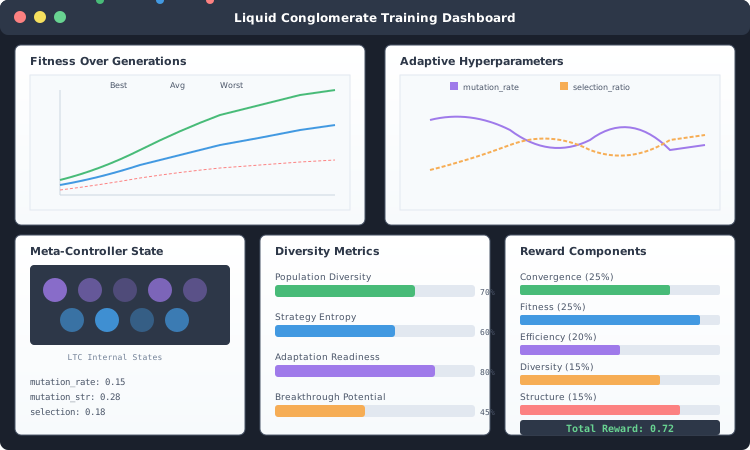
A typical Liquid Conglomerate training dashboard shows:
- Fitness curves - Best, average, worst fitness over generations
- Hyperparameter trajectories - How mutation rate, selection ratio evolve
- Meta-controller state - Internal LTC neuron states
- Diversity metrics - Population health indicators
- Reward components - What the meta-controller is optimizing
Meta-Controller Internals
%% Get meta-controller state for visualization
{ok, MetaState} = meta_controller:get_state(MetaPid),

%% MetaState contains:
#{
    inputs => [...],           % Current observations
    internal_state => [...],   % LTC neuron states (temporal memory)
    outputs => [...],          % Current hyperparameter values
    reward_history => [...],   % Recent rewards
    generation => N
}.
Theoretical Foundation
Multi-Timescale Learning
The Liquid Conglomerate exploits separation of timescales:
Fast dynamics:    Agent actions        (milliseconds)
                        ↑ controlled by
Medium dynamics:  Hyperparameters      (per generation)
                        ↑ controlled by
Slow dynamics:    Meta-strategies      (across experiments)
                        ↑ controlled by
Glacial dynamics: Fundamental patterns (across domains)
Each level operates independently but couples to adjacent levels through:
- Upward: Performance metrics (feedback)
- Downward: Parameter settings (control)
Self-Organizing Criticality
With LTC meta-control, the system naturally finds the "edge of chaos":
- Too much exploitation (low mutation) → Stagnation → Meta-controller increases mutation
- Too much exploration (high mutation) → Chaos → Meta-controller decreases mutation
The liquid dynamics provide smooth transitions, preventing oscillation.
Temporal Cognition
The system develops an intuition about when to change parameters:
- LTC's adaptive tau means timescales self-organize based on signal dynamics
- A meta-controller facing rapid improvement speeds up (lower effective tau)
- A meta-controller facing stagnation slows down (higher effective tau)
This is not just optimization - it's a form of temporal cognition.
Comparison to Other Approaches
| Approach | Adapts During Training | Learns Meta-Knowledge | Multi-Timescale |
|---|---|---|---|
| Manual tuning | No | No | No |
| Grid search | No | No | No |
| Random search | No | No | No |
| Bayesian optimization | Limited | No | No |
| Population-based training | Yes | Limited | No |
| Liquid Conglomerate | Yes | Yes | Yes |
Future Directions
Topology Evolution Integration
The current implementation controls weight evolution parameters. A natural extension is controlling topology evolution - structural changes to the neural networks themselves.
The macula_tweann library already provides topology mutation operators:
add_neuron/1- Insert neurons into existing connectionsadd_outlink/1,add_inlink/1- Add connections between neuronsoutsplice/1- Split connections with new neurons
The meta-controller could extend to control:
| New Output | Effect on Evolution |
|---|---|
topology_mutation_rate | How often structural changes occur |
add_neuron_rate | Bias toward growing complexity |
add_connection_rate | Network density control |
complexity_penalty | Fitness penalty per structural element |
This enables the Liquid Conglomerate to learn when to complexify networks, not just how to tune weights. Early in training, it might encourage exploration of different topologies. Later, it might focus on weight optimization of proven structures.
See Topology Evolution Roadmap for detailed integration plans.
Level 2+: Recursive Hierarchy
The current implementation is Level 1. Future work includes:
Level 2 meta-meta-controller could control:
- Level 1's tau values
- Level 1's network topology
- Level 1's reward weights
- When to reset Level 1

Level 3 could control:
- Problem decomposition strategies
- Domain transfer decisions
- Architecture search
Distributed Liquid Conglomerate
With Macula mesh, different levels can run on different nodes:
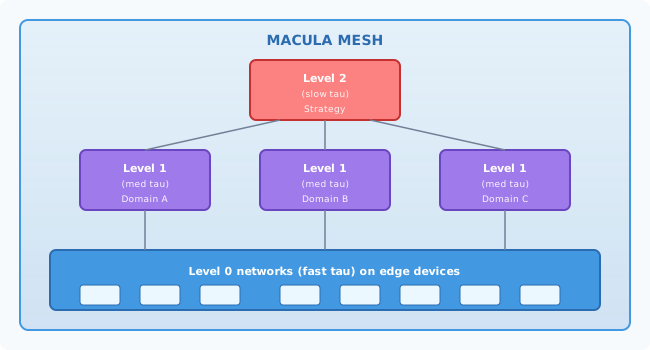
Co-Evolution
Co-evolving meta-controllers alongside task networks could discover novel training strategies that human researchers haven't conceived.
Summary
The Liquid Conglomerate is:
- A hierarchical architecture of LTC neural networks at different timescales
- Self-tuning - learns optimal hyperparameters from training dynamics
- Adaptive - responds to stagnation, diversity loss, and phase changes
- Transferable - meta-knowledge can transfer across domains
- Emergent - develops sophisticated training strategies through learning
By embedding "how to train" knowledge into LTC networks, we move from static optimization to dynamic meta-optimization - systems that learn how to learn.
Related Guides
- LTC Meta-Controller - Implementation details
- Overview - Neuroevolution fundamentals
- Custom Evaluators - Domain-specific training
- Inference Scenarios - Deploying evolved networks
References
LTC Networks
- Hasani, R., Lechner, M., et al. (2021). "Liquid Time-constant Networks." AAAI 2021.
- Hasani, R., Lechner, M., et al. (2022). "Closed-form Continuous-time Neural Networks." Nature Machine Intelligence.
Meta-Learning
- Finn, C., Abbeel, P., Levine, S. (2017). "Model-Agnostic Meta-Learning for Fast Adaptation of Deep Networks." ICML.
- Xu, Z., et al. (2018). "Meta-Gradient Reinforcement Learning." NeurIPS.
Evolved Plasticity
- Soltoggio, A., et al. (2008). "Evolutionary advantages of neuromodulated plasticity."
- Clune, J., et al. (2013). "The evolutionary origins of modularity."
Multi-Timescale Systems
- Hopfield, J.J. (1982). "Neural networks and physical systems with emergent collective computational abilities."
- Izhikevich, E.M. (2007). "Dynamical Systems in Neuroscience: The Geometry of Excitability and Bursting."