Getting started
View SourceThis guide takes a working Erlang/OTP environment and walks you to a two-node barrel_p2p cluster, with a real handshake and a real service lookup. We do not skip the underlying ideas: each step explains what the system does and why.
The audience is an Erlang developer comfortable with gen_server,
releases, and the standard distribution. You do not need prior
knowledge of HyParView, QUIC, or CRDTs; we will introduce the parts
that matter as they appear.
What you are about to build
A barrel_p2p cluster is, on the surface, a normal Erlang cluster:
Pid ! Msg, rpc:call/4, gen_server:call/2, and global all work
as you expect. Under that surface, three pieces replace the default
Erlang behaviour:
- The dist carrier. Instead of TCP, barrel_p2p runs the distribution channel over a single QUIC connection per peer. That gives us encryption by default, multiplexed streams on top of the same connection, and connection migration when the local network changes.
- The membership protocol. Instead of a full mesh where every node opens a TCP connection to every other node, each node keeps a small, bounded set of gossip peers (the HyParView "active view", typically five). The cluster as a whole remains fully addressable through OTP's demand-driven auto-connect.
- A service registry. Processes can be registered under a name and discovered from any node in the cluster, without you running a separate service-discovery service.
Read the graph from the node in the centre. The active view is the small set of peers used for gossip. The passive view is a cache of known peers. They are not connected now, but they are useful when an active peer drops or when the topology needs to refresh.
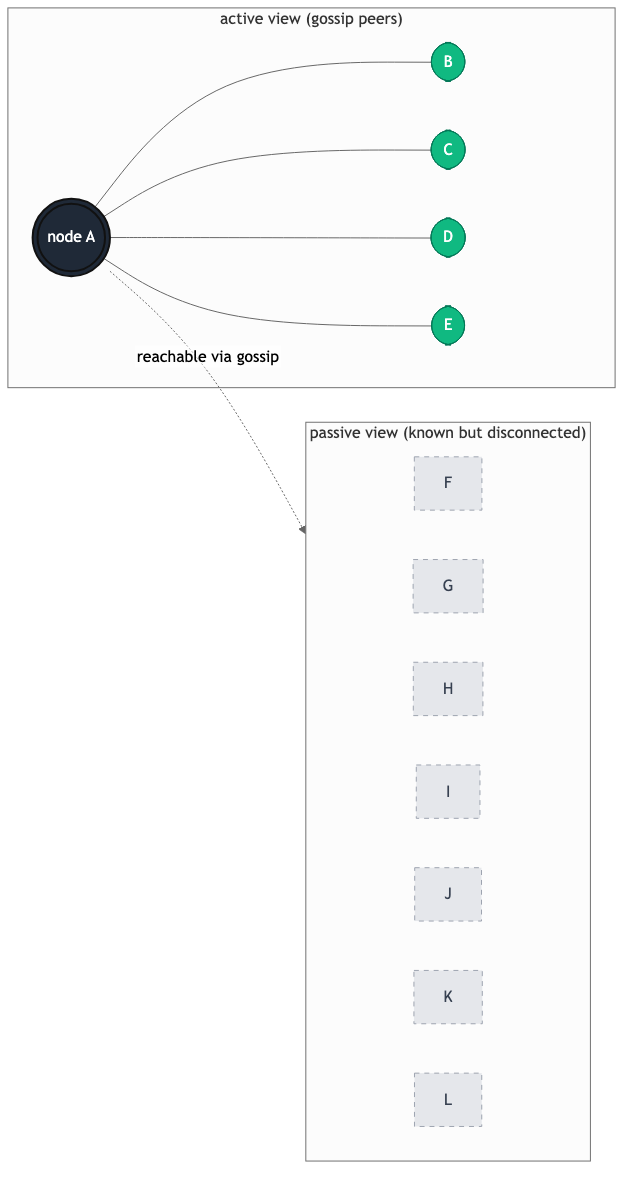
For an Erlang application, this graph is not nodes(). It is only
the maintenance topology. Application traffic can still reach a pid
on another cluster member.
The rest of this guide is the smallest path from a fresh checkout to two nodes exchanging a message.
Prerequisites
- Erlang/OTP 27 or later.
rebar3.- A single UDP port available on each node (the default is
0, meaning "let the OS assign one"; in production you pin it).
We assume no EPMD daemon is running. Barrel P2P does not use it: peers discover each other through the discovery chain described later.
One-time setup: where credentials live
Each barrel_p2p node carries two kinds of credentials on disk. They are generated the first time the node boots; you do not have to create them manually.
data/
├── quic/
│   ├── node.crt    (TLS certificate; auto-generated, self-signed)
│   └── node.key    (TLS private key; chmod 0600)
└── keys/
    ├── node.pub    (Ed25519 public key, 32 bytes)
    ├── node.key    (Ed25519 private key, 32 bytes; chmod 0600)
    └── trusted/
        └── ...     (one .pub per peer this node has pinned)
The two layers serve different purposes:
- The TLS material secures the transport. QUIC needs a cert to start a listener. Barrel P2P uses self-signed certs by default; the certificate's identity is the Ed25519 public key recorded below, not the CN field.
- The Ed25519 keypair is the node's identity. After the QUIC TLS handshake completes, the two peers run a short challenge-response over a pair of QUIC streams to prove they hold the private key matching the public key they presented. The cluster uses this layer, not the TLS layer, to decide whether to trust the peer.
Both materials are regenerated on a fresh boot if missing. You can also pre-generate the TLS material with the helper script:
_build/default/lib/barrel_p2p/priv/bin/barrel_p2p_gen_cert.sh
(--out-dir, --cn, --days, --key-bits, --force are the
flags; the script is idempotent unless you pass --force.)
Adding barrel_p2p to a project
In rebar.config:
{deps, [
    {barrel_p2p, "0.1.0"}
]}.
Fetch and compile:
rebar3 get-deps
rebar3 compile
That is the full dependency setup. Barrel P2P pulls in the upstream
QUIC implementation, hlc for hybrid logical clocks, and instrument
for metrics.
Configuring the node
Barrel P2P is opinionated about defaults. A minimal config/sys.config
that lets you boot a node looks like this:
[
    {barrel_p2p, [
        %% HyParView membership parameters
        {active_size, 5},          %% Maximum concurrent gossip peers
        {passive_size, 30},        %% Known-but-disconnected peers

        %% Network
        {listen_port, 9100},       %% 0 lets the OS choose

        %% Authentication
        {auth_enabled, true},      %% Default; flip to false only for dev
        {auth_trust_mode, tofu}    %% tofu | strict
    ]}
].
The two membership parameters deserve a word. The active view is the small set of peers a node currently exchanges gossip with. The protocol guarantees that the whole cluster is reachable from any node by repeatedly forwarding through this view, so the active view does not need to grow with the cluster: five peers per node is enough for thousands of nodes. The passive view is a cache of known peers that are not currently in the active view; they are warm spares used when an active peer drops.
Trust mode controls the authentication layer:
tofu("trust on first use") is the default. The first time a node meets a peer, it records the peer's Ed25519 public key. From then on, that peer is rejected if it presents a different key.strictrequires every peer's key to be pinned in advance. Useful in environments where you do not want any first-contact window.
See authentication.md for the operational side of trust modes.
Boot arguments
Two BEAM-level boot flags switch Erlang's distribution layer to barrel_p2p:
-proto_dist barrel_p2p
-epmd_module barrel_p2p_epmd
-start_epmd false
The first selects barrel_p2p as the dist module. The second tells
net_kernel to use barrel_p2p's discovery shim instead of the stock
EPMD daemon. The third disables the daemon entirely; barrel_p2p does
not need it.
These three lines are the entire dist configuration. Everything
else, certificate paths, the auth callback, the discovery chain, is
projected by barrel_p2p into the underlying quic_dist app
environment when the listener starts.
Starting one node
The fastest path is a rebar3 shell with the boot args injected:
ERL_AFLAGS="-proto_dist barrel_p2p -epmd_module barrel_p2p_epmd -start_epmd false" \
rebar3 shell --config config/sys.config --sname node1
Inside the shell:
1> barrel_p2p:active_view().
[]
You have a running barrel_p2p node with no peers yet. The TLS material
and the Ed25519 keypair are in data/quic/ and data/keys/.
To inspect the identity:
2> {ok, PubKey} = barrel_p2p_dist_auth:get_public_key().
{ok, <<...32 bytes...>>}
3> barrel_p2p_dist_keys:fingerprint(PubKey).
<<...32 bytes SHA-256...>>
The fingerprint is what you log and share when verifying a node out of band.
Forming a two-node cluster
Open a second terminal and start a second node:
ERL_AFLAGS="-proto_dist barrel_p2p -epmd_module barrel_p2p_epmd -start_epmd false" \
rebar3 shell --config config/sys.config --sname node2
On node2, ask to join node1:
1> barrel_p2p:join('node1@yourhost').
ok
2> barrel_p2p:active_view().
['node1@yourhost']
On node1, you will see the symmetric view:
4> barrel_p2p:active_view().
['node2@yourhost']
What happened, in order:
node2'sjoin/1produced aJOINmessage tonode1.- The QUIC layer opened a UDP-backed connection between the two nodes. The TLS handshake completed using the self-signed certs.
- The Ed25519 challenge-response ran on a pair of unidirectional
QUIC streams. Because both nodes are in
tofumode and neither had seen the other before, both pinned the other's public key under its node atom. - The standard Erlang dist handshake then ran on top of the authenticated channel.
- HyParView added each side to the other's active view.
From this point on, anything you can do with stock Erlang
distribution works: rpc:call/4, Pid ! Msg, global, links,
monitors.
Seeds and discovery
The manual join/1 above is the teaching path. In a real deployment a
node joins the cluster from configuration, and you never type a node name.
This section explains the two pieces that make that work: what a seed is,
and how a node turns a seed's name into an address.
What a seed is
A seed is just an existing cluster member that a new node contacts to get in. Nothing about a seed's own configuration is special; what matters is that other nodes know how to reach it. The very first node you start has no one to join (it is the seed); every later node joins through one or more seeds. Seeds are not masters: once a node is in the overlay it is an equal peer, and any member can seed the next joiner.
Because membership is gossiped, you need only a few seeds. Two or three stable, well-known addresses are enough for a large cluster, since a joiner needs just one of them to answer.
How a node resolves a seed's address
Barrel P2P runs no EPMD, so a node name like seed@10.0.0.1 must be turned
into a UDP {address, port} some other way. That is the discovery chain:
a list of backends tried in order, first hit wins.
{barrel_p2p, [
    {discovery_backends, [
        barrel_p2p_discovery_static,   %% explicit {Node, {Addr, Port}} table
        barrel_p2p_discovery_file,     %% shared dir of <node>.endpoint files
        barrel_p2p_discovery_dns       %% resolve the host part via DNS
    ]}
]}
static reads an explicit table from the
quicapp'sdistenv. Use it when seed addresses are fixed and known up front:{quic, [ {dist, [ {nodes, [ {'seed1@10.0.0.1', {"10.0.0.1", 9100}}, {'seed2@10.0.0.2', {"10.0.0.2", 9100}} ]} ]} ]}file uses a directory every node can read. Each node writes its own
<node>.endpointfile there at boot (discovery_dir, defaultdata/discovery), so peers sharing the filesystem (one host, or a shared/NFS volume) find each other with no static table. This is what the local multi-node examples use.dns takes the host part of the node name (
seed@db.svc.cluster.local), resolves it through DNS, and pairs it with the listen port. Handy on Kubernetes or anywhere the name already resolves to an address.
A seed must be reachable through whatever chain its joiners use. The
simplest setups are one static entry per seed (cloud VMs with fixed IPs)
or a shared discovery_dir (a single host or a shared volume).
Auto-joining seeds with contact_nodes
List the seeds in contact_nodes and barrel_p2p joins them at boot, so you
never call barrel_p2p:join/1:
{barrel_p2p, [
    {listen_port, 9100},
    {contact_nodes, ['seed1@10.0.0.1', 'seed2@10.0.0.2']}
]}
While its active view is empty, the node asks each contact to let it in,
retrying every contact_retry_ms (default 5000) until it is in the
overlay. A seed that comes up after its joiners, or a node that briefly
loses every peer, recovers on its own. The seeds must be resolvable
through the discovery chain.
Ship the same contact_nodes list to every node, seeds included (a node
skips its own name), so the configuration is uniform across the fleet. A
single-seed cluster leaves the seed's list effectively empty and points
everyone else at it.
Starting a node in production
In a release the three dist flags go in vm.args and the barrel_p2p
configuration in sys.config:
## vm.args
-name app@10.0.0.5
-setcookie <your-secret>
-proto_dist barrel_p2p
-epmd_module barrel_p2p_epmd
-start_epmd false
%% sys.config
[
{barrel_p2p, [
{listen_port, 9100},
{contact_nodes, ['seed1@10.0.0.1', 'seed2@10.0.0.2']},
{dist_cookie, <<"your-secret">>},
{auth_trust_mode, tofu}
]},
{quic, [
{dist, [{nodes, [
{'seed1@10.0.0.1', {"10.0.0.1", 9100}},
{'seed2@10.0.0.2', {"10.0.0.2", 9100}}
]}]}
]}
].The node generates its TLS and Ed25519 material on first boot (see where credentials live), resolves the seeds through discovery, and joins the overlay, all without a scripted join step. See run in production for ports, secrets, sizing, and shutdown.
A first service lookup
Service registration is the part of barrel_p2p that you reach for most often when building a real application. A service is a process registered under a name; that name is replicated across the cluster so any peer can find the process.
On node1:
5> barrel_p2p:register_service(my_worker, #{role => worker}).
ok
The service is registered for the process that calls
register_service/2. In a real application this call normally lives
in the service process itself, often in init/1. The metadata map is
free-form; you can store anything that fits naturally in a Map.
On node2, a moment later (replication is asynchronous, typically
under a second):
3> barrel_p2p:lookup(my_worker).
{ok, [{service_entry, my_worker, <0.123.0>, 'node1@yourhost', #{role => worker}}]}

4> {ok, _Node, FoundPid} = barrel_p2p:whereis_service(my_worker).
{ok, 'node1@yourhost', <0.123.0>}

5> FoundPid ! hello.
hello
Three things to notice:
lookup/1returns all instances registered under the name. There may be more than one if multiple nodes register the same name.whereis_service/1returns a single instance and prefers a local one when there is a choice. The shape is{ok, Pid}for a local service and{ok, Node, Pid}for a remote one. It is the function you reach for from application code.- The pid we got back is the real pid on
node1. The send-bang uses standard Erlang distribution, opened on demand. No barrel_p2p primitive is on the data path once you hold the pid.
The flow of a cross-node send, when the target is not in the local active view, is the part to keep in mind:
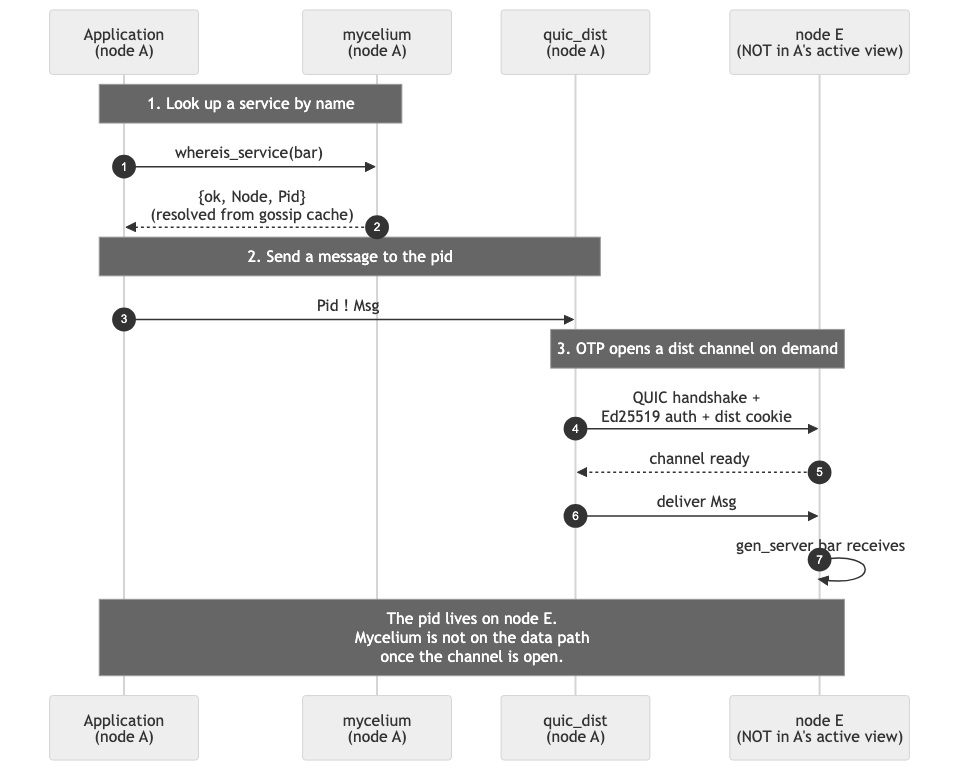
Barrel P2P helps you find the pid. OTP sends to it. If no dist channel exists yet, the QUIC channel is opened and authenticated before the message is delivered.
Subscribing to membership and service events
If your application needs to react to cluster changes:
6> barrel_p2p:subscribe().
ok
%% receive {barrel_p2p_event, {peer_up, Node}} | {barrel_p2p_event, {peer_down, Node, Reason}}

7> barrel_p2p:subscribe_services().
ok
%% receive {barrel_p2p_service_event, {service_registered, Name, Node}}
%%       | {barrel_p2p_service_event, {service_unregistered, Name, Node}}
%%       | {barrel_p2p_service_event, {service_down, Name, Node, Reason}}
These two subscription bus are independent and idempotent: subscribing twice from the same pid is a no-op. Both deliver standard Erlang messages, so you can route them through your existing handler.
Tearing down
Either call barrel_p2p:leave/0 for a graceful exit (peers move you
to their passive view immediately), or stop the application:
8> barrel_p2p:leave().
ok
In production, the recommended shutdown order is
barrel_p2p:leave/0, then application:stop(barrel_p2p), then
init:stop/0. The reasoning is in deployment.md.
A quick look at what just happened
Stepping back from the commands you typed:
- Two BEAM nodes ran with
-proto_dist barrel_p2p. That replaced the default TCP dist with a QUIC carrier, automatically projected the certificate paths and the auth callback, and disabled EPMD. - Each node generated its identity material on first boot. No manual provisioning.
- A join over QUIC was authenticated end to end: TLS at the transport layer, Ed25519 at the identity layer, the dist cookie at the Erlang layer.
- Membership was managed by HyParView with active view size 5; even with thousands of nodes, each node would keep only five active peers.
- The service registry is a CRDT (an Observed-Remove Map). That is why we said "a moment later": registrations are gossiped through the cluster and merge without coordination.
Where to go next
- tutorial.md is the practice handbook: build a small Erlang application using the primitives introduced here.
- internals.md describes the protocols in more depth: HyParView's failure handling, Plumtree's gossip tree, the OR-Map merge, and how the QUIC carrier is wired.
- authentication.md covers strict mode, key rotation, and the trust store on disk.
- deployment.md is the operational reference: ports, permissions, sizing, shutdown.
- troubleshooting.md is the table to skim when the cluster does not do what you expect.