Introduction
View SourceThis is the longer companion to What is barrel_p2p?. It explains why each piece of the system is shaped the way it is. Read this once; the per-concept pages then make sense without context-switching.
The problem
Erlang's default distribution is wonderful for what it was
designed to do: tightly couple a small set of nodes that trust
each other on a local network, and make Pid ! Msg work across
machines as if they were one.
It struggles outside that envelope. Three specific ways:
- Full mesh. Every node opens a TCP connection to every other
node. Past a few dozen nodes, the connection count, the kernel
resources, and the
nodeup/nodedownevent volume start to be expensive. - No identity layer. The Erlang cookie is a shared secret; knowing the cookie is enough to join the cluster. There is no per-peer identity, no rotation, no revocation.
- No service discovery.
globalprovides cluster-wide registration coordinated through a distributed consensus-but-not-quite, and it does not scale much past the full mesh.
Barrel P2P addresses all three, while preserving the property that
matters most: standard Erlang code paths still work. Pid ! Msg
is still the right way to send a message.
The shape of the solution
Three subsystems, mostly independent of each other:
- The dist carrier. A QUIC-based replacement for the TCP carrier, with Ed25519 mutual authentication slotted in between the QUIC TLS handshake and the Erlang dist handshake.
- The membership protocol. HyParView keeps each node connected to a small, bounded set of gossip peers. The cluster stays fully reachable through OTP's demand-driven auto-connect.
- The service registry. An Observed-Remove Map (OR-Map) CRDT replicated through Plumtree epidemic broadcast. Names are cluster-wide; eventual consistency, no coordination.
The rest of this introduction walks through each in turn, in enough depth that the per-concept pages make sense.
Layer one: the QUIC carrier
Why QUIC?
- Encryption is mandatory. Every Erlang dist byte rides on a TLS-protected QUIC connection. No mode where you accidentally ship cleartext over a hostile network.
- One UDP socket per peer. A single connection multiplexes
the Erlang dist control stream plus any application streams
(
barrel_p2p_streams) plus the Ed25519 auth handshake. This is the natural shape for a P2P system. - Connection migration. A QUIC connection can rebind to a new local 4-tuple without losing keys or streams. Useful when the local network changes (laptops, CGNAT shuffles, tunnel reconnects).
The carrier itself is upstream quic_dist. Barrel P2P is a thin
proto_dist shim on top: it auto-generates the self-signed TLS
material on first boot, projects the right defaults into the
quic.dist app env, and wires the Ed25519 callback. Everything
else delegates to upstream.
Why Ed25519 on top of TLS
The QUIC TLS handshake gives us a confidential channel, but it does not say who is on the other side. The certs are self-signed; there is no authority barrel_p2p expects you to trust.
The Ed25519 layer adds that. Each node has a long-lived Ed25519 keypair stored on disk. The public key is the node's identity; the private key is what the node uses to prove that identity. Across TLS rotations, across reboots, the Ed25519 keypair persists. Peers pin each other's public keys under the node atom; subsequent handshakes verify the pinned key matches.
Two trust modes:
- TOFU (trust on first use): the first handshake records the peer's key. Subsequent handshakes verify the pin.
- Strict: every peer's key must be pre-pinned. No first-contact window.
The same mechanism powers SSH's known_hosts.
Layer two: bounded membership
The HyParView protocol gives each node two sets:
- The active view, a small bounded set (default 5) of peers this node currently exchanges gossip with. Symmetric: if A has B in its active view, B has A in its active view.
- The passive view, a larger bounded cache (default 30) of known but disconnected peers, used as warm spares.
The key insight: the active view does not need to grow with the cluster. The protocol guarantees that any peer is reachable from any starting point by repeatedly forwarding through this small bounded view. For a cluster of thousands of nodes, five active links per node is enough.
When a peer fails, exponential backoff prevents reconnection storms. After enough failures, the protocol promotes a peer from the passive view to replace the failed one in the active view.
A periodic shuffle (every 10 seconds by default) exchanges a small random sample of the active and passive views with one active peer. That is how new members reach corners of the cluster that did not see their initial join, and how the passive view stays fresh enough that there is always a spare.
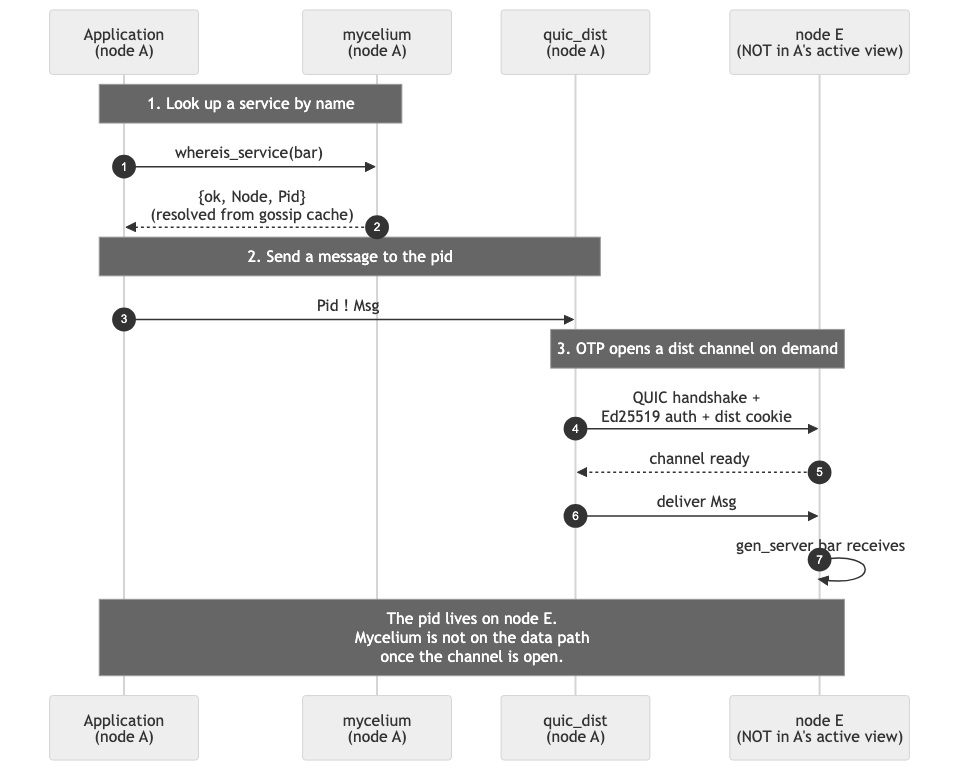
Why this matters for Pid ! Msg
In the default Erlang dist, every node has a TCP connection to
every other node, so Pid ! Msg is always a no-op at the
connection level. In a partial-membership setting, two nodes that
have never met have no open connection between them.
Barrel P2P leans on OTP's demand-driven dist auto-connect. When
Pid ! Msg targets a node outside the active view, a fresh
QUIC channel opens on demand: TLS handshake, Ed25519 mutual auth,
Erlang dist handshake, and only then does the message flow. If
the channel is then idle for long enough, the dist GC reaps it.
The end result: from the application's perspective, sending to any peer works. The connection count stays bounded.
Layer three: the service registry
Names are stored in an Observed-Remove Map (OR-Map) CRDT. Three properties matter:
- Adds and removes commute. Two concurrent adds of the same name produce two entries; removes only delete the dots they have observed.
- Tombstones are bounded. Old removes can be garbage collected once every node has observed them.
- Causal merging. Two replicas merge by union plus the rule that a tombstoned dot stays tombstoned.
Each registration carries a dot: a {node, hlc_timestamp}
pair. The hybrid logical clock guarantees that two registrations
from the same node are ordered, and two registrations from
different nodes can be compared causally.
Replication happens through Plumtree epidemic broadcast:
- Each broadcast goes to the eager peers in the active view first (full message body).
- Lazy peers receive only the message ID (
IHAVEannouncement). - A duplicate triggers a
PRUNE(the sender becomes lazy). - A missing message triggers a
GRAFT(the lazy peer is promoted back to eager).
The tree self-organises into a near-optimal spanning structure
for broadcasts and self-heals through GRAFT after peer
failures. The cost of a broadcast is O(n) messages, not
O(n²).
Putting it together
A real example: a registration on node A flows like this:
- The application calls
register_service/2. The local registry updates its OR-Map with a fresh dot. - The registry's
barrel_p2p_replicainstance produces a delta and broadcasts it through Plumtree. - Each eager peer receives the delta, merges into its OR-Map,
and forwards to its own eager peers. Lazy peers receive an
IHAVEand graft if they have not seen the message. - Within a fraction of a second, every node has the registration in its local OR-Map.
- A
whereis_service/1call on any node now finds the registration.
From the application's point of view, the call returned ok and
the name is "out there". The protocol does the work.
Where to read next
If you want to skim:
- What is barrel_p2p? is the short version.
- Benefits and trade-offs tells you when to pick this and when not to.
If you want to start using it:
If you want to dig into one piece at a time: