Temporal Silo Guide
View SourceWhat is the Temporal Silo?
The Temporal Silo is the time management controller in the Liquid Conglomerate architecture. It manages how long to evaluate individuals, episode durations, reaction time budgets, and early termination decisions. Poor time management wastes 30-70% of evaluation compute on hopeless individuals or cuts off promising ones too early.
Think of the Temporal Silo as a project manager with a stopwatch. It decides how long each individual gets to prove itself, terminates hopeless cases early to save resources, and extends evaluation time when task complexity demands it. Without it, every individual - good or bad - receives the same fixed evaluation time.
The Temporal Silo solves two fundamental problems in neuroevolution:
- Wasted Compute: Stopping hopeless individuals early saves 2-5x compute
- Adaptive Difficulty: Matching episode length to task complexity improves results
Architecture Overview
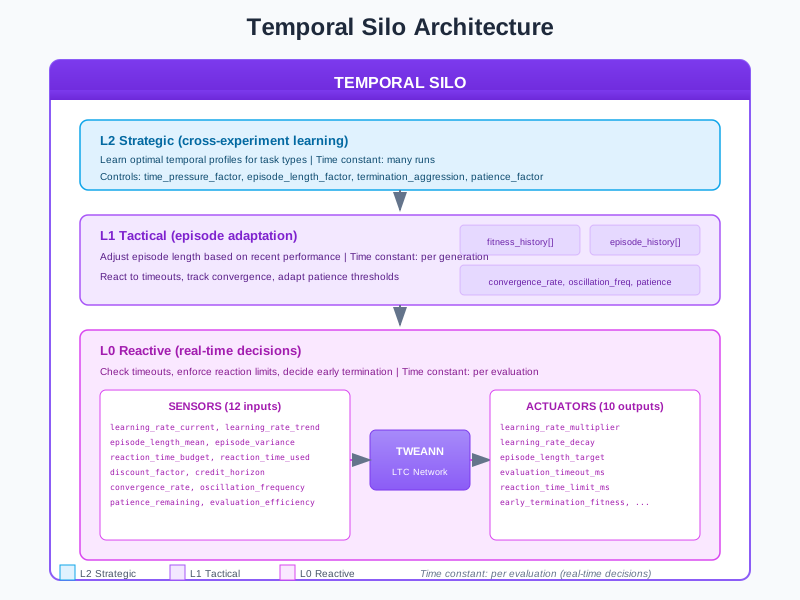
The Temporal Silo operates as a three-level hierarchical controller:
| Level | Name | Role | Time Constant |
|---|---|---|---|
| L0 | Reactive | Real-time timeout/termination decisions | Per evaluation |
| L1 | Tactical | Adapt episode length based on performance | Per generation |
| L2 | Strategic | Learn optimal temporal profiles (future) | Across runs |
Key Principle: Time is Money
The Temporal Silo operates on the principle that evaluation time is the primary cost in neuroevolution:
- Bad individuals waste time if evaluated fully
- Good individuals may need more time to show potential
- Different tasks require different episode lengths
- Real-time applications have strict timing constraints
How It Works
Sensors (Inputs)
The Temporal Silo observes 12 sensors describing time-related dynamics:
| Sensor | Range | Description |
|---|---|---|
learning_rate_current | [0, 1] | Current network learning rate (normalized) |
learning_rate_trend | [-1, 1] | Direction of learning rate change |
episode_length_mean | [0, 1] | Average episode duration / max duration |
episode_length_variance | [0, 1] | Variance in episode lengths |
reaction_time_budget | [0, 1] | Allowed reaction time per step |
reaction_time_used | [0, 1] | Actual reaction time / budget |
discount_factor | [0, 1] | Temporal discount for credit assignment |
credit_horizon | [0, 1] | How far back credit propagates |
convergence_rate | [0, 1] | Speed of fitness convergence |
oscillation_frequency | [0, 1] | Fitness oscillation (instability indicator) |
patience_remaining | [0, 1] | Generations until early stopping |
evaluation_efficiency | [0, 1] | Fitness gained per evaluation time |
Actuators (Outputs)
The Temporal Silo controls 10 parameters governing time management:
| Actuator | Range | Default | Description |
|---|---|---|---|
learning_rate_multiplier | [0.1, 10.0] | 1.0 | Scale factor for learning rates |
learning_rate_decay | [0.9, 1.0] | 0.99 | Per-generation decay rate |
episode_length_target | [10, 10000] | 1000 | Target episode steps |
episode_variance_allowed | [0.0, 1.0] | 0.3 | Acceptable variance in episode length |
evaluation_timeout_ms | [100, 60000] | 5000 | Maximum evaluation time |
reaction_time_limit_ms | [1, 1000] | 100 | Max per-step thinking time |
discount_factor | [0.9, 0.999] | 0.99 | Gamma for credit assignment |
patience_threshold | [5, 100] | 20 | Generations without improvement tolerance |
early_termination_fitness | [0.0, 1.0] | 0.1 | Fitness below which to terminate early |
eligibility_trace_decay | [0.0, 1.0] | 0.9 | Lambda for eligibility traces |
Early Termination
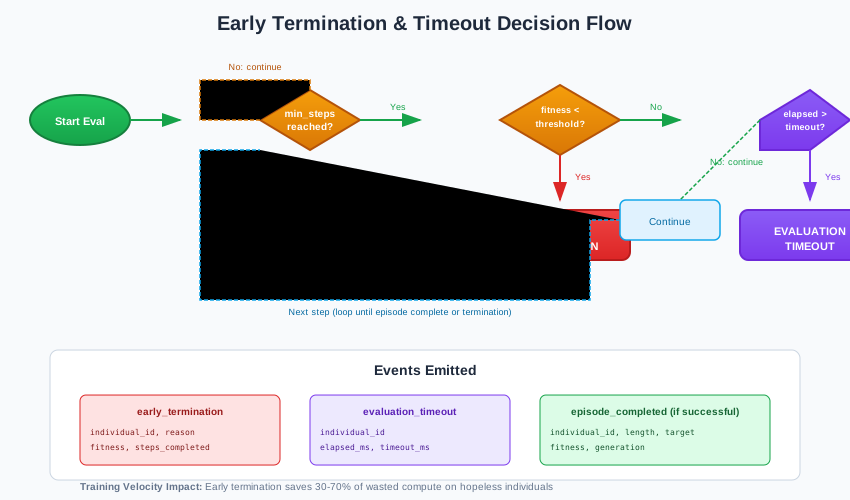
Early termination is the primary mechanism for saving compute:
Decision Logic:
- Wait for
min_steps_before_terminationto gather data - Check if
fitness < early_termination_fitnessthreshold - Also consider fitness trend (is it improving?)
- If hopeless, terminate and emit
early_terminationevent
Benefits:
- 30-70% compute savings by stopping bad individuals
- False termination rate can be tuned via threshold
- Frees resources for promising individuals
The Control Loop
- Per Step: Check reaction time limits (for real-time applications)
- Per Evaluation: Track elapsed time, check timeout, check early termination
- Per Episode: Record episode length, update efficiency metrics
- Per Generation: Adapt episode targets based on performance
- Emit Events: Publish timeout/termination/convergence events
%% Typical usage in evaluation
evaluate_individual(Individual, State) ->
    %% Get temporal parameters
    Params = temporal_silo:get_temporal_params(TempPid),
    #{evaluation_timeout_ms := Timeout,
      early_termination_fitness := TermThreshold} = Params,

    StartTime = erlang:monotonic_time(millisecond),
    evaluate_loop(Individual, StartTime, Timeout, TermThreshold, State).

evaluate_loop(Individual, StartTime, Timeout, TermThreshold, State) ->
    Elapsed = erlang:monotonic_time(millisecond) - StartTime,

    %% Check timeout
    case temporal_silo:check_timeout(TempPid, Elapsed) of
        true ->
            {timeout, current_fitness(Individual)};
        false ->
            %% Check early termination
            Fitness = current_fitness(Individual),
            case temporal_silo:should_terminate_early(TempPid, Fitness) of
                true ->
                    {early_termination, Fitness};
                false ->
                    %% Continue evaluation
                    step_evaluation(Individual, State)
            end
    end.
Integration with the Neuroevolution Engine
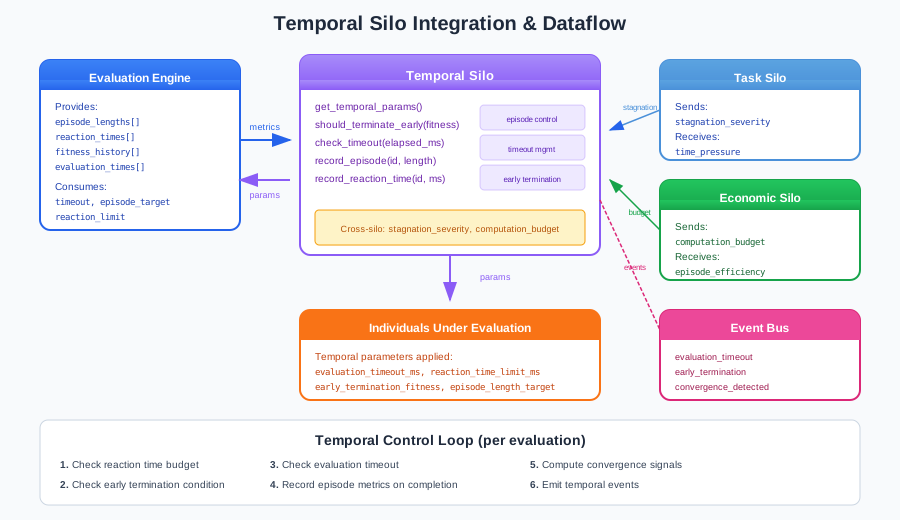
Wiring Diagram
The Temporal Silo integrates with evaluation and other silos:
Data Sources:
evaluation_engine- Episode lengths, reaction times, fitness historytask_silo- Stagnation severity (triggers longer episodes)economic_silo- Computation budget (constrains timeouts)
Data Consumers:
evaluation_engine- Timeout limits, episode targetsindividuals- Reaction time limits, termination thresholdsneuroevolution_events- Event bus for monitoring
Cross-Silo Interactions
The Temporal Silo exchanges signals with other silos:
Signals Sent:
| Signal | To | Description |
|--------|-----|-------------|
| time_pressure | Task | High pressure = need simpler solutions |
| convergence_status | Resource | Near convergence = can reduce compute |
| episode_efficiency | Economic | Compute spent per fitness gained |
| eval_time_constraint | Competitive | Available time for evaluation matches |
Signals Received:
| Signal | From | Effect |
|--------|------|--------|
| computation_budget | Economic | Constrains evaluation timeout |
| stagnation_severity | Task | Stagnation = try longer episodes |
| population_diversity | Distribution | Low diversity = earlier termination |
| resource_pressure | Resource | Pressure reduces available time |
Engine Integration Points
%% Start Temporal Silo
{ok, _} = temporal_silo:start_link(#temporal_config{
    enabled = true,
    min_episode_length = 100,
    max_episode_length = 10000,
    min_timeout_ms = 500,
    max_timeout_ms = 30000,
    enable_early_termination = true,
    min_steps_before_termination = 20,
    enforce_reaction_time = false,
    emit_events = true
}),

%% Query for temporal parameters
get_evaluation_params() ->
    Params = temporal_silo:get_temporal_params(?MODULE),
    #{
        timeout => maps:get(evaluation_timeout_ms, Params),
        episode_target => maps:get(episode_length_target, Params),
        early_term_threshold => maps:get(early_termination_fitness, Params)
    }.

%% Record completed episode
on_episode_complete(IndividualId, Length, Fitness) ->
    temporal_silo:record_episode(TempPid, IndividualId, Length),
    %% Temporal silo tracks for efficiency analysis.
Training Velocity Impact
| Metric | Without Temporal Silo | With Temporal Silo |
|---|---|---|
| Wasted evaluation time | 40-60% | 10-20% |
| Time to convergence | Baseline | 0.4-0.6x (faster) |
| Compute efficiency | 1.0x | 2-4x |
| Real-time compliance | No guarantees | Enforced limits |
The Temporal Silo provides the largest training velocity improvement of all silos by eliminating wasted compute on hopeless individuals.
Practical Examples
Example 1: Early Termination Saves Compute
%% Scenario: Individual showing poor performance early
%% After 50 steps, fitness = 0.05 (very low)

%% Temporal Silo parameters:
%% - early_termination_fitness = 0.1
%% - min_steps_before_termination = 20

%% Decision: Terminate early
%% Without early termination: 1000 steps wasted
%% With early termination: Only 50 steps used
%% Savings: 950 steps = 95% compute saved for this individual
Example 2: Stagnation Triggers Longer Episodes
%% Scenario: Task Silo reports stagnation
%% Cross-silo signal: stagnation_severity = 0.8

%% Temporal Silo responds:
%% - episode_length_target increased from 1000 to 1500
%% - evaluation_timeout increased proportionally

%% Rationale: Complex problems may need more time
%% The stuck population might benefit from longer evaluation

{episode_extended, #{
    old_length => 1000,
    new_length => 1500,
    reason => stagnation
}}
Example 3: Budget Constrains Timeouts
%% Scenario: Economic Silo signals budget pressure
%% Cross-silo signal: computation_budget = 0.3 (low)

%% Temporal Silo responds:
%% - evaluation_timeout_ms reduced from 5000 to 2000
%% - early_termination_fitness raised to 0.15 (more aggressive)

%% Rationale: Limited budget = faster decisions
%% Accept lower accuracy for speed

{temporal_params_updated, #{
    old_timeout => 5000,
    new_timeout => 2000,
    trigger => budget_pressure
}}
Tuning Guide
Key Parameters
| Parameter | When to Increase | When to Decrease |
|---|---|---|
evaluation_timeout_ms | Complex tasks, slow evaluation | Simple tasks, speed needed |
episode_length_target | Long-horizon tasks | Fast feedback loops |
early_termination_fitness | Too many bad individuals | False terminations |
patience_threshold | Noisy fitness, slow progress | Clear improvements |
reaction_time_limit_ms | Complex decisions | Real-time requirements |
min_steps_before_termination | High fitness variance | Clear early signals |
Common Pitfalls
Termination threshold too aggressive: Good individuals killed early
- Symptom: Best fitness drops unexpectedly
- Fix: Lower
early_termination_fitnessto 0.05
Episodes too short: Not enough time to show potential
- Symptom: All individuals seem equally bad
- Fix: Increase
episode_length_target2-4x
No early termination: Wasting compute on hopeless cases
- Symptom: Evaluation takes forever, most individuals are bad
- Fix: Enable early termination, start with threshold 0.1
Patience too high: Stuck on local optima
- Symptom: No improvement but keeps running
- Fix: Lower
patience_thresholdto 10-15 generations
Debugging Tips
%% Get current sensor values
Context = build_temporal_context(State),
Sensors = temporal_silo_sensors:collect_sensors(Context),
io:format("Convergence rate: ~.2f~n", [lists:nth(9, Sensors)]),
io:format("Oscillation freq: ~.2f~n", [lists:nth(10, Sensors)]),
io:format("Eval efficiency: ~.2f~n", [lists:nth(12, Sensors)]),

%% Get current actuator values
Params = temporal_silo:get_temporal_params(TempPid),
io:format("Timeout: ~p ms~n", [maps:get(evaluation_timeout_ms, Params)]),
io:format("Episode target: ~p~n", [maps:get(episode_length_target, Params)]),
io:format("Term threshold: ~.2f~n", [maps:get(early_termination_fitness, Params)]).
Events Reference
The Temporal Silo emits events on significant actions:
| Event | Trigger | Key Payload |
|---|---|---|
evaluation_timeout | Hit time limit | individual_id, elapsed_ms, timeout_ms |
early_termination | Terminated early | individual_id, reason, fitness, steps_completed |
episode_extended | Episode length increased | old_length, new_length, reason |
episode_shortened | Episode length decreased | old_length, new_length, reason |
reaction_time_exceeded | Over time budget | individual_id, budget_ms, actual_ms |
convergence_detected | Fitness stabilized | convergence_rate, final_fitness |
patience_exhausted | No improvement | generations_waited, action_taken |
episode_completed | Episode finished | individual_id, length, target, fitness |
Example Event Payload:
{early_termination, #{
    silo => temporal,
    timestamp => 1703318400000,
    generation => 42,
    payload => #{
        individual_id => <<"agent_123">>,
        reason => low_fitness,
        fitness => 0.03,
        steps_completed => 75
    }
}}
L0 Hyperparameters (L1-Tuned)
| Parameter | Range | Default | Description |
|---|---|---|---|
min_episode_length | [10, 1000] | 100 | Absolute minimum episode |
max_episode_length | [100, 100000] | 10000 | Maximum allowed episode |
min_timeout_ms | [100, 5000] | 500 | Minimum timeout |
max_timeout_ms | [1000, 600000] | 60000 | Maximum timeout (10 min) |
enable_early_termination | bool | true | Allow early stopping |
min_steps_before_termination | [1, 100] | 20 | Min steps before deciding |
enforce_reaction_time | bool | false | Strict reaction limits |
max_history_size | [10, 1000] | 100 | History for analysis |
L1 Hyperparameters (L2-Tuned)
| Parameter | Range | Default | Description |
|---|---|---|---|
time_pressure_factor | [0.5, 2.0] | 1.0 | Urgency multiplier |
episode_length_factor | [0.5, 2.0] | 1.0 | Episode length scaling |
termination_aggression | [0.0, 1.0] | 0.5 | How aggressive to terminate |
patience_factor | [0.5, 2.0] | 1.0 | Patience scaling |
convergence_sensitivity | [0.5, 2.0] | 1.0 | How quickly to detect convergence |
Configuration Examples
Real-time Application Config
#temporal_config{
    enabled = true,
    min_episode_length = 100,
    max_episode_length = 1000,
    min_timeout_ms = 500,
    max_timeout_ms = 5000,
    enable_early_termination = true,
    min_steps_before_termination = 50,
    enforce_reaction_time = true,  % Critical for real-time
    emit_events = true
}.
Exploratory Research Config
#temporal_config{
    enabled = true,
    min_episode_length = 1000,
    max_episode_length = 100000,
    min_timeout_ms = 10000,
    max_timeout_ms = 600000,  % 10 minutes
    enable_early_termination = false,  % Let everything run
    enforce_reaction_time = false,
    emit_events = true
}.
Cost-Optimized Config
#temporal_config{
    enabled = true,
    min_episode_length = 50,
    max_episode_length = 500,
    min_timeout_ms = 100,
    max_timeout_ms = 2000,
    enable_early_termination = true,
    min_steps_before_termination = 10,  % Aggressive
    emit_events = true
}.
Source Code Reference
| Module | Purpose | Location |
|---|---|---|
temporal_silo.erl | Main gen_server | src/silos/temporal_silo/ |
temporal_silo_sensors.erl | Sensor collection (12) | Same |
temporal_silo_actuators.erl | Actuator application (10) | Same |
temporal_silo.hrl | Record definitions | Same |
lc_cross_silo.erl | Cross-silo signals | src/silos/ |
Further Reading
- Liquid Conglomerate Overview - Full LC architecture
- Economic Silo - Budget and cost management
- Task Silo - Hyperparameter adaptation
- Resource Silo - Computational resource management
- Meta-Controller Guide - L2 strategic layer
References
Early Termination and Adaptive Evaluation
- Jaderberg, M., et al. (2017). "Population Based Training of Neural Networks." arXiv preprint arXiv:1711.09846.
- Li, L., et al. (2018). "Hyperband: A Novel Bandit-Based Approach to Hyperparameter Optimization." JMLR.
Credit Assignment and Temporal Difference Learning
- Sutton, R.S. (1988). "Learning to Predict by the Methods of Temporal Differences." Machine Learning.
- Williams, R.J. (1992). "Simple Statistical Gradient-Following Algorithms for Connectionist Reinforcement Learning." Machine Learning.
Convergence Detection
- Henderson, P., et al. (2018). "Deep Reinforcement Learning that Matters." AAAI.