Cooperative Silos: Cross-Silo Communication in LC v2
View SourceThis guide explains how the three silos in the Liquid Conglomerate v2 architecture cooperate through signal routing, shared resources, and cooperative reward signals.
The Core Goal: Optimal Training with Resource Stability
The fundamental purpose of LC v2 is to train Task TWEANNs as fast as possible while keeping the system stable. This is achieved through a feedback loop between the Resource Silo (the governor) and the Task Silo (the training engine):
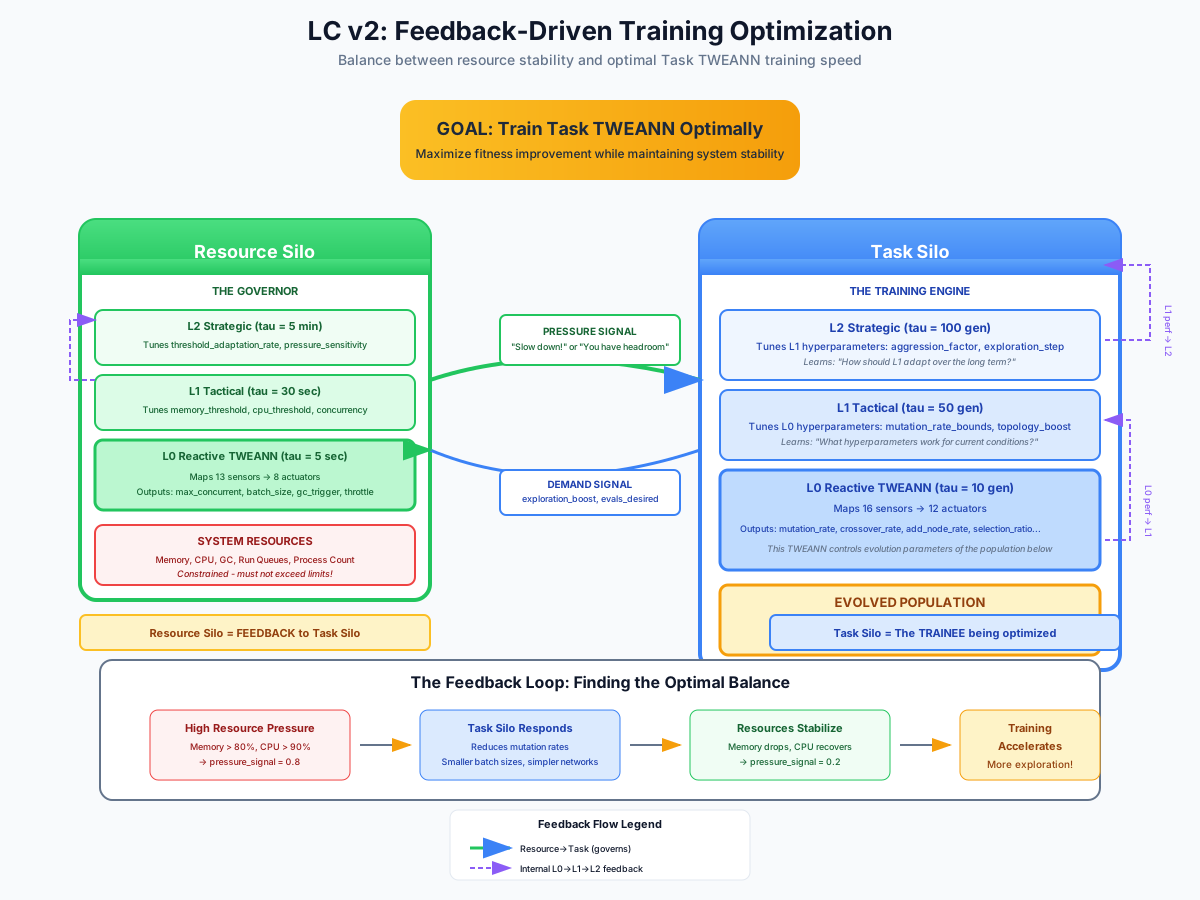
Key insight: Resource Silo acts as a feedback controller that modulates Task Silo's aggressiveness based on system health. When resources are stressed, Task Silo backs off; when resources are healthy, Task Silo can explore more aggressively.
Overview
The LC v2 architecture separates concerns into three specialized silos, each with its own hierarchical L0/L1/L2 controller:
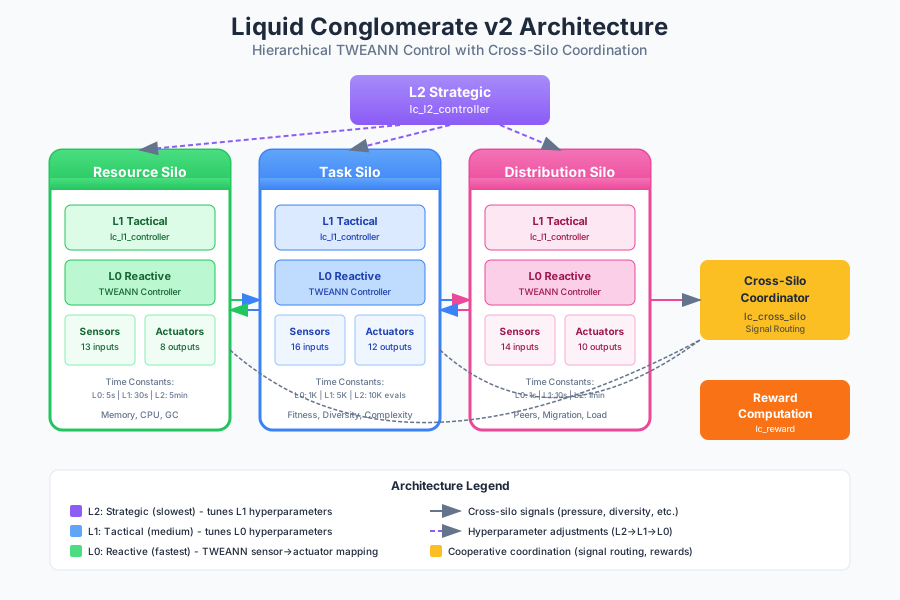
Each silo optimizes a different aspect of the system:
| Silo | Focus | Time Scale | Optimization Target |
|---|---|---|---|
| Resource | System stability | Fast (ms) | Maximize throughput, minimize GC |
| Task | Evolution quality | Medium (evals) | Maximize fitness improvement |
| Distribution | Network efficiency | Variable | Balance load, maintain diversity |
L0 TWEANN Sensors and Actuators
Each silo's L0 controller is a TWEANN that maps environment sensors to control actuators:
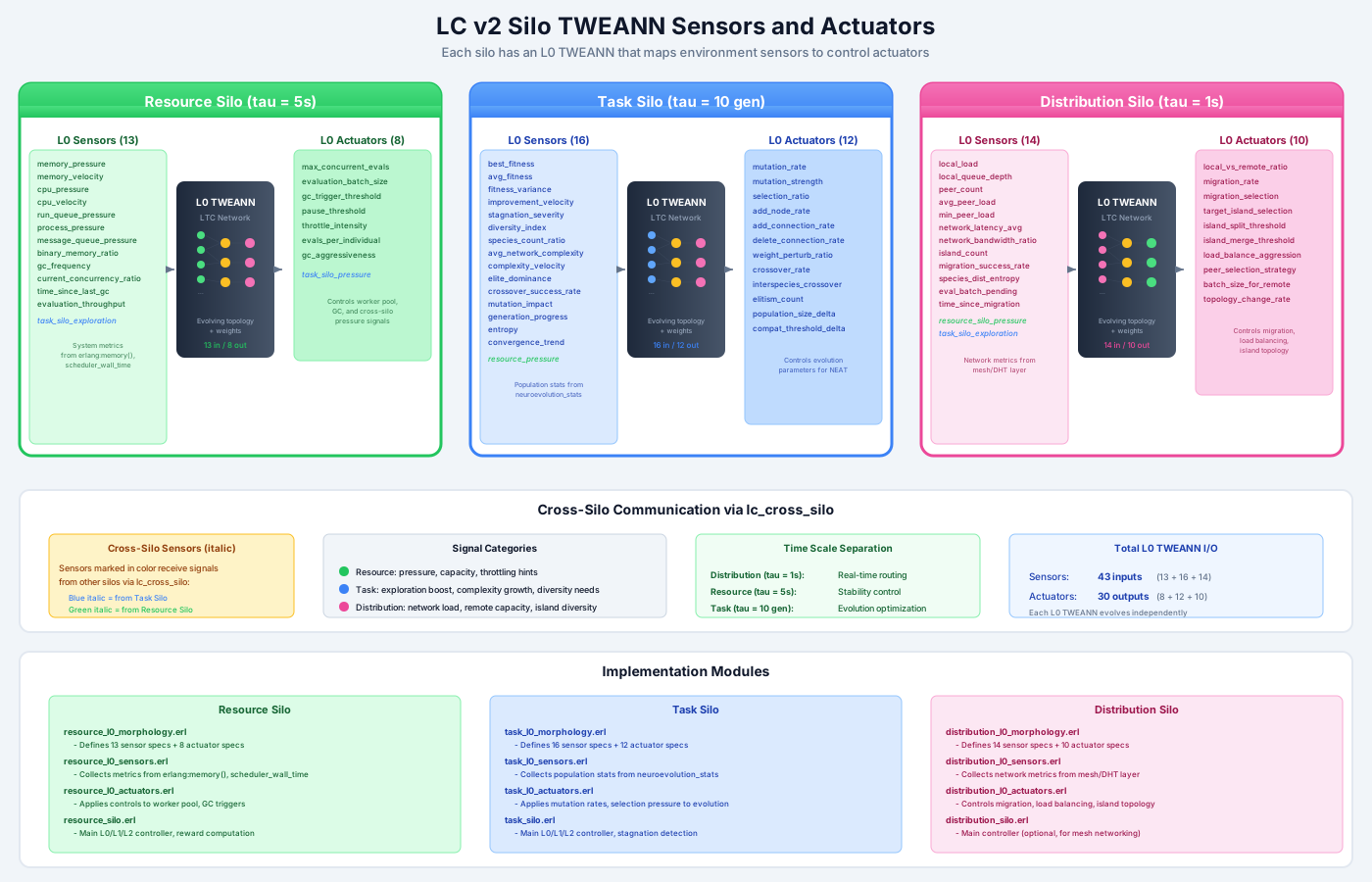
Sensor/Actuator Summary:
| Silo | Sensors | Actuators | Total I/O |
|---|---|---|---|
| Resource | 13 | 8 | 21 |
| Task | 16 | 12 | 28 |
| Distribution | 14 | 10 | 24 |
| Total | 43 | 30 | 73 |
Hierarchical Learning
Each silo implements a 3-level hierarchical controller:
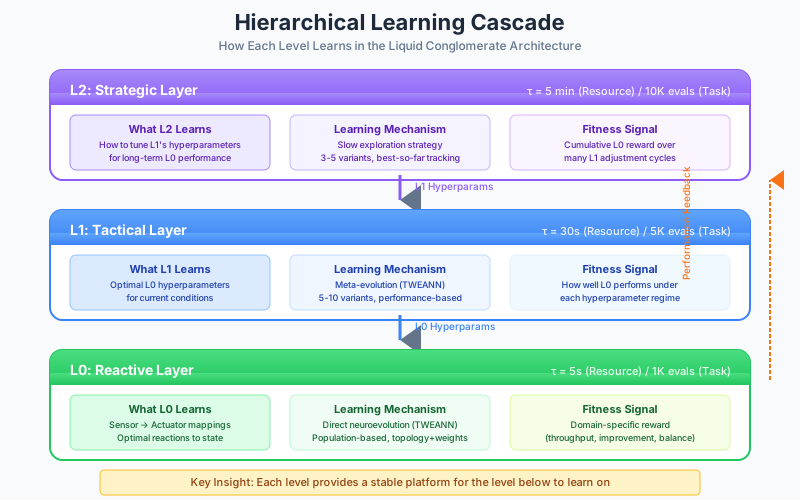
L0: Reactive Layer
- Always active, cannot be disabled
- Responds immediately to current sensor readings
- TWEANN that maps sensors to actuators
- Time constant: 5s (Resource), 1K evals (Task), 1s (Distribution)
L1: Tactical Layer
- Observes L0 performance over a sliding window
- Adjusts L0's hyperparameters based on performance trends
- Time constant: 30s (Resource), 5K evals (Task), 10s (Distribution)
L2: Strategic Layer
- Observes L1 performance over a long-term window
- Adjusts L1's hyperparameters through slow exploration
- Time constant: 5min (Resource), 10K evals (Task), 1min (Distribution)
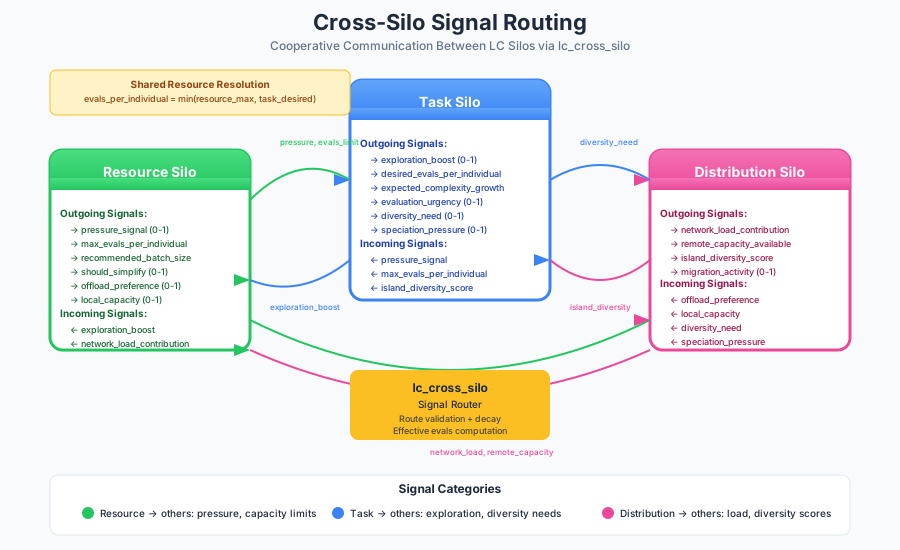
Cross-Silo Signal Routing
The silos communicate through lc_cross_silo, which routes signals between silos with validation and decay:
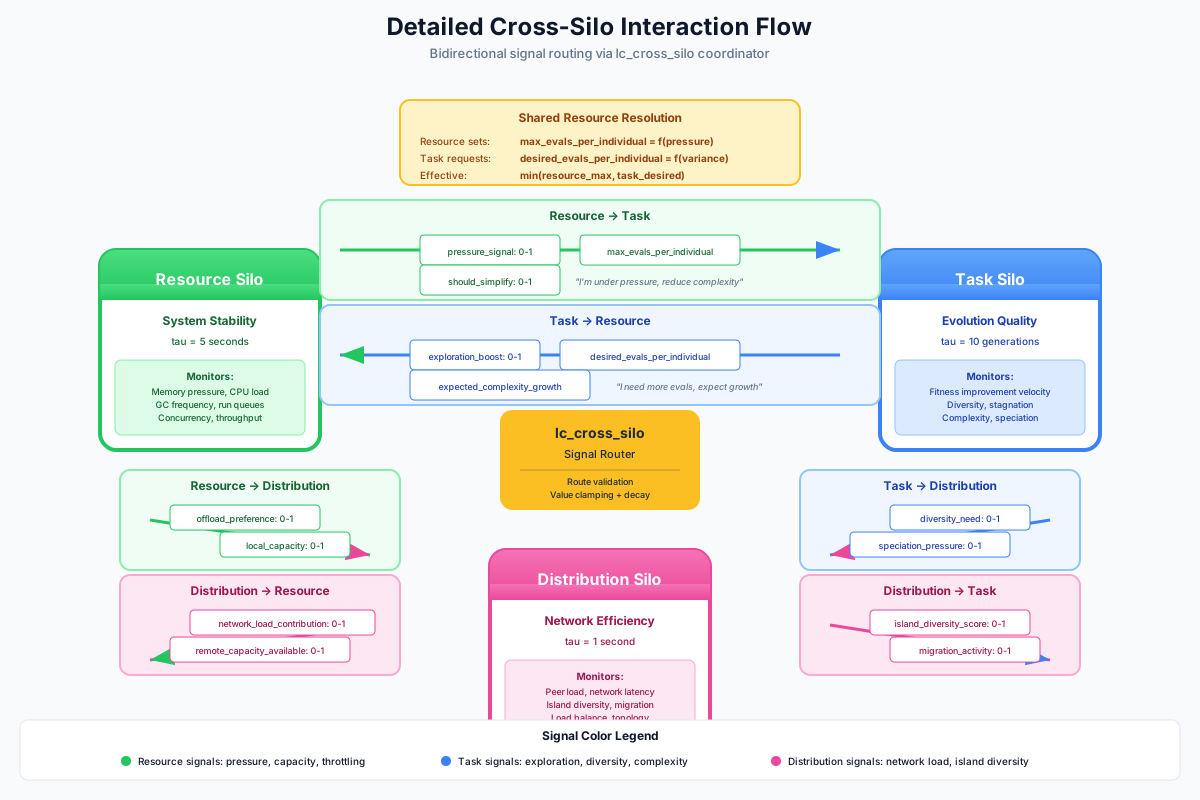
Detailed Interaction Flow
Each pair of silos exchanges specific signals that enable cooperative optimization:
Signal Types
%% Resource Silo → Others
#{
    pressure_signal => 0.0-1.0,          % 0=healthy, 1=critical
    max_evals_per_individual => 1-20,    % Resource-constrained max
    recommended_batch_size => 1-50,      % Suggested batch size
    should_simplify => 0.0-1.0,          % Hint to reduce complexity
    offload_preference => 0.0-1.0,       % How much to prefer remote
    local_capacity => 0.0-1.0            % Available local resources
}

%% Task Silo → Others
#{
    exploration_boost => 0.0-1.0,        % How aggressively exploring
    desired_evals_per_individual => 1-50,% Fitness-based request
    expected_complexity_growth => 0.0-1.0,% Anticipated memory needs
    evaluation_urgency => 0.0-1.0,       % How important speed is
    diversity_need => 0.0-1.0,           % How much migration helps
    speciation_pressure => 0.0-1.0       % Species splitting tendency
}

%% Distribution Silo → Others
#{
    network_load_contribution => 0.0-1.0,% Load from distribution
    remote_capacity_available => 0.0-1.0,% Peers can help
    island_diversity_score => 0.0-1.0,   % How diverse across islands
    migration_activity => 0.0-1.0        % Recent migration level
}
Signal Routing Example
%% Send a signal from Resource to Task silo
ok = lc_cross_silo:send_signal(
    resource,  % Source silo
    task,      % Destination silo
    #{pressure_signal => 0.8, max_evals_per_individual => 5}
),

%% Task silo receives the signal
{ok, Signals} = lc_cross_silo:get_signals(task),
%% Signals = #{pressure_signal => 0.8, max_evals_per_individual => 5}

%% Signals decay over time if not refreshed
timer:sleep(60000),
{ok, DecayedSignals} = lc_cross_silo:get_signals(task),
%% DecayedSignals values are lower due to decay
Signal Decay
Cross-silo signals decay over time to prevent stale information from affecting decisions. The decay rate is configurable per signal route:
%% Default decay configuration
decay_config() ->
    #{
        {resource, task} => #{decay_rate => 0.1, decay_interval => 5000},
        {task, resource} => #{decay_rate => 0.1, decay_interval => 5000},
        {resource, distribution} => #{decay_rate => 0.2, decay_interval => 10000},
        {distribution, resource} => #{decay_rate => 0.2, decay_interval => 10000},
        {task, distribution} => #{decay_rate => 0.15, decay_interval => 8000},
        {distribution, task} => #{decay_rate => 0.15, decay_interval => 8000}
    }.
Shared Resource Resolution
Some resources are contested between silos. The lc_cross_silo module provides resolution functions:
Evaluations Per Individual
Both Resource and Task silos have opinions on evaluations_per_individual:
- Resource sets
max_evals_per_individualbased on memory/CPU pressure - Task requests
desired_evals_per_individualbased on fitness variance
%% Resource silo signals its constraint
ResourceSignals = #{max_evals_per_individual => 5},

%% Task silo signals its preference
TaskSignals = #{desired_evals_per_individual => 20},

%% Effective value is the minimum
EffectiveEvals = lc_cross_silo:compute_effective_evals(ResourceSignals, TaskSignals),
%% EffectiveEvals = 5 (resource-constrained)
This ensures Resource constraints are always respected while allowing Task to optimize within those constraints.
Cooperative Reward Signals
Each silo's L0 controller receives a reward signal that includes both local objectives and cross-silo cooperation penalties.
Resource Silo Reward
%% From lc_reward.erl
resource_reward(Metrics) ->
    Throughput = throughput_score(Metrics),
    Stability = stability_score(Metrics),
    Efficiency = efficiency_score(Metrics),
    TaskBlocked = task_blocked_penalty(Metrics),
    DistBlocked = distribution_blocked_penalty(Metrics),

    0.35 * Throughput +
    0.25 * Stability +
    0.15 * Efficiency -
    0.15 * TaskBlocked -
    0.10 * DistBlocked.
Task Silo Reward
task_reward(Metrics) ->
    Improvement = improvement_velocity(Metrics),
    Diversity = diversity_maintenance(Metrics),
    Complexity = complexity_growth_penalty(Metrics),
    ResourcePressure = resource_pressure_caused(Metrics),
    DistBonus = distribution_diversity_bonus(Metrics),

    0.40 * Improvement +
    0.20 * Diversity -
    0.15 * Complexity -
    0.15 * ResourcePressure +
    0.10 * DistBonus.
Distribution Silo Reward
distribution_reward(Metrics) ->
    LoadBalance = load_balance_score(Metrics),
    Migration = migration_effectiveness(Metrics),
    NetworkEff = network_efficiency(Metrics),
    ResourcePressure = resource_pressure_caused(Metrics),
    TaskDiversity = task_diversity_contribution(Metrics),

    0.30 * LoadBalance +
    0.25 * Migration +
    0.20 * NetworkEff -
    0.15 * ResourcePressure +
    0.10 * TaskDiversity.
Global Cooperation Metric
In addition to individual rewards, each silo receives a bonus based on global system health:
global_health(Metrics) ->
    ResourceHealth = maps:get(resource_throughput, Metrics, 0.5),
    TaskHealth = maps:get(task_improvement, Metrics, 0.5),
    DistHealth = maps:get(distribution_efficiency, Metrics, 0.5),
    AnyBlocked = maps:get(any_silo_blocked, Metrics, 0),

    (0.4 * ResourceHealth + 0.4 * TaskHealth + 0.2 * DistHealth) -
    (0.5 * AnyBlocked).

cooperation_bonus(Metrics) ->
    HealthImprovement = global_health(Metrics) - previous_global_health(),
    max(0.0, 0.1 * HealthImprovement).
Usage Example
Starting the LC Supervisor
%% Full LC v2 configuration
Config = #{
    %% Resource silo config
    resource_config => #{
        morphology_module => resource_l0_morphology,
        tau_l0 => 5000,    % 5 second L0 cycle
        tau_l1 => 30000,   % 30 second L1 cycle
        tau_l2 => 300000   % 5 minute L2 cycle
    },

    %% Task silo config
    task_config => #{
        morphology_module => task_l0_morphology,
        tau_l0 => 1000,    % 1K evaluations for L0
        tau_l1 => 5000,    % 5K evaluations for L1
        tau_l2 => 10000    % 10K evaluations for L2
    },

    %% Distribution silo config
    distribution_config => #{
        morphology_module => distribution_l0_morphology,
        tau_l0 => 1000,    % 1 second L0 cycle
        tau_l1 => 10000,   % 10 second L1 cycle
        tau_l2 => 60000    % 1 minute L2 cycle
    },

    %% Cross-silo config
    cross_silo_config => #{
        enable_decay => true,
        log_signals => false
    }
},

{ok, SupPid} = lc_supervisor:start_link(Config).
Querying Silo State
%% Get L1 hyperparameters from each silo
{ok, ResourceL1} = lc_l1_controller:get_current_hyperparameters(ResourceL1Pid),
{ok, TaskL1} = lc_l1_controller:get_current_hyperparameters(TaskL1Pid),

%% Get L2 performance summary
{ok, L2Summary} = lc_l2_controller:get_performance_summary(L2Pid),
%% #{
%%     silo_type => resource,
%%     cycles_observed => 42,
%%     current_hyperparameters => #{...},
%%     best_hyperparameters => #{...},
%%     best_cumulative_reward => 0.85,
%%     exploration_rate => 0.1
%% }
Monitoring Cross-Silo Communication
%% Get all pending signals for a silo
{ok, Signals} = lc_cross_silo:get_signals(task),

%% Get signal history
{ok, History} = lc_cross_silo:get_signal_history(task, 10),
%% Returns last 10 signal updates
Module Reference
Core Modules
| Module | Purpose |
|---|---|
lc_supervisor.erl | Supervises all LC v2 child processes |
lc_cross_silo.erl | Signal routing between silos |
lc_reward.erl | Cooperative reward computation |
lc_l1_controller.erl | Generic L1 hyperparameter tuning |
lc_l2_controller.erl | Strategic meta-tuning |
lc_chain.erl | Cascades L2→L1→L0 hyperparameters |
Silo-Specific Modules
| Module | Purpose |
|---|---|
resource_l0_morphology.erl | Resource silo TWEANN morphology (13→8) |
resource_l0_sensors.erl | Resource sensor data collection |
resource_l0_actuators.erl | Resource actuator application |
task_l0_morphology.erl | Task silo TWEANN morphology (16→12) |
task_l0_sensors.erl | Task sensor data collection |
task_l0_actuators.erl | Task actuator application |
distribution_l0_morphology.erl | Distribution silo TWEANN morphology (14→10) |
distribution_l0_sensors.erl | Distribution sensor data collection |
distribution_l0_actuators.erl | Distribution actuator application |
Design Principles
Separation of Concerns
Each silo focuses on one optimization objective:
- Resource: System stability
- Task: Evolution quality
- Distribution: Network efficiency
This separation allows independent tuning and debugging.
Graceful Degradation
If L2 fails or produces bad outputs:
- L1 provides reasonable reactive behavior
- L0 guarantees safe operation through hard limits
Each level provides a safety net for the level above.
Time Scale Separation
The silos operate at different time scales to prevent oscillation:
- Fast silos (Resource, Distribution) respond to immediate conditions
- Slow silos (Task) learn stable evolutionary strategies
- Cross-silo signals bridge the time scales with appropriate decay
Cooperative Optimization
Silos are not purely selfish - their reward signals include:
- Penalties for blocking other silos
- Bonuses for contributing to global health
- Shared resource resolution mechanisms
Related Guides
- LTC Meta-Controller - Detailed LC v2 architecture
- The Liquid Conglomerate - Theory and rationale
- Evolution Strategies - Pluggable evolution algorithms
References
Hierarchical Control
- Sutton, R. S., Precup, D., Singh, S. (1999). "Between MDPs and semi-MDPs: A framework for temporal abstraction."
- Barto, A. G., Mahadevan, S. (2003). "Recent advances in hierarchical reinforcement learning."
Multi-Agent Cooperation
- Tan, M. (1993). "Multi-Agent Reinforcement Learning: Independent vs. Cooperative Agents."
- Lowe, R. et al. (2017). "Multi-Agent Actor-Critic for Mixed Cooperative-Competitive Environments."