What is barrel_p2p?
View SourceBarrel P2P is a peer-to-peer distribution layer for Erlang/OTP. It
replaces the default TCP-based Erlang distribution with three
opinionated pieces, while keeping Pid ! Msg, gen_server,
rpc:call/4, and global working exactly as you expect.
The three pieces are:
- A bounded membership protocol (HyParView). Each node keeps a small, bounded set of gossip peers. The cluster as a whole remains fully addressable: any node can reach any other node on demand, through OTP's auto-connect.
- A secure transport (QUIC + Ed25519). One QUIC connection per peer carries the dist channel; an Ed25519 mutual handshake proves identity before any Erlang traffic flows. Connection migration moves the session to a new local network path without dropping streams.
- A service registry (CRDT-backed). Processes register under a name; the name is replicated through the cluster and lookups return either a local pid or the remote node + pid. No external service-discovery service is required.
Visually, this is the shape of a barrel_p2p cluster from one node's point of view:
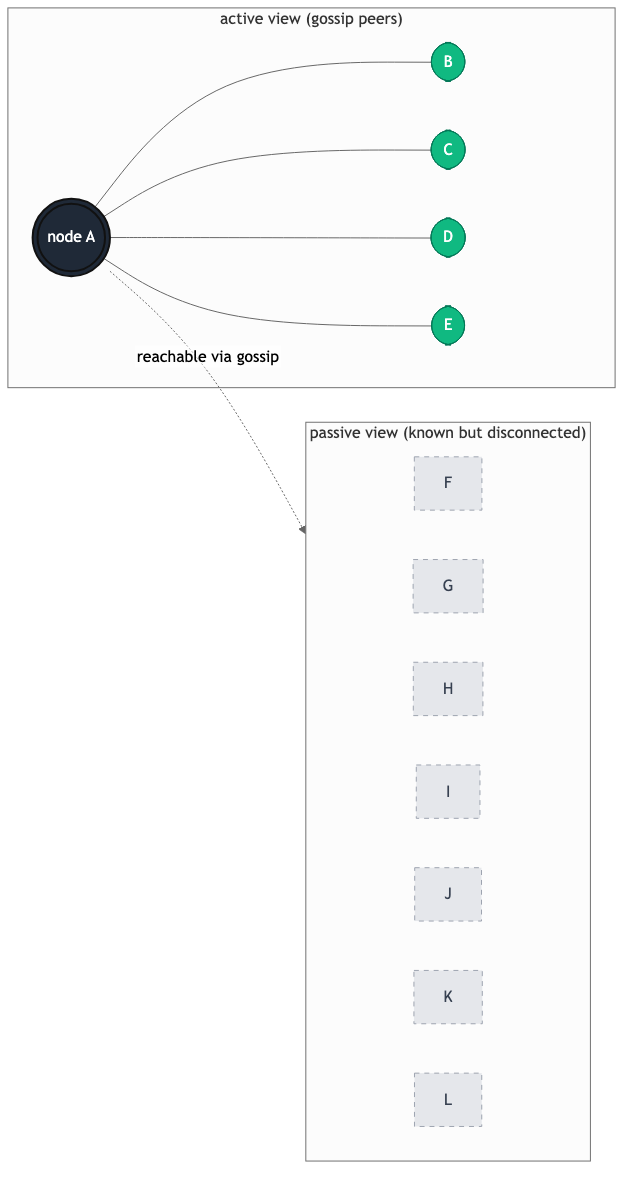
Each node holds a small active view (its current gossip peers, typically five) and a larger passive view (known but disconnected peers used as warm spares). The cluster topology scales: a node with a thousand peers in its passive view still keeps only five active links.
What you get out of the box
| Capability | What it gives you | Where to read more |
|---|---|---|
-proto_dist barrel_p2p boot flag | Drop-in replacement for the default dist | Dist channel concept |
| HyParView membership | Bounded connection count, gossip-based reachability | Cluster membership concept |
| Ed25519 mutual auth | TOFU or strict per-peer key pinning | Authentication concept |
| CRDT service registry | Cluster-wide named services with eventual consistency | Service registry concept |
| Replicated maps | Gossiped key-value state for config, flags, routing tables | Replicated maps concept |
| Plumtree gossip | Efficient broadcast for service-state updates | Gossip broadcast concept |
| Tagged user streams | App-level multiplex over the same QUIC connection | Streams concept |
| Connection migration | RFC 9000 §9 path rebind without restart | Migration concept |
instrument metrics | OpenTelemetry-style counters and histograms | Observe a cluster |
What barrel_p2p does not do
A few things are explicitly not part of the project:
- NAT traversal, STUN, UPnP, hole punching. Nodes are expected to reach each other directly. If they cannot, an external relay is wired through the connect-time override hook (route through a relay).
- Topologies other than HyParView. There is no full-mesh, no client-server, no hub-and-spoke mode. If you need topology flexibility, Partisan is the right library.
- A standalone HTTP metrics server. The
instrumentlibrary provides formatters; you wire them into your existing HTTP layer.
When to use barrel_p2p
Barrel P2P is a good fit when:
- You want a partial-membership topology to replace Erlang's
full mesh, without giving up
Pid ! Msg. - You need cluster-wide service discovery without standing up a separate registry (Consul, etcd).
- You want encryption between peers by default, with no certificate authority to operate.
- You prefer opinionated defaults to a wide configuration surface.
Barrel P2P is the wrong fit when:
- You need multiple topology backends.
- You need explicit message channels with per-channel parallelism.
- You are building research on distributed protocols.
For each of those, Partisan is the better library.
Next
- Benefits lists the trade-offs in more detail.
- Introduction is the longer narrative, ideal if you want to understand why each piece is shaped the way it is before reading the per-concept pages.
- Getting started gets a two-node cluster running.